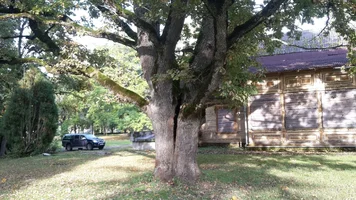
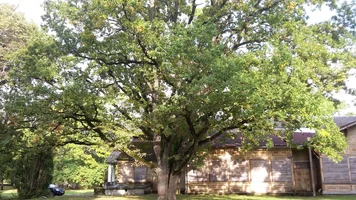
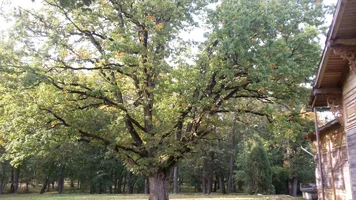
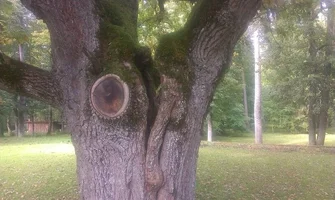
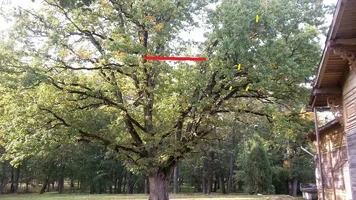
big massiv oak with two tears

andrus kokerov

Participating member
Location
Estonia
Got a customer with a big massiv oak tree next to a house. The problem is that it is split in two places. I am a bit confused what to do with the big boy. I am thinking about a big reduction cut and cabeling just to save the tree for some time. Does cabeling help at all with such big splits? Or is a removal the only way out... I added some pictures.
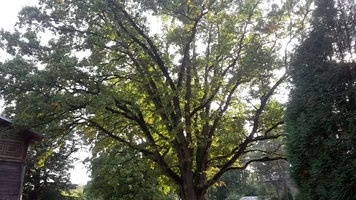
 

Attachments

  • 20150917_163107.webp
    20150917_163107.webp
    679.8 KB · Views: 114
  • 20150917_163021.webp
    20150917_163021.webp
    638.6 KB · Views: 112
  • 20150917_162947.webp
    20150917_162947.webp
    763.6 KB · Views: 102
  • 20150917_162915.webp
    20150917_162915.webp
    652.7 KB · Views: 94
That split looks like it is more than a few years old. If you can get your hands on the ISA's BMPs for cabling and bracing, you definitely can mitigate the risk significantly. It looks like the tree is in good health (from the pictures), and with proper bracing and cabling, coupled with targeted end weight reductions of more horizontal limbs in the upper crown, you should be able to keep that big tree around for decades.

Or, you could remove it.


SZ
 
I think I saw a copy of the BMP on Heiki Hanso's shelf. Heiki also has terminal fasteners I gave him June 2014 and i bet he has not used them all yet--tell him I ask him to give you two!

Here's a pic of your tree with yellow lines for cuts. 20% off over the house from the outer half of the crown, <10 cm cuts, leave upright laterals. Black line indicates location for cable, or at least a hunk of old climbing line tied off well as a 'dynamic' system.

SZ is right; the opening looks old, so the tree has responded.Andrus whole oak.webp
 
Try not to remove any inner crown, the tree will naturally retrench in time and leaving the developing lower crown will help it. Weight reductions in part and light tip pruning or ripping to snap internal water flow back into action will help, along with the brace.
A beautiful tree
 
I'm referencing Neville Fey. Hatfield Forest along with s handful of similar sites in south-east England house many old un-managed oak and hornbeam pollards. I had the pleasure of 2 continuous seasons work there back in 2009 and we followed Neville's method statement, a lot of which were up to 25 year management plans to control the sudden collapse and subsequent death of portions of and whole trees. The boles easily split apart. The aim was to lower the canopy and slowly release leverage forces.
http://treeworks.co.uk/downloads/8 - Coronet cuts & retrenchment pruning 17 April 2003.pdf
 
In some instances the small cut or rip, 1o-20mm, helps to move air bubbles that form in the vessels, reactivating process' in the very old wood and enabling dormant buds to awaken.
It was vogue for a time to try it externally through spiking at the required section, on Beech anyway, this did not work.
 
"The winching off partially cut branches" sounds like an exciting treatment option!
I suppose a surgeon trying a similar technique on a human appendage would get some interesting feedback from his peers in the medical community. "The distal part of the forearm and wrist was badly damaged, so I proceeded to apply sufficient torsion to result in the dislocation of the humerus and subsequent amputation".
 
Low horizontal hornbeam branches were cut with an axe on the upper side and slowly lowered on to roughed up soil in the hope that the branch would copy natural process and root to form a vertical stem. There are incredible examples at Weald Park in Essex where the trunk had hollowed and both sides, somehow managed to fold over, re-root, regrow and repeat. Rainbow trees!
 
"the small cut or rip, 1o-20mm, helps to move air bubbles that form in the vessels, reactivating process' in the very old wood and enabling dormant buds to awaken. "

I can't quite follow this, anatomically or physiologically. From what I saw from Burnham Beeches etc., buds released at nodes, no matter where or how cuts were made. ime, extra wounding means extra drying means extra tissue death.

Upon request, Fay reported no benefits from extra wounding. It would be front page news if there were!
 
Beech reacts differently to hornbeams, I have experience only with hornbeam, field maple and hawthorn. I have to say it is several years since I did this work and my work is not pruning these days, I'm out of any developmental loop for sure. There is a tall hornbeam pollard at Hatfield that showed definate retrenching after pruning. The upper crown was lowered strategically and slowly. I wonder how that tree is now?
 
I miss the place, the trees and the work. It really opened my eyes to different thoughts about tree care, not applicable for all situations but gets one thinking about energy flow much more than the standard branch collar system.
 

New threads New posts

Back
Top Bottom