Best 11mm or less climbing line

Sit back... Relax... This is a looooong post... /forum/images/graemlins/grin.gif

I'm going to be using mostly SRT. The bummer is that the gri-gri that I have and the Trango cinch that I just got only work up 11mm. My climbing line right now is half inch. I like the strength (8100 lbs tensile), but at 1/2" it's not going to work with either device.

I'm looking for something no more than 11mm, maybe a little less if it's strong. What do you recommend/use?

What about Velocity as compared to Fly?

What about Samson, in gerneral, as compared to New England Rope?

Nick, is this the rope you are referring to: Yale PoBOn in your thread "Yale XXX New Rope!!!"? It's actually listed under industrial not arborist. I took a look and it says:

"Yale PoBOn is a double braided rope consisting of a polyester sleeve covering an inner load-bearing core of 100% Zylon® PBO. Zylon PBO poly (p-phenylene-2, 6-benzobisoxazole)..."

"It has outstanding tensile strength, high modulus, flame resistance and thermal stability."

(Hope the table below lines up. It didn't the first time due to extra blanks being removed.)

Diam ... Average Break ... Minimum Break ... Max. Working . Weight Pounds
Inches . Strength Pounds . Strength Pounds .. Load 5:1 ...... Per 100 ft.
.5/16 ... 11,000 .......... 9,900 ............ 2,200 ......... 2.8
.3/8 .... 17,500 .......... 15,750 ........... 3,700 ......... 4.2
.7/16 ... 24,000 .......... 21,600 ........... 4,800 ......... 6.5

Would this be good for a climbing line, also?

What I liked is the high strength of the rope for its diameter.

OK, 15 minute break, everyone /forum/images/graemlins/wink.gif

Thanks,
Jim
 
Jim,

I'm not gonna bore anyone with why I use NE Ropes or any other brands. I think that NE Ropes, Yale, PMI Rope and Samson all make great quality products. There are little differences, but that will be a personal choice.

For SRT I'd say try to get an ascension line. Static 11mm would be great for this. I use NER KMIII. I'm sure there are plenty of choices. Very durable stuff and you won't lose a lot of efficiency through elastic energy.

For a climbing line, buy an "arborist climbing line" and not a technora core, dynamic climbing rope, polypro water rescue line, spectra braid.....or any other type of rope. You really should only use a rope designed for what we do. On that note, I'd say lose that heavy rope and try an 11mm line like Fly, Blaze or Velocity.
 
Mark, thanks. KMIII & Fly (Tom Dunlap, I believe, likes that one) are two I've been looking at.

I was considering the Yale PoBOn, but don't know anything about it's characteristics as a climbing line or how well it holds knots. I liked its strength to size ratio.

For Fly, NER says, "Designed for all vertical applications that interface with mechanical hardware... The Fly's unique construction creates a rope that's easy to knot yet resists flattening and glazing. With a hand that's the perfect balance between firm and supple, The Fly runs through gear without feeling mushy and gives you a smooth and controlled descent. Add to this excellent knot holding capabilities..."

NER's site didn't have much to say about KMIII in the above respects. Cna you give me any insight?

Thanks again,
Jim
 
And the best line is.......I agree with Marc.

If you buy an arborist climbing line don't bother about Average Break, Minimum Break, Max. Working. Those lines are designed and tested for you to hold you no matter wat. The tricky part is US. WE want to tie a knot, or splice them and thats wat makes the ropes go weaker (still not enough to let you drop out of their care).

I was, together with Jelte, the first in Holland to use the Velocity. All worked well the first few months, but then the rain came pooring down. I never knew that a climbingline could be that slippery. During the last few months of the winter I used Jeltes Blaze and found it to be a more friendly climbingline. The Blaze gets not slippery and does not make my frictionhitch bite as much as it does on the Velocity.

The overall atvantage of these lines is the weight. If you have been on a 11 mill. its not hard to get your head around the question of getting back to 12.5 mill.

NO, Never out of free will.

Makes me think back 12.5 / 13 / 16 / 22 mill. was a little less but about the same time ago for me in years to climb with those diameters.

Give up the big ones if you can get your fingers around the slender ones (I am not referring to the girls /forum/images/graemlins/blush.gif ).

Wolter
 
If the rope fits the diameter of the climbing tools, give it a try. I've used KMIII in a RADS system with good results. I've used a Gri-gri and I'd attached to my saddle and it feeds in and out just fine.

Here's one version of RADS:

http://www.rescueresponse.com/html/news02-02/highlight.html

Let us know how the Cinch works. It seems like a nice tool.

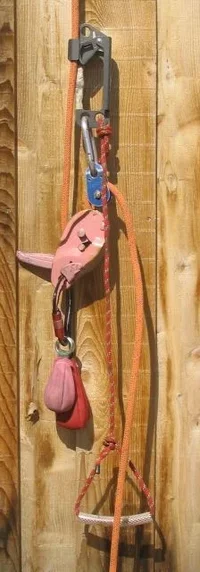
In the picture you'll see one of the RADS setups I use. The upper ascender can be any one that you might have. You'll see the footloop that I made up. My favorite RADS setup is made using the Shunt up top. A cord comes down from the back of the Shunt and ties to my saddle. As I descend the Shunt slides down kind of like having a slack tender. I'll see if I can get a picture of the setup.
 

Attachments

  • 22469-RADS- web.webp
    22469-RADS- web.webp
    30.8 KB · Views: 122
...wouldn't the grigri or I'D also be attached to your saddle...

Does the grigri and I'D move smoothly through 11mm line or do they need some assistance (talking KMIII/Fly and, hopefully, clipped to the saddle)?

Thanks,
Jim
 
Tom,

Do you or any other people who use this rads system find the weight of lifting the rope each time you take a step tiring? With an aprox. average weight of 9 lbs per 100 ft (excluding new 11mm lines) and keeping in mind this is a mechanical disadvantage setup, at 50 ft each time you took a step you would be pushing almost 10 lbs up. This does not sound like a lot on the ground but if someone asked to attach a 10 lb weight to my ascenders I would not be pleased. Lots of reps too.

Dave
 
It's been a while since I climbed w/RADS so I have to think this through.

When I used RADS I didn't really think about rope weight. Maybe because I was paying attention to how the system worked and rope weight wasn't a detail that come onto the radar screen of awareness.

If the tether from the saddle to the Shunt is long enough the climber can pull on the down rope and hoist themselves with a 2:1 MA. If I knew that I was going to be doing a lot of yo yo climbing I'd have a longer tether. If the crown was thick I'd keep the tether short so that the Shunt didn't get hung up on the other side of a limb.
 
Jim-

Don't use pobon as a climbing line. No stretch (read: no shock absorbtion). Super expensive. Knots diminish rope strengthe much more so than in polyester climbing ropes

Get blaze instead.

Treespotter, I'd like to add that there are 2 GREAT advantages- weight, as you mentioned, but also space savings. 150' Blaze takes up less space that 120' XTC.

love
nick the rope dork
 
Nick, Thanks. I ordered some KM III Max Sunday, so I'll see how that goes.

Tom, I hope to try the cinch this week. I'll do a post on it.

I have seen that RADS system before. It looks good, especially for long ascents.

My setup won't provide the leverage of the RADS, but this is my plan:

1.) For my friction hitch, a Knut hitch with a carabiner hooked to my saddle.

2.) For back-up, fall-arrest, self-belay - the cinch attached to my climbing line and hooked to my saddle with another carabiner. (What I'm hoping is that the cinch won't get in the way of my hitch and vice versa, and that both will move smoothly up the line.)

3.) Petzl pantin.

Any comments would be greatly appreciated.

Thanks,
Jim
 

New threads New posts

Back
Top Bottom