
Navigation
Install the app
How to install the app on iOS
Follow along with the video below to see how to install our site as a web app on your home screen.
Note: This feature may not be available in some browsers.
More options
You are using an out of date browser. It may not display this or other websites correctly.
You should upgrade or use an alternative browser.
You should upgrade or use an alternative browser.
Bending moment question
- Thread starter Neill
- Start date


Steve Connally
Been here much more than a while
- Location
- Suffolk, Virginia
Humbolt would have the least and narrow hinge the most.


This table of cuts for aerial tree cutting work is interesting:
The physics associated with your question appear to be quite interesting. Forces transmitted by an intact hinge, moving center of mass as the top falls but is still attached, forces exerted breaking the hinge, increasing kinetic energy of the top as it falls, etc. Seems I never get to bomb any tops, so the rigging force seems to exert the lion's share of the force on the stem.
The physics associated with your question appear to be quite interesting. Forces transmitted by an intact hinge, moving center of mass as the top falls but is still attached, forces exerted breaking the hinge, increasing kinetic energy of the top as it falls, etc. Seems I never get to bomb any tops, so the rigging force seems to exert the lion's share of the force on the stem.
Last edited:
dmonn
Branched out member
- Location
- Port Washington Wisconsin
Yes, very interesting. I didn't realize the different cuts I make all had names! Very satisfying to read that the different cuts I make are correct for the reasons described in the table. I definitely don't use them all, but the ones I use are correctly applied. They just seemed to make sense to me.

RogerM
Carpal tunnel level member
- Location
- Louisville,KY USA
Thank you Mr. Cobb, and Alex Laver.
That doc is a keeper.
That doc is a keeper.

Zebco Kid
Branched out member
- Location
- Ashland, Oregon
I find all of this fascinating. From the untrained eye, it looks like a person with a chainsaw cutting down a tree. However, as you learn more...there's a whole lot going on. This was the piece that taught me the most...so far!Yes, very interesting. I didn't realize the different cuts I make all had names! Very satisfying to read that the different cuts I make are correct for the reasons described in the table. I definitely don't use them all, but the ones I use are correctly applied. They just seemed to make sense to me.
ghostice
Been here a while
There's lots going on. Maybe look up copies of To Fell A Tree by Jeff Jepson and Professional Timber Falling A Procedural Approach by D. Douglas Dent. On AdTube there's stuff like Terry Hale's engineer's view of felling, Husqvarna USA's How to Safely Fell or Cut Down a Tree Using a Chainsaw, BC Faller Training Standard videos. Lotsa stuff . . . . Stay safe out there.
Could you elaborate a bit?Humbolt would have the least and narrow hinge the most.
A humboldt with say, a 20 degree notch?
I thought a narrow hinge would reduce the force since it will break easier/ sooner
I’m not sure, but this video says that the moment is at its greatest when the top reaches 45 degreesWouldn’t an open face have the most bend?
It does not answer though what notch would create the least bending moment

- Location
- Retired in Minneapolis
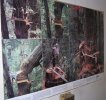
Look at Jerry B's '150' up' poster to see how much push back he got. Compare the pics and use one of the small trees as an indicator.
Seems like the 8 Ways to Fell a Tree video confirms @Steve Connally statement about the Humboldt. If the Humboldt tends to let the butt hit the ground first when felling, the tree is departing the stump before it has rotated enough to hit crown first. Less rotation = less fall = less speed = less kinetic energy to kick the stem. Additionally, the CoG of the whole stem + top is not displaced as far prior to the top departing when the top departs early, which should lessen the shaking of the stem. A narrower angle on the face cut also helps in this respect.
If the top rotates a lot before breaking free (over 45° like shown in the ArborPod video??), seems like a portion of the force starts going into compressing the stem downward rather than bending it.
[Disclaimer: that's my "thought experiment" on this matter, not the result of any practical real world testing.]
If the top rotates a lot before breaking free (over 45° like shown in the ArborPod video??), seems like a portion of the force starts going into compressing the stem downward rather than bending it.
[Disclaimer: that's my "thought experiment" on this matter, not the result of any practical real world testing.]
Look at Jerry B's '150' up' poster to see how much push back he got. Compare the pics and use one of the small trees as an indicator.
Is this what your referencing? Impressive work no doubt. Amazing photos
- Location
- Retired in Minneapolis
Is this what your referencing?
That's one of the pics. Find other one and compare the push back.
Charly Pottorff, WIldcat Tree Service, Manhattan, KS was taking pics with a motor drive camera so he caught the drop.
Steve Connally
Been here much more than a while
- Location
- Suffolk, Virginia
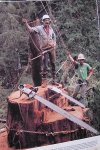
So I cut a fairly wide mouth. It allows the butt to slide off and down instead of the butt pushing off or jumping off the base of the cut when the hinge breaks. Tends to not push the spar back away from the mouth when the hinge is breaking. Also less tendency to go tips down so fast as was mentioned above. It just pushes back a little and slides off instead of jumping off the cut and speeding up the rotation. Make sense?Could you elaborate a bit?
A humboldt with say, a 20 degree notch?
I thought a narrow hinge would reduce the force since it will break easier/ sooner

Chris Schultz
Carpal tunnel level member
- Location
- Minturn
I’m assuming this thread is in the interest of minimizing pushback, therefore minimizing the “ride”? I agree about the humbolt face, and I may add (when situations allow/by experts only) that severing hingewood on both sides (shortening the length of hinge) also helps in reducing the pushback/bending moment. To be clear if the diameter of trunk at hinge is 15” across you’d shave an inch or two an each side leaving 10-12” long hinge inside. Also leaving some brush on the spar (if allowable) helps with dampening that “lashing” effect.
Sprucinator
New member
- Location
- Northern IL
The arborpod video brought up something interesting I haven't thought about before. When it said that the greatest pushback force is when the top is at 45 degrees and if the hinge breaks right at this moment it would result in more reaction forces.
I've always thought that you'll have more of a ride if the hinge is still attached when the piece is almost horizontal.
There was also an ISA book I read that said a 70 degree face cut for a top is ideal....
Now I'm confused....
I've always thought that you'll have more of a ride if the hinge is still attached when the piece is almost horizontal.
There was also an ISA book I read that said a 70 degree face cut for a top is ideal....
Now I'm confused....

TheTreeSpyder
Branched out member
- Location
- Florida>>> USA
In trying to throw a smaller top cleanly, with least push back i tried for least amount of angle that still carried away from me, and top not moving very fast.
.
Tried to keep the weight more vertical down the column of trunk support rather than across.
Made a conventional face, but tried to not let it close, but rather after facing skinny sides, maybe even around back to a triangle patch, sometimes center punch to remvoe more fiber from saw final cut speed, then try to race thru and not let close , just tilt and fly away, at shallow angle for less push back, just enough to commit.
.
Unless going for hop, then used a kerf on smaller vertical top for again fast backcut to now slam close and hop but force still vertical on that slam face2face, trying to hop over fence. Kinda what have tried to show as a useful Dutchman full face in small tops, and horizontal pieces that could not 'over rule the constitution of the spar'(in my terms) like can at full force/weight in a full tree felling and so would never just kerf face, as also guard against bypassing the face cuts past apex of face intersection of each other. The horizontal bypass here is the force as the close is then down the fiber columns vs. slanted bypass horiz closes across fiber columns for more of a flex potential than dead stop(unless moves so softly jsut rests close).

.
Extending from that model many times went with shallow conventional with deeper kerf horizontal bypassing slanted face(slanted bypassing horiz not same effect) for the face within a face 'accidental 'Dutchman' warned against in felling, now giving some face slap towards top hop and 'nose clearance' in the face as well. i never did find that cut useful in horizontal limb by contrast tho, but a few times in bucking. Finding a home for the 'errant' mechanix , too easily accidentally made in felling.
.
Liked Humboldt more for short but wide pieces in tree, as a ramp slide to tilt into, sometimes with saw off using semi truck tire spoon as lever, sometimes with ground control pulling piece, preferring up over the top , down back with rope trying to incite roll input along with the pull forward.
.
As L-earned more and more; i had Gerry's 7'@150' topping poster on wall to stare at if thought was getting too good. In time, as helped train other climbers and their mouth started running about own fame, would stand them in front of poster to quiet. Later pointing out the cast on foot as seems generally they don't read well while in shock. Generally no more motor mouth of own greatness for awhile tho.
Years later when visited MasterBlaster his foot was again in a cast.
1 man chainsaw marketed in late 50's. Gerry and Dent pretty much first on scene documenting deeply, and so thankful for their works lent to allow finding my own way. Especially as they tested and proved theories in most sizable wood that could not touch locally.
.
Tried to keep the weight more vertical down the column of trunk support rather than across.
Made a conventional face, but tried to not let it close, but rather after facing skinny sides, maybe even around back to a triangle patch, sometimes center punch to remvoe more fiber from saw final cut speed, then try to race thru and not let close , just tilt and fly away, at shallow angle for less push back, just enough to commit.
.
Unless going for hop, then used a kerf on smaller vertical top for again fast backcut to now slam close and hop but force still vertical on that slam face2face, trying to hop over fence. Kinda what have tried to show as a useful Dutchman full face in small tops, and horizontal pieces that could not 'over rule the constitution of the spar'(in my terms) like can at full force/weight in a full tree felling and so would never just kerf face, as also guard against bypassing the face cuts past apex of face intersection of each other. The horizontal bypass here is the force as the close is then down the fiber columns vs. slanted bypass horiz closes across fiber columns for more of a flex potential than dead stop(unless moves so softly jsut rests close).
.
Extending from that model many times went with shallow conventional with deeper kerf horizontal bypassing slanted face(slanted bypassing horiz not same effect) for the face within a face 'accidental 'Dutchman' warned against in felling, now giving some face slap towards top hop and 'nose clearance' in the face as well. i never did find that cut useful in horizontal limb by contrast tho, but a few times in bucking. Finding a home for the 'errant' mechanix , too easily accidentally made in felling.
.
Liked Humboldt more for short but wide pieces in tree, as a ramp slide to tilt into, sometimes with saw off using semi truck tire spoon as lever, sometimes with ground control pulling piece, preferring up over the top , down back with rope trying to incite roll input along with the pull forward.
.
As L-earned more and more; i had Gerry's 7'@150' topping poster on wall to stare at if thought was getting too good. In time, as helped train other climbers and their mouth started running about own fame, would stand them in front of poster to quiet. Later pointing out the cast on foot as seems generally they don't read well while in shock. Generally no more motor mouth of own greatness for awhile tho.
Years later when visited MasterBlaster his foot was again in a cast.
1 man chainsaw marketed in late 50's. Gerry and Dent pretty much first on scene documenting deeply, and so thankful for their works lent to allow finding my own way. Especially as they tested and proved theories in most sizable wood that could not touch locally.
Last edited:
New threads New posts
-
test
-
-

-

-
What's on your mind? TCI Magazine wants to know
- Started by Tree Care Industry Assoc.
- Replies: 25
-
 Apr 09 (Free CEUs) & May 07 - 'Urban Forestry Today' Webcasts @ Noon (Eastern)
- Started by UFT
- Replies: 0
-


