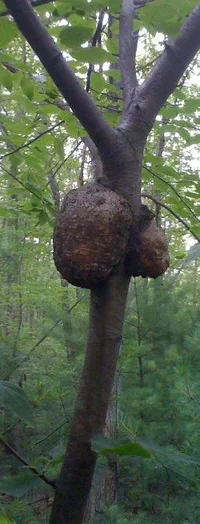
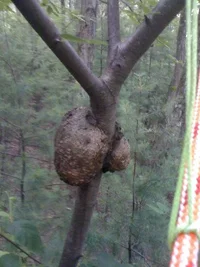
Bark growth on trunk

What caused this (and what is it)? It's at the top union of a 20 foot Birch.
thanks
HUK
 

Attachments

  • 287274-IMG_0618crop.webp
    287274-IMG_0618crop.webp
    41.9 KB · Views: 180
Thanks guys, I didn't see any insects (at least the one time I climbed up there) or holes. I haven't come across anything that large before, considering such a small trunk- so it was puzzling.
huk
 
Funny, I just worked on a tree which had this growing on a limb. It was a weeping birch, not a river birch like yours looks to be. I was instructed to remove the limb, because my employer thought it was a gall. After I removed the limb, I ripped the suspected piece of wood. Good sound wood throughout the whole thing, the attachment to the parent stem seemed to be intact and functional...as in the growth was not adversely affecting the vascular system of the branch. So, I believe what I cut was a small burl, just as this is. I agree with Starlet.

 
[ QUOTE ]
I was instructed to remove the limb, because my employer thought it was a gall. After I removed the limb, I ripped the suspected piece of wood. Good sound wood

[/ QUOTE ]

Neither galls nor burls are defects unless they sound hollow or have a lot of ooze or frass.

Tell your boss let's give trees the benefit of the doubt okay?
 
yeah, the only time I remove galls,is when they are caused by Gnomonia which could go systemic and kill the tree. (they usually pop right off with a kick or smack of a rubber mallet)
 
Haha...right, Guy.

It was the first prune for my new employer, the homeowner was there too and insisted...even after I informed her it was most likely a burl. So I cut it off, showed the both of them the sound tissue and explained what I believed it to be. I'm with you on this one.

But...

Galls are not defects?? On our lodgepole and ponderosa pines, Western Gall Rust causes malformation and breakage and in some cases can girdle and kill stems. Young pine stems which survive a stem gall are generally left with a weak point where the gall used to be present. Twigs dieback from beyond the gall, which usually leads to the loss of the greater limb. How is this not a defect?

Oh, and I thought your climber's corner article was a good one...in fact I think the latest Arborist News issue has been my favorite!
 

New threads New posts

Back
Top Bottom