Bark cleanely off branches

I've seen squirrels stripping bark and upon watching them for longer periods noticed they were coming back to areas and licking the sap on places they had wounded. California Bays, Redwood (where bark was thin), Black Oak.

This happened the most just after a huge die off of Tan Oak trees that provided a food source in acorns. (About 90% mortality.)
No die-off here though. Only difference from other years is that the acorns started and ended falling quite a bit earlier this year.
 
@HansL
ODNR has verified that there is a very occasional porcupine sighting in NE Ohio.
I like you have never seen one around here.
What are the heights of these stripped branch ?
In particular, the height of branches stripped to 5 - 6 ft length ?
Bark on the ground ? If so, what size are the chunks ?
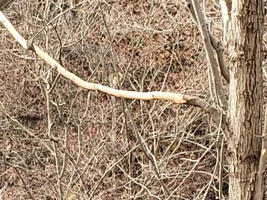
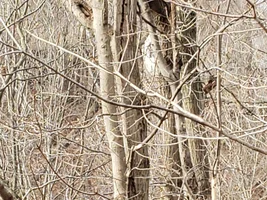
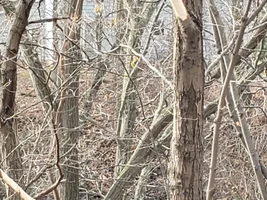
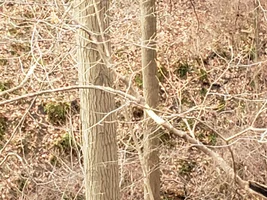
Hard to see any bark on the ground, as there are tons of leaves (and even if they fell before the bark, they are mixed in). Height: 35-40 feet. Branches not reachable from ravine sides.
 
Here are the promised pictures. The best I can do, unfortunately. As I said, using binoculars, I could not make out bite marks, but the surface seems uneven (ridges). / Hans L
 

Attachments

  • 20191226_120142.webp
    20191226_120142.webp
    359.7 KB · Views: 29
  • 20191226_120201.webp
    20191226_120201.webp
    371 KB · Views: 29
  • 20191226_120244.webp
    20191226_120244.webp
    333.3 KB · Views: 28
  • 20191226_120447.webp
    20191226_120447.webp
    346.4 KB · Views: 28
Okay, looks like most of you believe squirrels. In lieu of any evidence to the contrary, I'll settle for squirrel. I'll also keep an eye out for more damage.

Thanks everyone for your input. Much appreciated. / Hans L
 
Looks right for squirrel.

Just to be mildly contrary ................
My squirrels, in NE Ohio, don't remove 5-6 ft of bark from a single branch.
They certainly don't chew on branches for "sap" in late fall (Nov.). i.e. no significant sap flowing.
The weather has not been that bad this year, that the squirrels are desperate.
There has been little snow, so they're eating lots of available nuts. Both buried & still on the ground.
My squirrels chew branches only in the spring, when the sap is flowing.

Has anyone actually witness this activity in late fall ?

Maybe this damage was not done in late fall; just noticed after the leaves started to fall ? ? ?
 
Last edited:
Yeah, a skeleton in the basement doesn't mean the victim died yesterday. But, no, I've never actually seen them take that much bark off, myself... but I don't generally do much squirrel research. Around here, they chew the buds off of elm trees like crazy. But, those are weeds, so I've never actually heard anyone complain about it. They also make up for it by planting hundreds of damn acorns, nuts, horse chestnuts, etc. in my garden and next to the garage. They'd reforest a desert if you left enough nuts laying around for them to plant. I'm sure it probably offsets any damage they do.

Their teeth grow throughout their life, so they do chew on wood. I've seen them do that... usually dead stubs on trees, fences, etc. and I've seen them ring young trees... but stripping that much bark off? Who knows. I merely commented that it looked like animal damage. Which animal, well... you'd almost have to catch them in the act.

Still, the sqirrels can fatten up on whatever they want... I'll still be able to fit the chubby little bastards in the crockpot.
 
Last edited:
Yes, they do that here, too... I tried to find info on them stripping bark like the OP's pics, but didn't have any luck. I have a bad habit of interrupting my own web research by falling down some rabbit hole of videos about hillbillies turning recliners into gas powered vehicles, or some guy hunting Hogzilla in the backwaters of Georgia, or some crazy crap.
 
Thanks, Jason... amazing what a slight difference in keywords makes in a search engine. Well, lots of those pics show the same damage. Apparently, I at least got the clue about them going around the nodes with branches right. Some of those look exactly like the OP's damage.

Cool. So, the little tree rats are guilty as charged. What the OP really needs is a good squirrel recipe.
 
What the OP really needs is a good squirrel recipe.
@JeffGu Love the new profile picture. Here’s a favorite squirrel recipe of mine:

Traditional Brunswick Stew

Ingredients
  • 2-3 squirrels
  • 2 cups stock
  • 4 tbsp bacon fat
  • 2-3 onions sliced very thin
  • 1 garlic clove finely chopped
  • 1 1/2 tsp salt
  • 1 Tbsp Worcestershire sauce
  • 1 tsp pepper
  • 1 tsp rosemary
  • 1 tsp thyme
  • 1 bay leaf
  • 1/2 cup Madeira
  • 3/4 cup tomatoes peeled, seeded and chopped
  • 1 cup lima beans or other broad bean
  • 1 cup corn
  • 1 cup cut okra - optional
  • bread crumbs
  • chopped parsley
Instructions
  1. Place whole squirrels in a dutch oven with 2 cups stock. Braise the squirrel meat, covered for about 30 minutes until tender.
  2. Remove the squirrels and stock to a separate container to cool. Debone the squirrels when they're cool enough to handle, and add the meat into the stock. Reserve it all for adding back into the dutch oven later.
  3. Add 4 tablespoons of bacon drippings to the empty dutch oven, and fry the onions until browned.
  4. Add in chopped garlic and fry for another minute.
  5. Pour the stock and squirrel meat into the hot dutch oven to deglaze the pan.
  6. Add in all the remaining ingredients including spices and vegetables. Cover and simmer for about 30 minutes.
  7. At this point, serve immediately or add a few handfuls of fresh breadcrumbs to help thicken the soup a bit, along with fresh parsley if desired. If adding breadcrumbs, simmer for another 10 minutes before serving.
 
I am just sitting here putting the titles of books I have in my bookcase and I care about into a database. So, I came to this Swedish book (I am Swedish by birth, now a US citizen), called "The Track Book" (Danish original: "Animal Tracks", and I flipped through it and suddenly saw a picture of a tree branch with the bark stripped off. And I read the caption: "The squirrel has stripped the bark off a dead branch to line its nest with it."

So, there we have it! Mystery solved, although I believe our near consensus was close.
 
:) Your close may be close. :)

They can strip all the dead trees they want in my area and though I will notice it it will never come up on my radar as an issue to think about or talk about. I even see where squirrels scratch the outside of bark on redwood trees to shred soft stuffing/insulation type fluff off for lining of their nests. You're the first person I have ever made mention of this to as far as I know as they only impact the outer quarter inch of bark of one to three inches thick bark and it does no apparent harm other than change the look of those areas.

What I have been disappointed to see in the last 15 years of 40 years focused on trees in the woods is the biting and removal of areas of bark on live trees/branches. This results in tops dying and branches dying when they do a full girdle, or frequently, later death and failure of a top or branch that is partially girdled.

I have seen this out in the woods when we lost 94 percent of our tan oak trees to sudden oak death - a major food source for squirrels were the acorns. (Indian tribes called in biologists to complain they were loosing a traditional food crop and see if there was anything to be done.) I have also seen it to a far lesser degree in city areas 30 miles away where there are no food crop trees in sight that could have been the trigger to them starting to gnaw bark. I have seen them strip redwood bark, oak, bay, camphor (in the city).

At the time I started to see it the thing that I thought all the situations might have in common is climate change and the acidiffication of things. The one approved method of preventing sudden oak death is Agrofos sprayed on causing conditions to go more base if I understand correctly. Also spreading oyster shell around trees to be protected was said to have good effect - it took things more base. The pacific ocean near me is said to be going more acid and there are many life forms being negatively impacted or dying off altogether in parallel with that.

Anytime I see live trees being stripped I point it out to clients and encourage them to not feed squirrels and possibly discuss it with any neighbors that may be. Animals tend to breed up to the food supply. (Bird feeders often feed squirrels too.)
 

New threads New posts

Back
Top Bottom