Attatchment Knot Failure

Re: Attachment Knot Failure

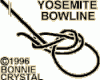
i like a DBY (Double Bowline w/Yosemite tie off) fior temporary, non shrinking eye in flexible line.

i favour making it with the slipped method of tying; which shows how easy a bowline could be capsized; but consider the double more stable. i also like the slip knot method because it breaks the lacing into 2 stages, that lend well to some applications. Also, lends itself easier to several alterations; changing the round turn to a clove for more secure water bowline and/or taking slip bight for slip knot method from the eye of the bowline to be, rather than standing end, for jacked versions.

The Yosemite tieoff not lending strength but security, and keeps tail out of the way of the eye, but not by placing in hazardous position like 'cowboy' bowline.

i think i prefer barrel for the other name in question, also pointing to how this strategy grips it's mount for less leveraging of carabiner; also i think the coils absorb shock better.

/forum/images/graemlins/propeller.gif
 
Re: Attachment Knot Failure

Anchor knot is OK. What is your application and what are you tying it on? (snap, carabiner). We are learning that most termination knots, hitches, etc. need to be backed up.

RescueMan, Is the Bowline with the Yosemite tieoff a good termination on a snap with a fixed eye? No back up required?
 
Re: Attachment Knot Failure

Is RescueMan still haunting this forum? I thought some may have offended him outta here. A shame if he isn't I thought he had some great insights.
 
Re: Attachment Knot Failure

I am tying into a locking carabiner with my main rope and split tail, using a figure 8 as a stopper. Also using it to attach the ends of my lanyard to the clips.
 
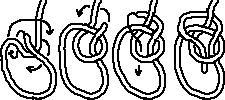
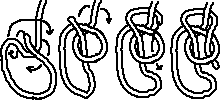
I have been using the bowline since i was a boy which my dad thought me from being a hotstick lineman. It was also the knot I was taught in climbing school (Hocking College Nelsonville, Oh) to tie in with on the traditional climbing method. While reading through all the posts, i did notice that no one mentioned that there are two different ways of tying this knot. A right way and a wrong way. If you finish with the ending tail on the outside of the loop, the knot was tied incorrect and if inverted, could become a slip knot(mentioned in one of the posts). Tying this knot with the ending tail on the inside of the loop is the correct way. One of the correct backup knots used with the bowline is the yosemite back up or tie off. I personally have never understood why some climbers feel its not a safe knot. I dress and snugg all my knots. I never in my own experience, with any type of rope, had this knot fail if tied and dressed correctly. From swinging in the trees of arborculture to the cliffs of vertical rope rescue, this knot has proven itself to me as one of the most versatile and safe knots around.
Tom Bartman
 

Attachments

  • 16662-yosemite.gif
    16662-yosemite.gif
    5.1 KB · Views: 80
To all of those that use the bowline as a termination knot on their climb line, Is this knot an approved knot for our profession? Personally I always use the Anchor hitch as my termination knot, backed up with a Blood knot instead of a figure eight. The figure eight loosens up as the rope impacts the tree and eventually falls out, or it will roll over and tighten, but when it is in that second position and I see it, I stop what i am doing and dress and set it again. So I have deleted the figure eight as a stopper knot on my climb line. The draw back of the Blood knot is that once it is loaded it is very difficult to untie. But, it has never failed me.
Bravo, to the poster that talked about the "left handed bowline" I just said that exact thing yesterday, to one of my ground workers.

Remember, there is nothing worth getting hurt over...
Adam
 
Re: Attachment Knot Failure

[ QUOTE ]
RescueMan, Is the Bowline with the Yosemite tieoff a good termination on a snap with a fixed eye? No back up required?

[/ QUOTE ]

Hi, I'm back.

The Yosemite bowline (which is a way of backing up the bowline and requires no additional backup) is certainly secure enough to use as a termination, but it's a bit bulky (too much "gain" or added length).

My preference is the double overhand noose. It's secure, compact, and it cinches on the snap or 'biner.

- Robert
 
Re: \"wrong\" bowline

[ QUOTE ]
there are two different ways of tying this knot. A right way and a wrong way. If you finish with the ending tail on the outside of the loop, the knot was tied incorrect and if inverted, could become a slip knot

[/ QUOTE ]

Either form of bowline can become inverted and fail, but the tail outside the fixed loop (called a cowboy or Dutch marine bowline) is easier to snag and cause an inversion.

The primary problem with the cowboy bowline is that it is a bit weaker or less secure (the tail isn't cinched as well within the knot).

Bowline:
lh1pst.gif

Cowboy Bowline:
lh2pst.gif


- Robert
 
Stopper knot?

I'm sure you guys can clarify this for me. I was told once that when you tie a knot that sits on it's own tail, such as the anchor knot, you do not need to tie a stopper. I usually do anyway because it doesn't take any extra time/effort on my part to tie a figure 8 in the end of the line. Does the anchor need to have a stopper knot?

Zac
 
Re: Stopper knot?

Zac,

Are you asking about using an anchor bend for tieing a snap or biner to the rope for the end of a climbing system?

Whenever I consider using a backup for a knot or hitch I stop and wonder if maybe there is a better knot or hitch for the application. Maybe one that is more secure standing alone. To me, it depends on the application and the rope that I'm using. In the rare times that I tie hitches or knots into static line I will generally tie a backup. Since static line is so stiff it's almost impossible to get a really good set to the knot.
 
Re: \"wrong\" bowline

Rescueman, I use rope snaps with metal thimbles on my climb line, split tail and lanyard, tying into them with the double overhand noose (double fisherman's). Do you think thimbles are a good idea in these applications or are they unnecesary?
 
Re: \"wrong\" bowline

[ QUOTE ]
Do you think thimbles are a good idea in these applications or are they unnecesary?

[/ QUOTE ]

A little tough to answer without knowing what rope diameter and what snap diameter you're using. If it's 1/2" (13mm) rope on a 5/16" (8mm) snap, then a thimble might be a good idea. I commonly tie 9mm cord directly onto 3/8" (9.5mm) carabiners for life support and I think the fact that the rope will cinch tightly onto the carabiner is more important than the slight weakening of the 4000 lb rope.

The rule of thumb that a pulley should be 4x the diameter of the rope is intended for high load situations - rigging or rescue. What causes failure of synthetic ropes is either external or internal friction (or cutting at an edge), and the internal friction can be caused by too tight a bend radius with a high load.

But if synthetic rope is terminated more or less permanently onto a metal clasp, it relaxes into that configuration and internal friction diminishes.

Thimbles are much more important for either steel rope (cable), high-strength cordage (which doesn't have the flexibility and stretch of nylon or polyester), or for high loads.

So that's a long-winded way of saying I wouldn't bother with thimbles in that application.

- Robert
 
Re: \"wrong\" bowline

Robert said more than I would have said :) Agreed.

Someone already said that there is a more likely chance of a biner cross loading if you use a thimble than the rope breaking from the bend radius.
 
Re: \"wrong\" bowline

To me a SheetBend is a Bowline, cut open. The Cowboy Bowline pictured; would also be the less secure pattern for the SheetBend. Each is less secure i think, for not making the most direct load pressure on the tail. In some quotes this might be inverse for kernmantle it seems.

Either form can be made with the slip knot method of tying a loose noose and feeding the working end through, and pinching the working end back to the working part and inverting the noose. Kinda a Mountain comes to Mohammed fer the bunny and tree deal. So i think either could invert, especially with real stiff line, that i think KnudeOne is werking on a knot strategy for(stiff line). Of shipyard born lore i believe, comes the tale that if the working end/bitter end/tail of the bowline is set as Cowboy, and the load run down to quickly, and the tail snagged on something in this less protected position; then knot could invert.

i would think an anchor needed backed up, especially for intermittent loading; especially stiff line, and or repsositined by angle/upside down while loose then loaded. Or preceded, like coming around device and making anchor back to standing part, with end exiting towards standing part, as to effect barrel/dbl. fisherman's wihtout the crossed turn.

One reason, one might use an eye that shrinks to the carabiner (not bowline, thimble) is to attempt to have less sideloading/ repositioning of carabier by firmer grip on it. Some forms i think, specifically desire to dent the carabiner directly into the tai to lock best, not softened by thimble. Tenex flattening more on carabiner, for better grip (barrel etc.) and even more strength, having less leverageble dimension flat i think.
 
Re: Stopper knot?

[ QUOTE ]
I was told once that when you tie a knot that sits on it's own tail, such as the anchor knot, you do not need to tie a stopper.

[/ QUOTE ]

All knots "sit on their own tail", otherwise they wouldn't stay together. But some, like the anchor hitch, do it better (it's tail is tucked inside the two turns and then finished with another half hitch).

Whether a stopper knot is necessary depends on a couple of things:
- is the knot inherently insecure (like the bowline)?
- is the knot intended to be more-or-less permanent?

If it's going to be tied once and then used over and over again, through many tension/release cycles, the tail can eventually work its way back into the knot or the knot can loosen - so a stopper knot is a good idea. The alternatives are to whip the end or to preload the knot (with many times the expected load) so that it cannot loosen or creep (I do this for terminations and the double overhand bends of my prusik loops by using a 9:1 pulley system).

In rock climbing, I've often used a bowline with no backup if it's going to be tied and tensioned for a single use and then untied. With an insecure knot like the bowline, it can come undone while untensioned.

Another key to keeping a knot secure is making sure there is plenty of tail - at least a hand's width (3"-4").

But using a backup or stopper knot is never a bad idea unless it interferes with the intended use of the primary knot.

- Robert
 
Re: Stopper knot?

I prefer to not put thimbles on flip lines. I have seen some on ropes for years and only caused minimal-to-no chafing. I see the thimble as unnecessary bulk. I fully understand the purpose of a thimble and endorse it's use where you're pushing the limits of the rope even a tiny bit, but in reality, a climbing line and a flipline just don't see those loads. I won't hesitate to put a thimble on a rope if someone wants one, but it's not unsafe to put a snap on without the thimble either.

love
nick
 
Re: Stopper knot?

Rescueman and Nick and Tom, thanks for the comprehensive response. I didn't know that over time the rope will internally adapt to what it is tied to.

I'm gonna take off the thimbles and try it that way...less bulk etc. is always a good thing..
 
Re: Stopper knot?

Btw Rescueman, it is all 1/2" braided NE rope or Bluestreak tied to basic Buckingham steel locking rope snap for climb line, and to aluminum locking rope snaps for lanyard.
 

New threads New posts

Back
Top Bottom