ASCENTREE

Well who out their has had some time working with Petzel's Ascentree?

Any pros or cons?

Adaptations, modifications,applications or safety concerns?

Anybody see it in action at the Petzel both at TCIA EXPO?
 

Attachments

  • 150207-Ascentreediagram.webp
    150207-Ascentreediagram.webp
    155.4 KB · Views: 365
The figure 8 would prevent the line from coming out of the pulley if one of the cams came off the rope?

jp
grin.gif
 
Yes it would.

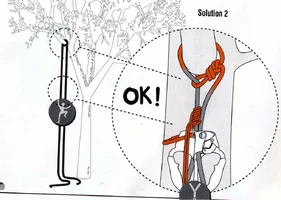
In the attachment you'll see where in the directions that Petzel provides a different solution for a different means of setting up the system. This is where the back-up is essential.
 

Attachments

  • 150223-Diagramofascentree.webp
    150223-Diagramofascentree.webp
    76 KB · Views: 179
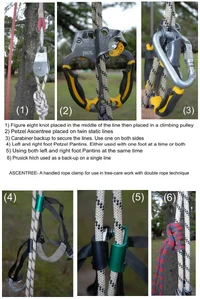
A lot of times I climb utilizing the advantage of a pulley. When I get up in the tree I change over the climbing system which means I clip into the carabiner or the tree with my core line and untie the figure eight and climb off the pulley. I tie the figure eight in the line so that both lines are static and that way I can use both of the foot ascenders (left and right Pantins)to climb up one at a time. The use of the figure eight knot is also taking advantage of the narrow bend ratio over the pulley wheel. Brings the rope together for easier climbing. Still fine tuning the technique.

The pulley is attached to another line that is anchored at the base of the tree. This way I can isolate the two climbing lines so that their are no interferring limbs. Saves time in working the trow line.
 
I'm still unclear as to the advantage of ascending a double line that required a single line to suspend from. Why not just ascend the single line and only use one pantin?
 
If you use a double line there is only half the weight on your anchor point - compared to a single rope setting...but in the end I like single rope ascending better, too...
 
I think Mark's solution to the problem is much easier. Either way you have to climb all the way up to you tie in point. Each system has it's own pros and cons and can be utilized in different trees. A long ascent my warrant an srt.
 
Choice and change it is your option in life...

Not everything is right for everybody.

It is not a matter of right or wrong it is just a matter of one way or the other.

Personal decision.
 
One reason not to use just one Pantin on one leg all the time..

In the TCIA Magazine May 2008 their was a letter to the magazine that stated the following.
"While the Pantin has proven to be an excellent tool, I couldn't stress enough the risk of injury if it used repetitively with only one leg. One of our climbing arborists hurt hinself two years ago after discovering the Pantin and loving it so much - he was out of commission for three weeks! His injury was located primarily in the left hip, from using the device on the right leg.
After recovering from the injury, he started to use two Pantins simultaneously on a double rope and climbed like one would climb a ladder. He also simply switched legs regularly using the single rope technique with one Pantin."
 
[ QUOTE ]
If you use a double line there is only half the weight on your anchor point - compared to a single rope setting...but in the end I like single rope ascending better, too...

[/ QUOTE ]

Not if its anchored via a single line anchored at the ground.
 
That is a good point as I'm sure my right quad is larger than my left for that very reason. There is an easier way around that by using second handled ascender with a foot loop. You can 'walk' up the rope in the same fashion with the loop on one foot and the pantin on the other, your hands will follow the same rythm.
 
[ QUOTE ]
One reason not to use just one Pantin on one leg all the time..

In the TCIA Magazine May 2008 their was a letter to the magazine that stated the following.
"While the Pantin has proven to be an excellent tool, I couldn't stress enough the risk of injury if it used repetitively with only one leg. One of our climbing arborists hurt hinself two years ago after discovering the Pantin and loving it so much - he was out of commission for three weeks! His injury was located primarily in the left hip, from using the device on the right leg.
After recovering from the injury, he started to use two Pantins simultaneously on a double rope and climbed like one would climb a ladder. He also simply switched legs regularly using the single rope technique with one Pantin."

[/ QUOTE ]

I had my Pantin within an hour of them being on the retail shelves years ago. In the following years I've climbed at least in the thousands of feet, who knows? There has never been an ache or pain. In fact, my whole body feels better because of using various rope climbing systems and abandoning footlocking for all but a few steps.

I have to wonder if the injured climber in the article was doing ascents with poor form? Too often footlocking is taught using competition FL as the model. In the workplace this is not good ergonomics. In comp mode the legs come up very hight and the knees go out to the side like frog legs. This throws every joint from the toes to the neck out of alignment. Good body positioning for work is much less aggresive. The knees stay forward and the movement is much like marching in place.

Taking a bit shorter bite on the rope and keeping all of the joints aligned naturally will reduce/eliminate the wear and tear from frog locking.
 
[ QUOTE ]
I'm still unclear as to the advantage of ascending a double line that required a single line to suspend from.

[/ QUOTE ]

well with the method your talking bout, can be used for those who can't footlock. There are some who still can't or don't climb this way. You can just tie in and body thrust or patin and pull. Allows you to work the tree as you go up. Great for say pin oak work one side up and other side down.
 

New threads New posts

Back
Top Bottom