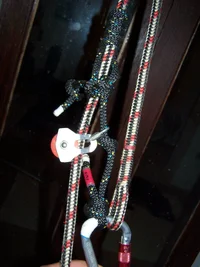
Ascender Hitch

rfwoodvt

New member
Morning!

Been reviewing <u>On Rope</u> during my quiet evening hours and have taken an interest in the "ascender" hitch. As described it uses a single line much like you would with a blakes, but it is a smaller diameter much like a prussic cord.

Basically it is a bowline loop that is wrapped around the climbing line before being tied. Kind of a neat knot/hitch and works as described.

AscKnot.jpg


I've compared this hitch with the Schwabish and Distal and they are completely different animals.

The S&amp;D will, over the course of the day cinch tighter and tighter and will need to be broken. Because the Ascender hictch has a fixed length to the part that grabs the climbing line the wraps don't seem to lock down.

I like the performance of this "ascender" hitch especially considering how much better it will be to move it when working in sticky sap/pitch trees.

A single line prussic (meeting ANSI strengths) could work. What I'd like to do is see about using my normal tenex eye &amp; eye prussics.

Anyone try that yet? what are some of the ways it could be done?

Input is very much welcome.
 
I use it every day now for the past couple of years.

I've always called it the helical?

make sure there is plenty of tail coming out of the bowline and add a stopper knot there also.

You can add a fairlead by using a small chainlink crab wdeged under the bolwline which holds an isc or similar small pulley.

It works great, it will self tend like a lockjack if its loose enough and there is enough rope below you, but be careful, too losse and it won't always grip automatically. Sometimes it needs to be pressed into position befor eloading to make it grab!
 
Hi, Rick;

I believe I learned this hitch through Don Blairs' Arborist Equipment. I use it on my saddle as an adjustable attachment for my safety lanyard. It is bi-directional. If I use the opposite end of my safety lanyard, the hitch will hold in that opposite direction as well as my standard direction. I need to feed the knot through my D-ring to make this work. I also add a few extra wraps when tieing the hitch for this application since the bowline tightens and gives more length to it. The extra cord length causes the hitch to be too loose and the knot won't work. The D-ring acts as a slack tender so I can adjust the lanyard with 1 hand.
I agree with adding the extra length of tail to the bowline. I had it loosen on me once. Luckily, the other end of my lanyard is attached to the opposite D-ring on my saddle so if it would have led to a mishap, I wouldn't have lost my tie-in point.

Joe
 
[ QUOTE ]
I use it every day now for the past couple of years.

I've always called it the helical?


[/ QUOTE ]

Yeah Rupe, it is also called the helical. I've seen a number of illustrations too using a biner as part of the whole set up.

Have you tried using a variation with an eye and eye prussic?

Thats the one thing I like about the schwabish is that your wrap the prussic around the mainline and clip into the eyes...no additional knots to fight with.

A buddy suggested I tie the helical with a figure 8 instead of the bowline. if I leave both legs the same length I can clip my biner into the eyes.

My first few tries were using a follow-through fig-8. Not the most timely method. I'll be testing out wrapping the helical then taking both ends and tying the 8. See how that goes.

Only concern really with the 8 is getting it undone at the end of the day.

Still makes getting it on and off the line a pain though.

I'll give it a whack later this week and post some pics of how it looks.
 
I leave it on the rope permanently, until it needs replacing that is. Here's a pic of it I found on my PC from when I first started using it, I tie it a lot shorter now. I found some mini clips that will grip onto the prussik cord so no need for the extra knot in the leg.
 

Attachments

  • 66117-a.webp
    66117-a.webp
    209.9 KB · Views: 240
[ QUOTE ]
Wouldn't that end up the same as a french prusik?

[/ QUOTE ]

Not exactly. the difference is that the French Prussik is open wrapping. Your ends only come together at your attachment link.

In my observation, the FP needs to be well dressed and kept dressed to work well throughout the climb. The top wraps can work thier way down and over the lower wraps.

Because the helical/ascender hitch has a fixed length loop it is much less likely to capsize or come undressed.
, and because of the small amount of slack built in to allow release there is not much room, if any for the upper coils to migrate down over the lower coils.
My lead climber has used it with a fairly stiff prussci cord and swears that hte helical will never capsized, undress or foul. In looking at his examples one can see that is very true.
 
Another advantage, that I find with this hitch, is that you can push it up the rope in the same way as an old fashioned prussik loop hitch. I just like that for some reason, its good fro returning from a branch walk and I find the VT's and distels etc dont allow for this.
 
I will give a quick rundown on the names used for this hitch. It was published in a local newsletter in 1961 by Clarence Cook, who simply called it "a new climbing knot". It was reprinted in the NSS News in 1961. The same issue had a commentary by Bill Plummer, who said "I have tested the helical climbing knot." This is the name I use. Larry Penberthy re-invented it and published it in 1969, calling it the "Penberthy Ascender Knot". He compared it to the "Prusik Ascender Knot". Dick Mitchell gave a talk on it at a cavers convention, calling it the "ascender knot". The best commentary on the "ascender knot" name was by Bill Mixon:
"What did you use to climb with?"
"Ascenders."
Profilic knot author Geoffrey Budworth calls it the "Penberthy Knot". Some French websites call it a "noeud valdotain".

Bob T
 
[ QUOTE ]
I now use five wraps instead of four.

[/ QUOTE ]

i been using this knot a few years now, with five wraps, but i cast the top wrap off, to form a cross over. this is the differance between the ascender and the helical(i think)
i put a over-hand knot on the main leg to hold the mini pullie in the right place with a small quater trun shackle. 10mm lyros works for me on 12mm rope.
 
[ QUOTE ]
[ QUOTE ]
I now use five wraps instead of four.

[/ QUOTE ]

i been using this knot a few years now, with five wraps, but i cast the top wrap off, to form a cross over. this is the differance between the ascender and the helical(i think)
i put a over-hand knot on the main leg to hold the mini pullie in the right place with a small quater trun shackle. 10mm lyros works for me on 12mm rope.

[/ QUOTE ]

Correct, the fifth wrap is "cast off", this gives better auto locking than just the four wraps I pictured above.

I'll get some pics of how its used now.

Judge, is that 10mm or 9mm lyros I'm using? I buy it from you so you may know, I can't remember!!

It works well on Blaze, and slightly too well on 13mm ropes such as arbormaster etc.
 
Now let me guess, Bob T is the great 'Bob Thrun', right?

I doubt anyone knows more about the history of ascending knots than BobT.

If it is, welcome to the buzz Bob! If it isn't...welcome to the Buzz Bob!
laugh.gif


There is no difference between a Helical and ascender knot Judge. I always tied it with 6 wraps then folded the top two down to form lower cross-overs, just like a 6 wrap VT. It performs the same, only its possible to really fine tune the Helical, to account for sap and wear, by tightening or loosening through the bowline tie off. There are various ways of tying off. I used a standard yosemite tie off. It tested almost as strong as the VTs in tests. No need to worry about a single leg.

Its good to set long as a split tail to replace a Blakes.
 
I feel i need to buy some new hitch cord. i'm running Edelweiss adline at the moment. 10mm any recomendations, I have some beeine left but not enough. nice but expensive

Jamie
 
Come on back Mr. Bob! Was the question about arborists first making use for knot tender ever answered?

i think this is essentially a coil (4 turns) in a closed-load /pull from both ends hitch; only instead of seperate pulls directly to saddle, they split off a straight line from saddle. Essentially same as/ same as. i think about all our closed hitches rely on this structure, but lace a preceding half hitch (in various strategies and altering functions to give different names) as another grab and buffereing loading to coil or braids for MT/VT family. Even the Blake's is similar, but just pulled from 1 end and bottom 2 turns interupted. But, all relying on this sinmple mechanic of the coil/4 turn grab as base/ final end mechanic.

i've played with it some; and seen it tied wrong (IMLHO). i think when making the Bowline, we must place our initating force on the Half Hitch / trap hold of the Bowline's SheetBend ; and not pull from the bight side of the Bowline's SheetBend (Bowline just being a SheetBend to self to form eye). Loading incorrectly places the intiating force on what i call the 'release' instead of the 'lock' side of the machinery. It also in this particular position tries to spread apart and not pinch together the 'release'/ bight side.

So the initiating pull from saddle should feed up into the choke of the half Hitch and then continue to the upper/far part of the coil i think. So, i only like it pulled in 1 direction.
 

New threads New posts

Back
Top Bottom