- Location
- healdsburg, CA
Article in ArboristNewsFeb.\'05
Page 47 in the 'ClimbersCorner' is an article titled: Using Snaps Safely,
by Norm Hall & Mark Adams.
In this article is a diss. on girth hitching ropes to alum. snaps.
I have alot of issues with this piece.
1. I dont think it is an appropriate use of alum snaps to use them as a primary connection on a climbing line.
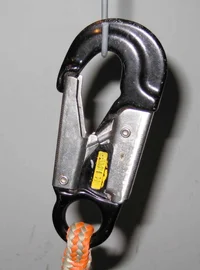
In paticular the only snap used in every picture of the article is one of the cheapest snaps available on the market today. The gate and locking mechanism is made of a super light weight 'sheet metal' that I have personally heard from folks who say they have bent these and caused a hazard from the gate either staying open, or not closing all the way.
2. The alum. snap that the article focussed on has an extremly small hook. So ANY bridge, "D" ring, or other hardware will be tightly captivated within this area and, in my opinion, increase the likelyhood of cross loading.
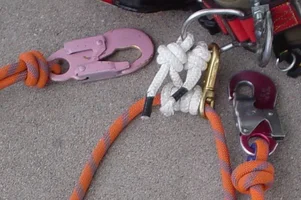
3. The article goes into great length on the risk of girth hitching around the 'eye' of this snap. Because with the large eye it can slip down and hold the safety latch open, or even worse, the snap can fall off completely!
I dont know of any climber who girth hitches different snaps onto a flip line. Maybe I just dont know whats out there, but on a flip line usually there is one piece of hardware, and one only, for each flip line.
So I have always spliced a small tight eye onto my snaps.
In addition, I dont use these cheap alum snaps, but the much heavier, slightly longer ones. (Sorry I dont remember who makes them, maybe DMM?)
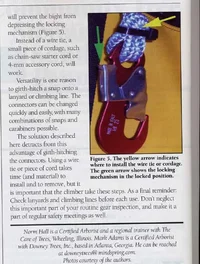
4. On page 48, (see pict) the authors give a solution to this girth hitching issue. They explain that the eye of the rope must be cinched up, by either a plastic zip cord or light piece of cordage. And they show a picture of one cinched up using a zip cord. (again see picture)
This 'work around' in the picture shows the zip cord wrapped completely around the bitter end of the rope as well as the eye itself. ?Would'nt the zip cord be able to 'pop' off? Why not feed it through the center of the eye AND THEN around the bitter end of the rope?
In my opinion (is'int this what its all about ) This is tottally lame and possibly dangerous as well. for one I am against incorporating ANY gear that requires bandaids, juryrigging, etc, just to make it work normally.
One of the reasons I am so adament about using the safest equipment is because the rock climbing industry has so many gadgets that are just not suitable for tree work: For example the (I think it is called) Ti-blok, it is a small toothed thing/cam you can feed a line through and maybe use it on your flip line as an adjuster.
Or another example, using the traxion to winch up large loads and hold them. I would'nt use it for anything else but maybe bringing up my lunch or a rope bag.
Or another example, Using the Petzl swivel on a load line.
Well I could go on and on (and if given half a chance will)
In the second case why did the authors not stipulate to not use alum snaps for your primary climbing line but only for flip lines?
Am I out of line to require my climbers to only use tottally up to date biners on their climbing lines, never snaps? Why would any one want to have some heavy snap(s) hanging off of their bridge?
And why did the authors not show different types of snaps? Of all the snaps out there the ones shown are the cheapest, most flimsy ones out there.
On the point of flip lines, I use snaps for several reasons; one is the weight, I like the weight to give me better control in 'flipping' around stems. Having the snap as the heaviest point enables me to 'flip' the lanyard around the tree with great control.
One other reason is a snap is alot more streamlined. Another reason, easy to open even with gloved hands.
Gear is sold, and because it is sold by all these major re-sellers every one assumes it is fine. In the case of these alum. snaps I dont think they are suitable for the rigors of tree work. But to each his own. However to write in an official trade magazine and not even mention the disadvantages of the paticular snap featured is in my opinion a dereliction of duty.
All types of folks read these articles and because they are in the official publication of the ISA, they trust the information they read. From the total beginner to the purchasing agent outfitting crews with tools and equipment that people literally depend on for their lives.
Frans
Page 47 in the 'ClimbersCorner' is an article titled: Using Snaps Safely,
by Norm Hall & Mark Adams.
In this article is a diss. on girth hitching ropes to alum. snaps.
I have alot of issues with this piece.
1. I dont think it is an appropriate use of alum snaps to use them as a primary connection on a climbing line.
In paticular the only snap used in every picture of the article is one of the cheapest snaps available on the market today. The gate and locking mechanism is made of a super light weight 'sheet metal' that I have personally heard from folks who say they have bent these and caused a hazard from the gate either staying open, or not closing all the way.
2. The alum. snap that the article focussed on has an extremly small hook. So ANY bridge, "D" ring, or other hardware will be tightly captivated within this area and, in my opinion, increase the likelyhood of cross loading.
3. The article goes into great length on the risk of girth hitching around the 'eye' of this snap. Because with the large eye it can slip down and hold the safety latch open, or even worse, the snap can fall off completely!
I dont know of any climber who girth hitches different snaps onto a flip line. Maybe I just dont know whats out there, but on a flip line usually there is one piece of hardware, and one only, for each flip line.
So I have always spliced a small tight eye onto my snaps.
In addition, I dont use these cheap alum snaps, but the much heavier, slightly longer ones. (Sorry I dont remember who makes them, maybe DMM?)
4. On page 48, (see pict) the authors give a solution to this girth hitching issue. They explain that the eye of the rope must be cinched up, by either a plastic zip cord or light piece of cordage. And they show a picture of one cinched up using a zip cord. (again see picture)
This 'work around' in the picture shows the zip cord wrapped completely around the bitter end of the rope as well as the eye itself. ?Would'nt the zip cord be able to 'pop' off? Why not feed it through the center of the eye AND THEN around the bitter end of the rope?
In my opinion (is'int this what its all about
) This is tottally lame and possibly dangerous as well. for one I am against incorporating ANY gear that requires bandaids, juryrigging, etc, just to make it work normally.One of the reasons I am so adament about using the safest equipment is because the rock climbing industry has so many gadgets that are just not suitable for tree work: For example the (I think it is called) Ti-blok, it is a small toothed thing/cam you can feed a line through and maybe use it on your flip line as an adjuster.
Or another example, using the traxion to winch up large loads and hold them. I would'nt use it for anything else but maybe bringing up my lunch or a rope bag.
Or another example, Using the Petzl swivel on a load line.
Well I could go on and on (and if given half a chance will
)In the second case why did the authors not stipulate to not use alum snaps for your primary climbing line but only for flip lines?
Am I out of line to require my climbers to only use tottally up to date biners on their climbing lines, never snaps? Why would any one want to have some heavy snap(s) hanging off of their bridge?
And why did the authors not show different types of snaps? Of all the snaps out there the ones shown are the cheapest, most flimsy ones out there.
On the point of flip lines, I use snaps for several reasons; one is the weight, I like the weight to give me better control in 'flipping' around stems. Having the snap as the heaviest point enables me to 'flip' the lanyard around the tree with great control.
One other reason is a snap is alot more streamlined. Another reason, easy to open even with gloved hands.
Gear is sold, and because it is sold by all these major re-sellers every one assumes it is fine. In the case of these alum. snaps I dont think they are suitable for the rigors of tree work. But to each his own. However to write in an official trade magazine and not even mention the disadvantages of the paticular snap featured is in my opinion a dereliction of duty.
All types of folks read these articles and because they are in the official publication of the ISA, they trust the information they read. From the total beginner to the purchasing agent outfitting crews with tools and equipment that people literally depend on for their lives.
Frans