Appropriate pre-tension on rigging lines inqury

Reading through my new "best practices book", it states that a rigging line should be properly pre-tensioned to the weight of the load ( or piece being cut). It seems simple, but can any of you cats elaborate on this in shape or form? My little pea brain thinks this is because you want to counter act the initial shock of the load. 100 lbs of tension on the line for a 100lb chunk would act like zeroing out a scale? Is the rope tension force measured in ft-lbs?

Now getting into how to pre-tension. I have seen all the different types of devices the Reg has youtubed, and MA systems, fiddle blocks etc cool stuff. I might show my green, But I was thinking about experimenting with our nylon webing style come along. Simply hook the come along to the porty, use appropriate textile loop/prussik, and capture progress with lotsa wraps or cleat on the porty. Anyone use this? I would think it would be easy to go overboard if you were not careful with a come along though.

Insight? Ideas? Criticism?
 
With my guys I call out "Guitar tight" "shoelace tight" or "take up the slack".

This has gotten me thru alot of work plainly and simply.

GRCS is the best tool available for lifting/pulling loads and makes everything easy peasy.

I find comealongs on the lowerin device to be a nuisance. IMO. Connect and reconnect and adjust and too short of a pull, not enough pwr etc.
Its easier and faster usually to figure something else out.
Speed line, redirect, change purchase point etc.
Hope this helps.
 
i think pretension to load ballast gives float, no impact, more clearance, affect steering to the side etc.

But, if over head rigging, can also slowly hinge load over, and add more tension / self tension some.

Generally, if can easily give equal/opposite of this (tension relief) on the fly, but can't increase tension. so pretension, for widest band of control.
 
I have to reread everything a few times and even then I will come back to it days later because I feel I am missing something and sure enough there is more enlightening.

Enlightening? More like sparks and smoke from the ol receptors fusing.

Its a trippy flow!
wink.gif
smile.gif
 
Joe!

When using hinge travel to self tighten, more apt to match weight exactly to get float at tearoff/separation , than when guessing at the pre-tension force to ballast load. Conversely, when rigging towards support, then line slackens, so needs more pre-pre-tightening for same tight line type effects to compensate, for eventual line tension at separation/tearoff.

Also is best if don't just butt hitch to load, but rather go nearer to center of balance of load/spar. This can give more time to tighten , and be more balanced horizontally; this will give more clearance to obstacles than same load length butt hitched too. This also makes head 'lighter' so can be moved or adjusted easier to get around stuff, lay down etc., for butt end above hitch is ballast to head. This also gives lever to same.

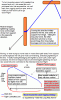
Support point is not always straight overhead in rigging, to get most tightening by slowly folding down. But main point is to fold away from support, to stretch (already stretched) rope. So can even support to steer eventually to right, but initially fold down towards left (into pretighened line). This tightens line more, hinge still hanging on, then let tighter line give fuller support and harder pull to right (actual target direction). Kinda a fake left, to go right, with fuller support if you can orchestrate right. Also, better with friction rather than pulley support, and then shorter length from support to load, so have less line stretch to fight as trying to self tighten by folding over on hinge away from support.

A long hinge hang as folding down or across, can also be viewed as a butt tie/hitch as secondary support to the main rig line. Like, there were 2 ropes until you only needed 1, that you would cut, or only have a short length of.
Then release that hinge/rope when it has positioned load better to rig line(that is placed closer to center of balance..).

i found this olde sketch.
 

Attachments

  • 290831-mostleveragedtightening.gif
    290831-mostleveragedtightening.gif
    46.7 KB · Views: 124

New threads New posts

Back
Top Bottom