- Location
- New Sealand
I've been using this version of cambium saver for a few years off and on. This particular model seems to be the least gear intensive, easy to instal, easy to retrieve and a comfortable level of friction.
I have climbed using all sorts of cambium savers from ART pulleys, double ring, one ring-one pulley, and this one ring configuration seems to be similar in performance to the double ring cambium savers, which I find comfortable.
I realise that the bend ratio may not be quite as much as a full-sized pulley or a two ring cambium saver. In my opinion, the difference is negligable and safety is not compromised. Take into consideration the way in which a two ring cambium saver acts under load (shifting somewhere between one ring and the other, depending on climber activity, ascending or descending).
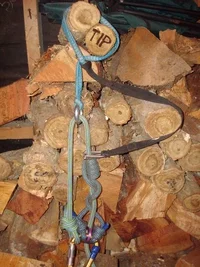
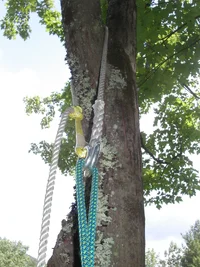
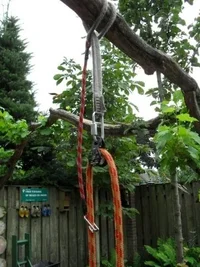
The attached picture shows how the one ring cambium saver is installed, being cinched off at the TIP. The climbing line is traced through the retrieval shackle, through the ring and back down to the harness. I do not set it from the ground, but I'm sure someone could figure out a way it could be. It is retrieved using the RG retieval ball.
I have had 100% success retrieving this cambium saver from real-live trees that I have climbed. It's easy to get a cambium saver to come out in the workshop but taking it in to the tree is the real test. The trick is to attach the retrieval webbing (any accessory cord would be acceptable as it is not exposed to load) to the centre of the sling stitching. This keeps the sling slightly more open, making retrieval more successful.
Just thought I would share my easy to assemble, inexpensive and easy to use cambium saver alternative. Please use rated components for any climbing application and practice low and slow.
I have climbed using all sorts of cambium savers from ART pulleys, double ring, one ring-one pulley, and this one ring configuration seems to be similar in performance to the double ring cambium savers, which I find comfortable.
I realise that the bend ratio may not be quite as much as a full-sized pulley or a two ring cambium saver. In my opinion, the difference is negligable and safety is not compromised. Take into consideration the way in which a two ring cambium saver acts under load (shifting somewhere between one ring and the other, depending on climber activity, ascending or descending).
The attached picture shows how the one ring cambium saver is installed, being cinched off at the TIP. The climbing line is traced through the retrieval shackle, through the ring and back down to the harness. I do not set it from the ground, but I'm sure someone could figure out a way it could be. It is retrieved using the RG retieval ball.
I have had 100% success retrieving this cambium saver from real-live trees that I have climbed. It's easy to get a cambium saver to come out in the workshop but taking it in to the tree is the real test. The trick is to attach the retrieval webbing (any accessory cord would be acceptable as it is not exposed to load) to the centre of the sling stitching. This keeps the sling slightly more open, making retrieval more successful.
Just thought I would share my easy to assemble, inexpensive and easy to use cambium saver alternative. Please use rated components for any climbing application and practice low and slow.