Advancing the TIP

Interesting concept Rich, I will have to give that one a try. I can see some use for that when I am up in my saddle "not moving" all day (hunting). The saddles do get uncomfortable after a few hours of just hanging in them.
 
Interesting concept, but like all things, make something idiot proof and along comes a better idiot. Somebody would actually put it on a stem against the curve!

I understand the "flack" Moss describes, but his process as described, under the conditions given, in my mind, is a acceptable use for the carabiner. Are there ways around it? Could it be done differently? Yes, but in Moss's situation it is a case of an experienced climber, knowing the limits of his kit and using it to potential in a specific circumstance where the gear can properly function.

The problem I often see in climbing and rigging, is climbers will claim to know and observe the limits of choking a carabiner to the stem, follow those limits for a bit, then disregard them at convenience. Often this disregard comes from being lazy. Unfortunately, this improper use behavior gets passed on as acceptable to others less experienced/knowledgeable.

Sort of a side track, but I felt it was important to point out that all techniques and equipment we use have benefits and limitations, the "ying and yang" of kit, if you will. This becomes more and more apparent and important especially now as clever, intelligent minds develop/adopt new and different techniques into the tree climbing world.

By the way Oceans, ever figure out the answer to the last climbing question I asked you when last we spoke in person of tree climbing? It's O. K. if you don't remember. I just recently recalled I asked!

Tony

Well, the answer is always '42'. :)

Let's get on PM for a minute and you can refresh me...
 
I believe a webbing loop would work great for that purpose.
I just used this the other day. I was removing a long 45° angle limb out over a roof and I had to cut back the tips 1st to make it work. There was squirrel damage on the smaller lateral that I planned to stand on. Well, apparently my fat arse went too far out on that lateral, as it began to crack right at the crotch. There was nothing left to stand on, and my only good TIP put me at a bad rope angle to go out any further. Just as I was calling for the spikes, I remembered my webbing loops. Girth hitching 2 small ones as foot loops, I could work my way out to the piece to be removed, standing in one while I moved the other.

All of the above ideas are great but IMHO, the best methods will use what you're already carrying on your saddle. We'll always have webbing loops and lanyards. I hate calling for extra gear in those situations but of course sometimes it has to be done.
 
Another idea about how to advance TIP in canopy. It's just theory at this point. It seems a bit more challenging to throw a bag while up in a tree. as opposed to from the ground. I've used fishing line from the ground with both slingshot and also xbow for very high branches. The fishing line has worked well as as segue to throw line.

I've seen the chalk line system and the older fishing reel system. Both require a hand throw, which has it's limits. A slingshot seems not too bad.

My idea is the classic Ronco Pocket Fisherman. With a bit of practice, I'm guessing that one could do a fairly lengthy and accurate cast to the next branch. It's relatively small. It folds up and has a hook system for belt attachment. I'm also guessing the gearing inside is better functioning than the chalk line. Perhaps could be modified to make it even better by those who like to tinker. And it's quite inexpensive, about $20 or so. You can see it on Amazon.
 
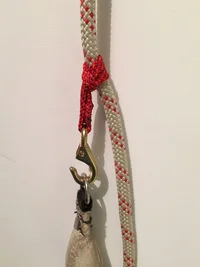
My saddle bag starts working, and earning it's 10 oz., even before I leave the ground. There is a short loop of shoe lace tied to the ring. The loop is girth hitched to my rope about 2' from the ground. The saddle bag is there to add just a tiny bit of weight so that the rope self-tends while I ascend. Without the weight I'd have to reach down to strip out the loop of rope for the first couple of steps.

When I'm in the tree the saddle bag stays on the rope until I pull it up to change locations. Once I do that I clip it to the back of my saddle so that its handy to use for rope advancements.

It does more than 10 oz. of work for me on every climb.

Thanks Tom! I had 2 questions in my head and this gave me great options for both:

1. I don't want to always carry a throwbag up with me, but what if I need it once I'm up there?
2. Do people usually weight their tails for SRT ascent, or do they jiggle it for the first few feet? I want to weight it, but still be able to advance the tip without dragging a gear bag or something even less useful into the canopy.

This just solves both issues, can't wait to try it.
 
Hardly ever weight my tail but always have a 10 oz throw bag on my saddle.
I get away without weighting my tail by taking all of the stretch out of the rope so I am hanging free just off the ground. My first few steps after that are with my knee level, bungee operated rope grab device, so that the foot ascender can tail the lower slack if it occurs (wi
Nichols is minimal.
I seldom use the throw bag, but when it's not on my harness I find I need it. I don't get how that works out but that's how it is.
An alternative to the throw bag (which I use when it is not in its place) is a money's fist. Quick simple and doesn't add weight to your system.
 
Thanks Tom! I had 2 questions in my head and this gave me great options for both:

1. I don't want to always carry a throwbag up with me, but what if I need it once I'm up there?
2. Do people usually weight their tails for SRT ascent, or do they jiggle it for the first few feet? I want to weight it, but still be able to advance the tip without dragging a gear bag or something even less useful into the canopy.

This just solves both issues, can't wait to try it.
I carry a throw bag on an oval mallion, but no throw line. If I want to weight my tail, I pass a bight into the mallion, then place the bag in the bight, then snug it down. Easy on / easy off. I use the same bag for advancing my tail through remote natural redirects. The throw bag is clutch for that.
 
I carry a throw bag on an oval mallion, but no throw line.

First of all, you get 2 extra points for making me lookup mallion (UK spelling, spelled maillon in the US and commonly called a quicklink) :sir:

This is a really simple option to add weight temporarily at any midline point, I like it. Out of curiosity - once your tail has been tossed over a natural redirect, how do you usually retrieve the end or get yourself or your primary attachment over said redirect?
 
First of all, you get 2 extra points for making me lookup mallion (UK spelling, spelled maillon in the US and commonly called a quicklink) :sir:

This is a really simple option to add weight temporarily at any midline point, I like it. Out of curiosity - once your tail has been tossed over a natural redirect, how do you usually retrieve the end or get yourself or your primary attachment over said redirect?
Great question...hopefully a short and elegant answer...

Provided I have enough line, I throw the tail "ahead" through a desired redirect. The throw bag helps the rope follow a clean, distinct path below the redirect. Next, I descend to a point at which I can move laterally to retrieve the tail. Lastly, I carry the tail back with me to a safe point at which I can lanyard in while transferring my climbing system to the tail and removing all slack between the redirect and previous TIP/redirect.

This technique actually goes quickly once the concept is hammered into your head. Next thing you know, you're redirected and ready to move on.

My other favorite is climbing to the redirect and installing a Thimble Prusik on the host line just above my Multiscender. Then I pass my Lanyard in SRT config through the union to the Prusik. Transfer into the lanyard, then pull the climbing system through the redirect and transfer back into that. Remove the Prusik and off you go.

Both of these techniques were used in my 'Snow' video for visual reference.
 
Great question...hopefully a short and elegant answer...

The first part made sense, I couldn't get my head around how to do the second part without sitting on the branch and slacking your main line. Had to go find the video, makes perfect sense now. I have done similar when switching to a descender (will hopefully have my first multicender in a few days).
 

New threads New posts

Kask Stihl NORTHEASTERN Arborists Wesspur TreeStuff.com Teufelberger Westminster X-Rigging Teufelberger
Back
Top Bottom