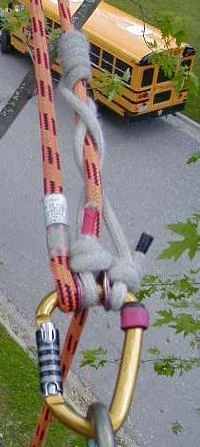
Adjustable bridge on Treemotion

I’ve looked at a recent accident where a Ropeman 1 severed (completely cut) 11mm LSK rope, when subject to (admittedly considerable) force. The device and rope combination were the primary attachment point (i.e. no back up). If you look through past postings, research documents and even the manufactures web site, the Ropeman 1 gets a lot of attention and comments. Whilst I could give a deeply technical appraisal (Laz 2 has covered most of the salient points) in my humble opinion it is not suitable to do any important (primary support role without back up) jobs in arboriculture (or on rock for that matter).
Best use for the Ropeman 1 is to haul your water bottle up the tree- however, if its more than a 1 litre bottle – back it up!

Frank 1
 
[ QUOTE ]
So, you suggest wearing it very low and tight on the legs?

[/ QUOTE ]

Yup, "How low can you go"
grin.gif
Not so tight that you get suspension trauma just by wearing it. Otherwise you'd be the first ever mentioned in the Irata files, and that with not even your legs hanging down
grin.gif
 
Since we have been discussing the correct use of bits of kit and forces and stuff, could one of you knowledgable folks remind me of the breaking strength of the little bridge on the back of a petzl fixe pulle, and what if anything, petzl say about using it.

I'm sure it has been dicussed here fully in past but I can't find it, and I have a new idea I want to share but need to check it out first.
 
I think the bridge isn't an attachment point, merely a connector of the two side plates. If it's used as an attachment point for one "leg" of the friction hitch, than you are loading it with only a quarter of the total "system weight" but you still don't know whether that's an overload when the [censored] hits the fan (I've used it though
blush.gif
).

Tell us Rupe, don't leave us in the dark, what's your plan.
 
I've used it for one leg of a friction hitch before and it works well and I feel safe on it.

My plan is different, still need a bit more info, I'm sure there is some research into this...maybe LAZ knows????

If the bridge is a connector for the two sides then theres no reason why it would be weaker than the two sides?
 
[ QUOTE ]
If the bridge is a connector for the two sides then theres no reason why it would be weaker than the two sides?

[/ QUOTE ]

I think there is.
In the first place there are two folds in the metal to curve the alloy towards the other side.
Second, there is a tiny hole in the middle.
Third, you are pulling on a flat plate (not curved like the CMI RP140).
Fourth you are not pulling in the appropriate direction of the metal (not in line, but over the flat plate).
IMO the little plate is there to keep the flexing forces on the axis to a minimum.
 
I see what your saying, but an exact breaking strength would be usefull...

anyway my little plan works, I've been climbing on it for a couple of days! Can't share till I'm happier with the safety aspect.
 
I believe it was Bruce Smith who made the announcement at the Nashville ITCC that upon describing this use of the 'becket' of the fixe, Petzl gave them the green light for use. Right from the manufacturer.
 
I'm pretty sure its strong enough Rupe. But that has never been my concern:

When undertaking the prusik research, the half double fihermans attaching the hitches to the krab cinched up so tight, they had to be cut off. I think I remember one hitch faiing at that point, though I'll have to check the reults table.

The reasoning that only 1/4 of the force is applied to the pulley, to me, isn't valid; the way the hitch grips the line and transmits force must vary.

My concern, observing how tight the knots become, are that the poor bend radius/sharp edge of the becket could sever a small cord easily. Couple this with poor resistance to flex fatigue of some high modulus fibres, and safety factors could be drastically reduced.

I prefer a removeable pulley for versatility with other set ups of my climbing system.

It would still be interesting to share though Rupe.
 
Mangoes wrote:

[ QUOTE ]
I believe it was Bruce Smith who made the announcement at the Nashville ITCC that upon describing this use of the 'becket' of the fixe, Petzl gave them the green light for use. Right from the manufacturer.

[/ QUOTE ]


Rupe wrote:


[ QUOTE ]
Now were talking!! Can anyone verify this?

[/ QUOTE ]


I don't remember that Bruce was the one who announced it, but, yes, some representative of Petzl did give a verbal, over the phone 'ok' about this use of the Fixe.
 
[ QUOTE ]
Yeah but your ovelooking the fact that the fixe is only rated at 22kn. It doesnt meet the min. standard for life support.

[/ QUOTE ]

You are referencing ANSI Z133.1-2006, which is a U.S. standard. Rupe is in the UK.
 
Since regional regs have been mentioned, in the UK we also have PUWER (Provision and Use of Work Equipment Regulations) and LOLER (Lifting Operations and Lowering Equipment Regulations) which state the importance of using equipment within its range of intended use i.e. Fit for purpose. Then there are the WAHR (Work At Height Regulations) which prefer a backed up system.

I don't think the Fixe was designed for this purpose, so if you wish to use it, check with the manufacturer. I wouldn't allow anyone who works for me to use it without approval from Petzl. They're unlikely to do that without tests. And even if they are happy with the break strength, there is the potential issue I mentioned.

At the end of the day, when running a system like we do in tree work that has no back up (justifiable more often than not), is there a safer option for similar performance? Will it make your work more productive without reducing safety factors?

I don't see the point in taking unecessary risks with unknown factors. I have done in the past, and i'm glad I got away with it to learn better.
 
Thanks for all the help..

Laz... I'm not using it for one leg of a friction hitch, so no worries about those points that you mention.

Mahk..."yes, some representative of Petzl did give a verbal, over the phone 'ok' about this use of the Fixe."...
..........thats good enough for me!!

Tophopper... 22kn is good enough for my slight frame!!

And finally,, FK, no I'm still not convinced by the hitch climber but have an idea for something similar..


I'll take some pictures tommorow.
 
So why do you need to secure the tres end to the tab of the pulley anyway? Why not just secure it to the biner between the cheek plates like this?
 

Attachments

  • 84110-frhitch.webp
    84110-frhitch.webp
    22.2 KB · Views: 183

New threads New posts

Back
Top Bottom