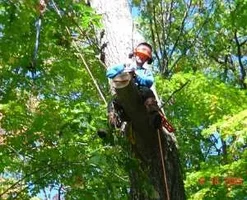
I often plunge or bore a top of a tree to ensure that I only have the holding I want. I do it quite regularly. Don't be affraid to experiment (sensibly) when the situation allows for it. It will make you more creative and accurate when needed.
Has anyone had a difficult time bore-cutting with an MS200T?
I bore-cut easily with my MS361 and MS460 but I need a lot of pressure to do it with the 200. Is it the low profile chain? I've tried different sharpening configurations to no avail. How about the Husqvarna 338? I have never used one but it has a narrower bar (top to bottom) and the tip is tapered more so than the MS200T. I've checked a few local saw shops for a similarly tapered bar that fits the Stihl but with no results.
[ QUOTE ]
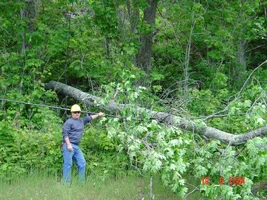
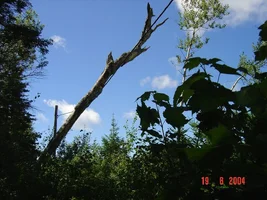
The attachment shows a typical wind throw that I topped out at a good lean.
They get bigger than that too!
[/ QUOTE ]
Kevin -- a bit off the topic, but I'm wondering how you got access to the top of the "wind throw" in your attached pic. Secure enough to climb "as is" or would you guy something like that first? Or is there a handy road nearby for a bucket truck?
Tom;
It was a sound tree, I climbed that one straight up from the ground and topped it.
Sometimes I can walk up the top side and top them.
Most of them usually come to rest on the messenger strand and sit pretty solid if they happen to come down near a pole.
The larger ones that come down mid span will take the messenger to the ground and have to be worked differently.
thanks for putting these lessons together. it's stuff that i have intuitively learned from experience, but you animations and explanations make things very clear.
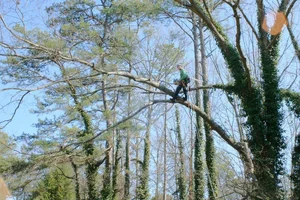
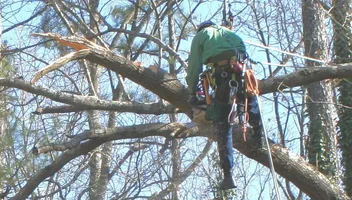
This was a long-reaching oak limb that I had the good fortune to get to play with. I was able to just drop it, no rigging.
I undercut it then made my topcut but there was so much weight that it ripped badly...which I thought it might. I may have offset my cuts too much...or not cut fast enough. I suspect that strapping would have made a difference.
I don't think I cut it fast enough...yes, there was a bottom cut...but I don't think I nipped the sides then. I have started since. It was a good lesson on what can go wrong...one of those practice things to see what might happen.
I use a triangular cut for that kind of limb. Two undercuts at 60 degrees to each other and as far in as you dare without trapping the saw. The top cut completes the triangle and the branch, hopefully pops off nicely. Speed is important for the top cut of course.
Rupe, I'd like to try your version one day. I use the 'box' cut on heavy horizontals.
1. Bottm cut deep as possible w/o pinching saw
2. Two side kerfs as deep as possible w/o pinching saw
3. Blow thru the top a kerf width back of the above, no hesitating
Almost always sends limbs down level and flat, out from the stem a fair bit too.