
A lesson in felling

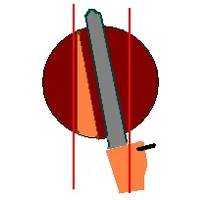
When cutting a tapered hinge run the bar up to the hinge on the angle of the taper from start to finish instead of cutting the felling cut square to the face then starting the taper late to prompt the tree to turn.
On large trees the holding wood can break much sooner than anticipated even with several inches of hinge wood leaving you without the necessary taper in the hinge.
 

Attachments

  • 57162-Alessoninfelling.webp
    57162-Alessoninfelling.webp
    3.6 KB · Views: 401
Good point i have had this happen a few times on some large trees. luckily i was more or less testing it out and had no targets, just ideal zones
 
Is this another way of saying it?

When using a tapered hinge the small taper is the compression wood, the thick taper is the tension wood.

You should cut into the compression side first, then your tension wood.

This guides the tree and prevents the bar from being pinched.
 
It doesn't relate to that, it's the start of the back cut.
I think most people would consider cutting a straight forward back cut up to the point where they would want to start tapering the hinge to turn the tree.
The problem with large trees is, even though there might still be six inches of hinge wood the hinge could begin to fail before you have a chance to taper the hinge.
What you're left with is a straight hinge and if you try and cut the remaining holding wood now to a taper in order to turn the tree you not only chance getting the bar stuck in the wood but you end up in a very dangerous position next to the tree while it's falling.
 
Well, get cracking, we want vids. we want vids. /forum/images/graemlins/grin.gif

Good soundtrack is important though.

Now, for all the smarties and there fancy big bars cutting those tapered hinges.

What about when your bar's too short?

Oh, by the way, I would consider it prudent practice to always maintain the taper right the way thru the back cut as it's usually to hold a side lean .... so the safest thing you can do is cut away the low side first and have more meat, the whole time, on the high side.
 
Mark;
In my view it would depend on the condition of the tree, lean and what the intended use for the logs would be.
Boring as everyone knows is good for relieving stress in heavy head leaners and fiber pull in saw logs but it wouldn't fit in here.
This would be a large tree with a large portion of the weight on one side or the other.
To compensate for the unbalance some choose to compensate by over gunning and use a tapered hinge.
The problem comes in when the hinge begins to fail regardless of being bored.
If you try and taper your hinge late in the cut the hinge may fail prior to starting the taper.
What you really should be doing is setting up the taper when you start your back cut and stay with it at an angle all the way through from start to finish so when the hinge fails you already have it set up.
This is a good rule for felling all trees when using a tapered hinge but more so for larger trees where more weight is present.
 
[ QUOTE ]
What about when your bar's too short?

[/ QUOTE ]

Are you having problems with the ladies again? /forum/images/graemlins/grin.gif

You need to get a longer bar, work both sides or use the tip of the bar from the back to reach the hinge all the way across.
I would prefer the longer bar so you can always stay on the high side for safety.
 
That is pretty good tip Kev; i always save enough backcut back; that i don't have this problem. But, i will certainly remember to recomend it to others for i can see where it could make a differance!

Setting up a trigger release is good and safer, but i really like just tickling (Gypo?) the wood away until she starts to go, then back out. i think staying with it like that gives better control; but cdertainly at higher risk.

Face and side cuts properly staged can help make up fer short bar, but a proper length bar for work is best for the all important aligning.

One of my running projects is Chainsaw Use; choosing "Felling Cuts" off of the menu takes you to plunge cuts etc. Will play full screen in window; pressing F11 giving even larger screen view; as Internet Explorer window menus are minimized at top, to leave more 'play area' below.
 
[ QUOTE ]
Boring as everyone knows is good for relieving stress in heavy head leaners and fiber pull in saw logs but it wouldn't fit in here.

[/ QUOTE ]

I understand what you are saying, but disagree a bit. You could achieve the same effect if you setup a tappered hinge to the "extra" thickness that you desire for the scenario. The tree won't move until you hit the right thickness, and it really won't matter if you hit it first or last. The only difference is it may be more difficult to predict the exact thickness needed, but with experience it can be done.
 
Mark;

I was thinking about this today and it hit me that I misunderstood what you were saying.
I get the drift that you intend on boring the tree and not the hinge to set up the hinge then cutting the strap of wood at the back to release the tree, is this correct?
 
Boring the hinge works when you have lots of hinge but too little and the bar gets caught in the compression of the wood on the face side of the hinge.
I've always liked using wedges and setting them as the tree favors the lay, if they don't set then it lets you know the tree isn't going over.
 
Kevin and Mark,
That is how I set up all of my tapered hinges. I bore cut to set up the tapered hinge the way that I want it and then proceed to bore out the back, leave a strap of wood and set wedges as needed.
I will use a wedge on the compression side too if there is a chance of pinching my bar.
 
Mark, what about boring big limbs?? Boring for felling cuts works well and seems pretty straightforward...But say you've got a big oak limb (14-16") growing at a 45 degree angle or maybe even closer to horizontal....the theory of using a boring cut to sever that limb safely , instead of a traditional backcut which you may not be able to cut through fast enough to prevent barberchairing, seems good. But actually doing it seems tough...put in a decently small box (quarter way), then the bore, but then there is so little room for both the hinge and rear holding wood to coexist, it seems real sketchy, like it might explode during boring. If you say don't bore it then, then we're back to making a trad back cut which might barberchair due to all the weight and limb angle. Of course we're talking sharp, well adjusted, highspeed saws for these cuts.
 
I've never had a problem with snap cuts on large limbs or trees that have failed and the tops are laying out and over the messenger wire by sometimes 25ft. or more.
What I use is a cinch strap around the piece that I'm on if I think it needs it but the tip usually just locks up on the bottom cut and then drops off with the saw running full tilt from the top side.
 
Cinch strap is a good idea, though sometimes the "stump" can barberchair. The particular instance I have in mind was when I was at full reach in the bucket and still a bit too short, didn't want to climb out to get more height etc. , the bore cut seemed sketchy for the above reasons, went with a regular backcut....the result was ugly.
 

New threads New posts

Back
Top Bottom