
A bad break

Roger,

Which face cut did you mean? I'll try to explain differently, or maybe it just doesn't make sense in the first place. There was one diagram where the text box took what looks like a facecut out of the tree. Its unintentional. Was it that, or some other one. I'll re-read the thread and see what I see.
 
[ QUOTE ]
Kevin, That's pretty much what Sean proposed. Whether the broken section separates or not, the force on the rigging and the gin pole spar will be intensified.

My suggestion (about 10 posts back) is better, methinx. It relies on the break being securely lashed together. Pull line attached at the break, and the tree faced and felled toward the spar tree. With slice cuts so it slides off. Minimal shock loading.

All methods require beefy rigging gear and a strong spar. Gord says he's going a different route. Sounds wild. No doubt he's up to it!!

Hope you get video Gord!!

[/ QUOTE ]

Roger,

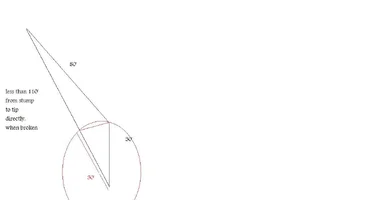
I think that to fell toward the gin pole spar would mean forcing the broken tree upward. The point at the break would have to follow the red arc.
 

Attachments

  • 204893-pushupwardasitrotates.webp
    204893-pushupwardasitrotates.webp
    13.5 KB · Views: 94
[ QUOTE ]
[ QUOTE ]
The fifth pic is how I left it on Friday, we just had a half day to work on it. If I had more beefy gear around I would consider rigging the whole piece but I really don't have the equipment to risk shocking the rigging with a piece that I guess is around 5k. Guying and chunking it down seems like the best option.

[/ QUOTE ]

If your gear isn't rated for the work you're doing, perhaps it can be configured to take more weight. If you make a dwt, your rigging block will take no more than the weight being rigged. But, a 2nd block is needed. The rope will be doubled so each leg experiences half of the load. But, 3 x's the length of rope is needed from the rigging point to the anchor point to lower the stem. More material to handle the load is better. The rigging point will be potentially 1.5 x's the load instead of a 2x's it. The load at the anchor point theoretically will be 1/2 the load.

More thought is needed to make it work without mishap, but you can get more from your gear if you use it properly.

It's a thought worth sharing.

Joe

[/ QUOTE ]


Joe, good technique to keep in the bag of tricks!
 
[ QUOTE ]
Man, I can't wait to see how it was done. Not to derail, but how would you guys propose handling the tree if the failure was in the root plate? We did a small doug-fir (16", 60-70') this year that had blown over and was leaning over into some healthy trees. We used a small crane to get it down, but I wondered what we would have done if we had to rig the tree.

[/ QUOTE ]

This is a good topic to discuss. Please start a new thread.

It will depend on whether the roots are completely broken, or only on the opposite-lean side. This is like a tree leaning on a house. What to do once you cut it down to just above the roof line?

If there is enough pressure from the remaining roots to push back up it will be different than if there is only very minor push-back, or completely broken roots.


So tempting to start into it, but I stopped.
 
Roger, not sure what doesn't make sense but if it is the saw cut on the compression side it's to eliminate wood pulling that hasn't already broke off.
It couldn't be safer than pulling the two apart from a good distance.
I agree that the rigging must meet or exceed the purpose but everyone here already knows that.
If something does fail then it's safe for the faller.
If you wanted to go one better then a temporary guy could be used on the spar until the back cut was complete but I don't see a need for it providing a sufficient hinge is left in place.
 
[ QUOTE ]
Roger, not sure what doesn't make sense but if it is the saw cut on the compression side it's to eliminate wood pulling that hasn't already broke off.
It couldn't be safer than pulling the two apart from a good distance.
I agree that the rigging must meet or exceed the purpose but everyone here already knows that.
If something does fail then it's safe for the faller.
If you wanted to go one better then a temporary guy could be used on the spar until the back cut was complete but I don't see a need for it providing a sufficient hinge is left in place.

[/ QUOTE ]

Kevin-

I was thinking a guy-line attached just below the break, run to a lowering device/ trunk wrap would be good to extend the escape window.


I also thought about cutting it such that if the face cut is at 3oclock, it could be bore cut leaving a thick backstrap.
Then cut away the more than half of the backstrap from the 12 oclock position leaving backstrap at the three oclock side. Cut trip the cut with a pole saw or the tip of a longer bar. Run down a well cleared escape path, like the one on the 12 oclock side in case it breaks free!


I think you suggested a kerf below the break to ensure that the break completely severs.
I don't see any concern about the break not completely severing during the fall. It seems like a situation that would want to pinch the bar. Maybe a sharp hatchet would be more appropriate.
 
Due to the extreme weight on the rigging I would want the saw cut, it's the wood that pulls off the outer inch or two that stalls the fall and adds to the weight on the rigging.
The cut needs only be two or three inches deep on a large tree like that.
Without the rigging I would just let it fly.
I've cut many off the utility lines like that and there isn't any huge risk involved and I've never had to secure a top.
Most will want to stay where they are due to the drag on the top.
 
Finished this up today as I had planned. It went well, spent a half day on it, plus six the other day with no crane time so the client was definitely pleased.

L9Zn1.jpg

This fir top was even worse than I had originally seen from the front side. The rot went down the stem for 25'. I temporarily evicted a few flying squirrels, woops. They came back soon after.

nvIkU.jpg

Highline tie in.

FZPub.jpg

Guying. The ropes at 2 o'clock and 8 o'clock go into two portys. We tensioned the lines with a tirfor. Then we ran the lines that run to the upper left back into the two tirfor jacks.

SbBpm.jpg

When I had chunked it down as far as the side-guys, we slowly released tension on them at the same time and it stayed steady so I got rid of them.

p2GP9.jpg

When I got it down to the guy at my feet we detensioned it and it stayed steady so I got rid of that last guy and chunked it down to the break and left it there. I had a few ratchet straps around the break that you can see.

WigIV.jpg

All down and done, bridge still in good shape.

Thanks for everyone's input on this one.
 
Great work, Gord!!

I can see why my idea of taking it whole was risky, due to the lack of integrity of the fir, and the proximity of the footbridge. And the fact that it was several feet away from the fir trunk.

I guess, with all the guys in place, the strapping around the break, and the highline, that you pretty much eliminated the risk of being on it whilst chunking it down.

That said, it still had to be a thrill!!
 
Nice work, Gord.

The skyline TIP sure must add a degree of comfort.

I'm impressed that it stayed so stable. It looked like it would have been teetering on the break.
 

New threads New posts

Back
Top Bottom