A bad break

thanks Gord for adding the pictures!

most people don't follow up and post them.


did you finish it?

I'm confused.

foot bridge didn't look like much.

an idea; stay on the hemlock spar, rig the broken section into the weak fir tree, cut the whole freakin thing at or near the break and let it run to the ground. It would come off, despite what Daniel said. ha ha.

You will be in a safe place.

if groundmen let it bump into the footbridge, repair the few peices of lumber...

just a thought I had after having a few beers on a Friday night.

i hope all went well.
 
[ QUOTE ]

an idea; stay on the hemlock spar, rig the broken section into the weak fir tree, cut the whole freakin thing at or near the break and let it run to the ground. It would come off, despite what Daniel said. ha ha.

You will be in a safe place.

if groundmen let it bump into the footbridge, repair the few peices of lumber...

[/ QUOTE ]

Yup....As long as Gord is working off that awesome skyline. Also, a pull line could be used just above his cut to help nudge the butt away. Face cut on top, backcut from underneath, as a slice cut, so nearly vertical.

However, I think this would be safer: Use that same pull line tied at the break, but above and below. Then, at the ground face the butt toward the lean (and fir it's hung in), and cut the back. Winch it over. Perhaps the ragged sections of the break cut away to act like a face cut, giving room for the closure than would occur as the tree is winched over.

The above would work if the fir is strong enough (Gord wasn't sure) and the rigging lines as well.

The largest hung tree I've done was a 150-160 foot fir that was 36 or so on the butt. But it was lodged in a beefy fir, at a 45 degree angle. Had another line rigged from near the stump in another large fir and tied at about 70 feet. GRCS on butt, Hobbs on top. Then, cut it off at the butt, and worked off blocks till it was straighter.
Bigger than Gord's tree, with huge weights, but a lot simpler.
 
So, did you get it done, Gord?

This was a great thread to read (I just spotted it) Lots of good ideas, for sure.

But I'm not sure I like your idea...if I understand what you said...

Was it this: Two side guys, then winch the broken section till its out of the fir? OK, now it has four lines on it? While you chunk it down, still attached to the skyline....and I assume with a breakaway lanyard?

I reckon that could work.....but if Xman's idea...and my additions to it are workable, would they not be as safe?

I'm glad you're doing it sans crane, as the access didn't sound good, nor did the 55' rip cuts, lol!
 
[ QUOTE ]
Jamin,
Having a climber makin a cut at the break, with all that weight still above is going to be tough and dangerous.. When a tree is hung at that angle, all the weight of the top is going to push right back into the cut, most likely pinching the saw well before the pice is free, and that is pretty uch no matter how you cut it, though there is a bore cut that might work.. Its hard enough to make on the ground though... ANyhow even once the pice comes free, there will be a tendency for it to push back over the standing trunk and righty into the climber's lap... It would be nearly impossible to lift all that weight with rope and tackle, to keep the top supported...

[/ QUOTE ]

Agreed, but it could be done. See my post above

[ QUOTE ]
I wonder if you could brush out the top and get a block and rope or two set up to control the top, then come down and lash the two pices together above and below the break, and set a pull line, and then come down and notch the tree at the base, gun (aim) the face away from the lean of the top.
When she goes let the top run' til the but hits dirt. So if there is room on the backside to drop the 30' stick, you might consider that.


[/ QUOTE ]

Again, see my post above. Your method would mean a lot more weight coming onto the rigging. Mine less, as it would fall much straighter down. Either way, the fast action with heavy loads could spell trouble if the wraps on a capstan were to lock up...it's been known to happen! However, if it was chained or lashed above and below the break, there would be much less radical shock loading, as the drop would be slight
 
Man you guys are impatient! Gord is probably not even getting to that job yet this morning. It is only 8:25 in the morning here on the west coast.

I think after seeing what he has to work with that Gord's rigging plan is really good. Looking forward to seeing pics. When he is done with the tree.
 
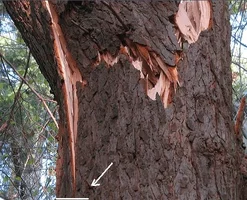
The fifth pic is how I left it on Friday, we just had a half day to work on it. If I had more beefy gear around I would consider rigging the whole piece but I really don't have the equipment to risk shocking the rigging with a piece that I guess is around 5k. Guying and chunking it down seems like the best option.
 
If there has been any significant damage to "strong" tree, could it be sacrificed by ground felling it in such a way to avoid damage to bridge and such if it is in a "natural" area.

or, and unlikely idea maybe.


What is the chance of guying the strong tree several ways. Rigging the broken trunk, strip the limb from whole tree. Leave top to maintain force on good tree as it slides down.

, rigging the whole tree, and slowly "walking it down" from the ground, so that the ground holds most of the weight each time the piece drops. Of course the break is an X-factor.

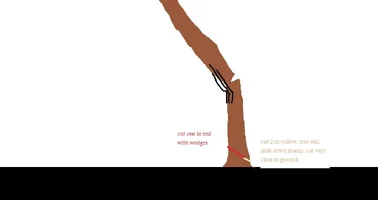
The force on the trunk will be on the underside of the break. Since GB suggested his method of bolting chains to reinforce the corners on a tree, I've wanted to incorporate this.

The break could break completely free and the tree will drop 30', possibly farther if it goes into the ravine. Ropes would have to be run in a co-ordinated fashion between the ropers, which could be tough.


Probably not the most predictable idea.
 

Attachments

  • 204697-walkdowncutone.webp
    204697-walkdowncutone.webp
    12.3 KB · Views: 130
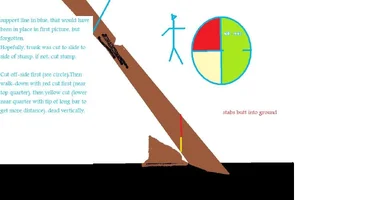
second cut, and successive cuts.

Ground will bear lots of weight.

Maybe a whole bunch of marls down the trunk, along with rachet straps in place of the chain idea.
 

Attachments

  • 204700-walkdownsecondandsuccessivecuts.webp
    204700-walkdownsecondandsuccessivecuts.webp
    40.1 KB · Views: 111
One method I would consider (if there's room) is to rig the top and pull the bottom away from it at a safe distance then lower the top to the ground.
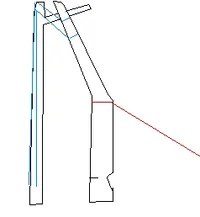
The break looks like it's only being held with end bind.

204799-Gordstree.PNG
 

Attachments

  • 204799-Gordstree.webp
    204799-Gordstree.webp
    3.3 KB · Views: 56
[ QUOTE ]
The fifth pic is how I left it on Friday, we just had a half day to work on it. If I had more beefy gear around I would consider rigging the whole piece but I really don't have the equipment to risk shocking the rigging with a piece that I guess is around 5k. Guying and chunking it down seems like the best option.

[/ QUOTE ]

If your gear isn't rated for the work you're doing, perhaps it can be configured to take more weight. If you make a dwt, your rigging block will take no more than the weight being rigged. But, a 2nd block is needed. The rope will be doubled so each leg experiences half of the load. But, 3 x's the length of rope is needed from the rigging point to the anchor point to lower the stem. More material to handle the load is better. The rigging point will be potentially 1.5 x's the load instead of a 2x's it. The load at the anchor point theoretically will be 1/2 the load.

More thought is needed to make it work without mishap, but you can get more from your gear if you use it properly.

It's a thought worth sharing.

Joe
 
Kevin, That's pretty much what Sean proposed. Whether the broken section separates or not, the force on the rigging and the gin pole spar will be intensified.

My suggestion (about 10 posts back) is better, methinx. It relies on the break being securely lashed together. Pull line attached at the break, and the tree faced and felled toward the spar tree. With slice cuts so it slides off. Minimal shock loading.

All methods require beefy rigging gear and a strong spar. Gord says he's going a different route. Sounds wild. No doubt he's up to it!!

Hope you get video Gord!!
 
Man, I can't wait to see how it was done. Not to derail, but how would you guys propose handling the tree if the failure was in the root plate? We did a small doug-fir (16", 60-70') this year that had blown over and was leaning over into some healthy trees. We used a small crane to get it down, but I wondered what we would have done if we had to rig the tree.
 
[ QUOTE ]
Man, I can't wait to see how it was done. Not to derail, but how would you guys propose handling the tree if the failure was in the root plate? We did a small doug-fir (16", 60-70') this year that had blown over and was leaning over into some healthy trees. We used a small crane to get it down, but I wondered what we would have done if we had to rig the tree.

[/ QUOTE ]

hm... glad you mentioned that. We've done quite many like that over the years, maybe 1/5 of those jobs video taped. Each one a little different, that would make a cool short video. a compilation of uprooted and broken tree removals, i put a note about this in my video box.

A big Tulip tree removal, tree was maybe at a 45 degree, uprooted and in another tree in neighbors yard; we pulled it somewhat upright with ropes and i peiced it out and roped it down like a regular removal, just had to stay away from the guide ropes.

most, we just secure and my rule is always to trim off every bit of weight first that isn't helping to hold the tree up. That's the most important. many times you'd be suprized how well it stands up after extra weight is cut off.

but every uprooted or broken tree is a little different.

thanks for the video idea!
 
It looks like toast from the picture but I would want a kerf on the compression side where the wood is attached.
A little lower than in my picture.

204860-Gordstree2.PNG
 

Attachments

  • 204860-Gordstree2.webp
    204860-Gordstree2.webp
    78.3 KB · Views: 41
Why, Kevin? Makes no sense to me. Nor did Sean's portrayal of a face cut. Risky for Gord to make such a cut as well.

I'd want the area as solidly lashed as possible, prior to pulling if over, preferably in the direction I suggest.
 

New threads New posts

Back
Top Bottom