A bad break

Thanks for the drawings and suggestions, they'll be helpful.
I have done similar hangups a bunch, but this one is just a bit bigger, heavier, taller, etc than most.
I'll have to get the brush off before I can really see what can be done. I couldn't tell from the ground how far away from the main stem the broken top is hung up or what diameter of limb is on leaning on. Also, the second tree I mentioned isn't tall enough to be any use in lowering or as a TIP, at least for the upper portion.
 
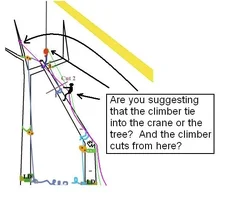
David. I'm wondering where the climber is for the second cut. Would you suggest he tie into the crane or the tree?

(I modified your illustration)

204459-GordJob2.jpg
 

Attachments

  • 204459-GordJob2.webp
    204459-GordJob2.webp
    24.6 KB · Views: 75
If i'm making that second cut i'm tied in as high to the standing tree as i can with a redirect out as far as i can. Then i would us a second tree behind as a second tie in point even if its not high. That way you can make your cut with out having to lanyard in (but still have two points of attachment) And as i finish the cut or the piece starts to go i can exit the area by swinging to my second tie in point, controlled by the first point.

Probably a bad explanation, not sure how to using the drawings you guys do. Maybe someone with a Mac con tell me where to find a drawing program (then ill do my best to draw what i explained)
 
get some ropes blocks and port-a-wraps and butt tie it as much as you can. Then if you can get 2 cranes or one and a lift hold the tip in 2 big crane sling then take a block and sling out with you in the lift and work your way into the stem small pieces the crane just holds tension to take any bounce out of the tree no lifting. With 2 slings you leapfrog them in towards the trunk so you always have a hold on it. If you can cut and drop any still go small and smooth.

As for slabing off vertical blocks I'd personally keep my trunk integrety if you sice it down a bit to far it could buckle mid system and then your screwed. Good luck be safe let us know what happens.
 
One other thought with the crane and the tree use lots of blocks big ropes and portys is ginning a posability?
 
[ QUOTE ]
David. I'm wondering where the climber is for the second cut. Would you suggest he tie into the crane or the tree?


[/ QUOTE ]

Which ever is best in the real world situation.

I know that you aren't supposed to be tied into the crane with a load on it. But if the load is very light and it's safer to be on the crane then I say do what is safest, no matter what OSHA or anyone says. I've done it.

In that diagram, either one looks okay, but if tied into the tree and worried about smacking into it too fast then do what countryboy said (explained well).

...but sometimes it might be good to swing to the tie in tree fast...

Sometimes, I've tied into the crane and a tree at the same time.

no load on the crane though. crane couldn't reach far enough for a good tie in, so i tied into another tree too.

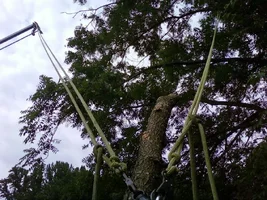
the removal was a black cherry that was uprooted and got caught by another tree.
 

Attachments

  • 204473-LizanneSmithuprootedcherry1.webp
    204473-LizanneSmithuprootedcherry1.webp
    163.7 KB · Views: 136
[ QUOTE ]
Thanks for the drawings and suggestions, they'll be helpful.
I have done similar hangups a bunch, but this one is just a bit bigger, heavier, taller, etc than most.
I'll have to get the brush off before I can really see what can be done. I couldn't tell from the ground how far away from the main stem the broken top is hung up or what diameter of limb is on leaning on. Also, the second tree I mentioned isn't tall enough to be any use in lowering or as a TIP, at least for the upper portion.

[/ QUOTE ]

sounds like a real bugger....
 
i was in a rush this morning...

if the spar might be unstable, before you move the rope down the spar on the cut #2 picture... if the rope is holding it in place, you might have to add a second rope in the holding tree for the second cut either in order to hold it temporarily while you move the first rope or whatever...

disclaimer: if anyone gets killed because of my diagrams, I am not at fault, every situation is different and I was simply going by a drawing submitted.
smirk.gif
 
[ QUOTE ]
Which ever is best in the real world situation.

[/ QUOTE ]

True.

[ QUOTE ]
I know that you aren't supposed to be tied into the crane with a load on it.

[/ QUOTE ]

I can't find where to cite this, but my understanding is this; You can be tied into the crane, with the load, as long as the load isn't greater than 50% of the lift capacity.

Some one feel free to correct me on that.
 
[/ QUOTE ]I know that you aren't supposed to be tied into the crane with a load on it. But if the load is very light and it's safer to be on the crane then I say do what is safest, no matter what OSHA or anyone says. I've done it.


[/ QUOTE ]

It IS OK to be tied into and work off the loadline if there is no other alternative, but the capacity of the crane for it's current configuration is reduced 50% (according to the ANSI Z). So, if the crane can lift 3,000 lbs. at it's current configuration, the load is reduced to 1,500 lbs. I've done it 3 times now. I go even lower than 50%.
 
Jamin,
Having a climber makin a cut at the break, with all that weight still above is going to be tough and dangerous.. When a tree is hung at that angle, all the weight of the top is going to push right back into the cut, most likely pinching the saw well before the pice is free, and that is pretty uch no matter how you cut it, though there is a bore cut that might work.. Its hard enough to make on the ground though... ANyhow even once the pice comes free, there will be a tendency for it to push back over the standing trunk and righty into the climber's lap... It would be nearly impossible to lift all that weight with rope and tackle, to keep the top supported...

I wonder if you could brush out the top and get a block and rope or two set up to control the top, then come down and lash the two pices together above and below the break, and set a pull line, and then come down and notch the tree at the base, gun (aim) the face away from the lean of the top.
When she goes let the top run' til the but hits dirt. So if there is room on the backside to drop the 30' stick, you might consider that.

Probably be good to plunge cut the backcut and leave a significant distance on the snap cut (as per the siberian elm removal video), so the cutter can get away fom the DZ prior to calling for the pull.

Just a thought.. sounds like a challenging tree. BE Safe..
 
Gord stated that it was going to be Friday. Its Friday. Let's just all hope for the best at this point, as he may be mid-removal. It'll be interesting to hear and hopefully see how he pulled it off.
 
[ QUOTE ]
Jamin,
Having a climber makin a cut at the break, with all that weight still above is going to be tough and dangerous..

[/ QUOTE ]

Daniel. You missed the part where I said that the butt end would be pulled off with a rope (winch or GRCS would do the trick). In the illustration, the butt end could be pulled away from the climber (towards the viewer of the illustration). And I'd cut with the bottom quadrent of the tip of the bar...

FTR. Nothing about this situation is safe...
smirk.gif
 
Looks tricky Gord, but with your experience and the amount of focus you are giving it, I am sure that you will be good to go for this. If it helps, I would suggest slinging the top with the crane, rigging the spar below where you know the crane can support with DWT and then cut the top out. This gives you twice the pulling power to pull slack out plus giving the extra added strength or two parts of rope to support it. Then you just come back and rig it again with the crane and see how it comes up. If it gets too heavy you can just readjust with a second set of rigging and try again. Make sense?
 
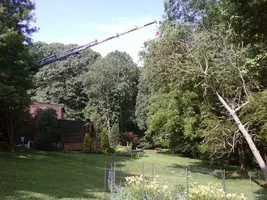
Thanks Mark. I went there today, went up the main tree that the broken Hemlock is hung into to get a look at what the weight is on and what I've got to work with. From the ground, as you can see in the first pic, not a whole lot was visible. The tree that is mostly supporting it is a an old fir, topped at least twenty years ago at about 100' up. Now the old topping site has rotted so far down that the entire upper stem has recently started to split, possibly because of the Hemlock falling onto it. So not a good candidate to rig or work off of, more work later on I suppose. So I set up a highline over the entire mess and brushed out as much as I could. Careful cutting, as there are about twenty limbs that are loaded heavily and are likely crucial to the piece not falling. The stem of the hemlock rests on a fir limb that I don't think would support the entire force of the lean.

5zKmg.jpg

Can't see much, the footbridge is just visible at the lower right.

gzLIC.jpg

The break. There may have been a little sap rot on back side of the break, but not much if any. This is why I hate Western Hemlock.

xEznm.jpg

The fir that the hemlock is leaning into. Arrow shows the hemlock stem.

GdhVq.jpg

Looking up from the footbridge.

dBcOZ.jpg

Looking up from the break after cutting off the brush. The skyline unweighted is at 110'.

Pqann.jpg

It's hard to get a pic that really depicts the whole thing.


I think what I'm going to do is set two guys about 2/3rds of the way up the span and tie them perpendicular to the lean to minimize side to side movement. Get a few beefy ratchet straps immediately below the break to support the strip of wood from splitting down. Then two tirfor jacks to pull directly back against the lean, raise it up just so it comes light and chunk it down airmail style as there's a good drop spot. Chunk it down to the back guy, then set a second one ten feet or so down, tension it, slack the upper one, repeat etc.

Thanks for all the rigging ideas, but I think this route seems best with what I've got to work with.

 
[ QUOTE ]
This is why I hate Western Hemlock.


[/ QUOTE ]

x2. Sounds like you have this nasty things tamed. Hope you get paid handsomly.
 

New threads New posts

Back
Top Bottom