













Anyone have any actual issues doing this over time? Not looking for theoretical objections but would appreciate anecdotal info for or against. About to buy a new rigging rope and I think this is my first choice but we use our 1/2" blocks frequently. Thanks in advance!
Navigation
Install the app
How to install the app on iOS
Follow along with the video below to see how to install our site as a web app on your home screen.
Note: This feature may not be available in some browsers.
More options
You are using an out of date browser. It may not display this or other websites correctly.
You should upgrade or use an alternative browser.
You should upgrade or use an alternative browser.
9/16" Sirius in 1/2" Blocks
- Thread starter Njdelaney
- Start date

Chris Schultz
Carpal tunnel level member
- Location
- Minturn
I feel like a 9/16” rope under tension shouldn’t affect a 1/2” capacity pulley…. That’s just me though. I think if you’re operating within the safe WLL of all pieces in the equation that is.


Serf Life
Been here much more than a while
- Location
- Maine Island
What 1/2” blocks? Never tried so no input just curious

Muggs
Been here much more than a while
- Location
- Canuckistan
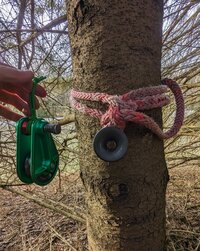
The ISC RP050 is rated for 1/2" rope. The Pinto pulley is rated for 9/16". Here they are side by side.
I often feel that the standard answer to any gear question "just follow manufacturer recommendations" is a bit of a cop-out. It's obviously the safest, most vanilla answer. It challenges no one. It offends no one. It also helps no one, because everybody already knows it. But how much of manufacturer recommendations are based on objective facts, and how much are based on subjective boardroom opinions? How can you know if the manufacturer is pushing the limits of what is possible, or being safe and conservative?
To the original question, I use 9/16" in 1/2" blocks quite a bit without issue (but not omni-blocks). Then again, it's only in overhead rigging. I use rings for all my negative rigging. As always, "follow manufacturer recommendations"
I often feel that the standard answer to any gear question "just follow manufacturer recommendations" is a bit of a cop-out. It's obviously the safest, most vanilla answer. It challenges no one. It offends no one. It also helps no one, because everybody already knows it. But how much of manufacturer recommendations are based on objective facts, and how much are based on subjective boardroom opinions? How can you know if the manufacturer is pushing the limits of what is possible, or being safe and conservative?
To the original question, I use 9/16" in 1/2" blocks quite a bit without issue (but not omni-blocks). Then again, it's only in overhead rigging. I use rings for all my negative rigging. As always, "follow manufacturer recommendations"
Attachments
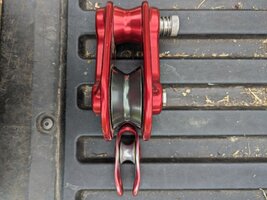
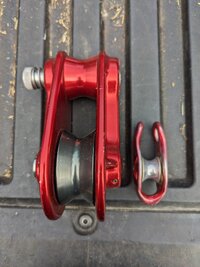
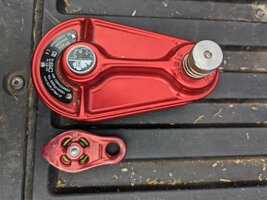
Last edited:

Treetopflyer
Been here much more than a while
- Location
- Coastal N.J
So you’ve worked a tree down to the wood and send down a perfectly good block to replace with a ring for wood , why?The ISC RP050 is rated for 1/2" rope. The Pinto pulley is rated for 9/16". Here they are side by side.
I often feel that the standard answer to any gear question "just follow manufacturer recommendations" is a bit of a cop-out. It's obviously the safest, most vanilla answer. It challenges no one. It offends no one. It also helps no one, because everybody already knows it. But how much of manufacturer recommendations are based on objective facts, and how much are based on subjective boardroom opinions? How can you know if the manufacturer is pushing the limits of what is possible, or being safe and conservative?
To the original question, I use 9/16" in 1/2" blocks quite a bit without issue (but not omni-blocks). Then again, it's only in overhead rigging. I use rings for all my negative rigging. As always, "follow manufacturer recommendations"
Muggs
Been here much more than a while
- Location
- Canuckistan
Treetopflyer
Been here much more than a while
- Location
- Coastal N.J
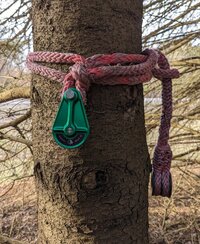
Hey that a quick changeover via photo,  so I say whatever floats your log !
so I say whatever floats your log !
Treetopflyer
Been here much more than a while
- Location
- Coastal N.J
I guess you stunned me when you said all your negative riggingBecause rings are smoother than blocks for negative rigging.
just seems like a waste of time for all occasions
usually my rope guy working with now is smooth as hell on whatever we rigging off so don’t notice
He has both the block and rings on the same sling. You can see the ring over to the right in the first picture.Hey that a quick changeover via photo,

Stumpsprouts
Been here much more than a while
- Location
- Asheville
The orange Sirius is 14MM, 9/16 = 14.3MM.
I used that particular rope for years on an Omniblock 2.6 which is rated up to 13MM.
I prefer not to use an omniblock with that rope anymore as a terminal rigging point, just bc there’s other blocks that work great and are appropriately rated. If it’s a redirect block I wouldn’t hesitate to use it.
A block rated for 1/2” is up to 12.7MM.. I dunno that seems like pushing it to put a 14MM rope in it. Certainly pushing it to put a 9/16 rope in it.
I used that particular rope for years on an Omniblock 2.6 which is rated up to 13MM.
I prefer not to use an omniblock with that rope anymore as a terminal rigging point, just bc there’s other blocks that work great and are appropriately rated. If it’s a redirect block I wouldn’t hesitate to use it.
A block rated for 1/2” is up to 12.7MM.. I dunno that seems like pushing it to put a 14MM rope in it. Certainly pushing it to put a 9/16 rope in it.
Treetopflyer
Been here much more than a while
- Location
- Coastal N.J
Yes I did see it. I just don’t like the use the words all or never in rigging or much other stuff although I’m sure everyone uses these terms loosely, time to time . He said he negative rigs on all rings, guess I was getting bit picky lolHe has both the block and rings on the same sling. You can see the ring over to the right in the first picture.
It’s a cool set up in the pictures.
I’m all about versatility and options! I like the side plates on a block for protection of the rigging line if I see a possibility for the ring to align in a direction that could pinch or squeeze , burn the rigging line ..all things I saw happen in certain instances. Could I pinch or worse severe a line with the side plate on a block too , maybe if I don’t rig carefully. Probably why manufacturers say certain size line as opposed to another .. The best point I can try to make is the variable and tolerance can be so great in this business I can’t say I do this or that too often to traditionally. I do rig usually with a rope that matches my block size but I’ll half inch line larger block with a beast ring and don’t think to hard on that. Would I one off negative rig with a 9/16 rig line on a1/2 inch pulley sheave? Not as a practice as per the norm , in situation we don’t have all kit needed for the job …okay. That’s me, I may not go as big with the pieces because I dunno if that’s gonna prematurely wear the line or “microslice”rope fibers decrease in strength over time as the rope furiously changes its form weighted rapidly as the pieces in its clutches get engaged once set free on the sheave of the pulley? I’m sure you’re already weighed that all out in your mind and thus a question to the buzz for evidence from other? If it doesn’t come on this particular question. I’d suggest low and slow with close eye on the action point does it look like the rope sits well in its place without bulging over side of pulley wheel or pinching in the side plates.
Muggs
Been here much more than a while
- Location
- Canuckistan
@Treetopflyer I use rings for *most* of my negative rigging, and mostliest most of my serious, heavy negative rigging. I do indeed use language too loosely on the internet, a habit meant neither to confuse or offend. My apologies.
Treetopflyer
Been here much more than a while
- Location
- Coastal N.J
I hear you man , no apologies necessary in my humble opinion at least to me.. As an aside I have had rings with large weights and small come to think of it turn and burn some nice ropes in negative riggings situations so I like the protection blocks provide the rigging line on certain spars. I’m a huge proponent of ring rigging usually if going that route in negative rigging situations I’ll have them strapped on the piece I’m removing in double whip fashion with impact block on tree if we’re in serious heavy wood. We have many urban oaks around here, they are basically the most dense wood I work with regularly.@Treetopflyer I use rings for *most* of my negative rigging, and mostliest most of my serious, heavy negative rigging. I do indeed use language too loosely on the internet, a habit meant neither to confuse or offend. My apologies.












New threads New posts
-
test
-
 Free CEUs: February 05 & March 05 - 'Urban Forestry Today' Webcasts @ Noon (Eastern)
- Started by UFT
- Replies: 0
-

-

-
-
-








