24" on a 550XP mk2

@Barc Buster Perhaps you have something to show evidence to conventional wisdom.

Are we discussing cutting cants or real world cutting?
I doubt there is anything I can post that will change anyone’s deeply held belief. Part of the problem is it is difficult to get quality pictures of the chain tooth.

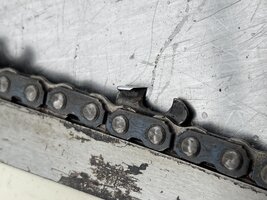
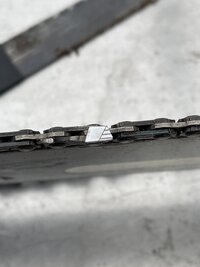
My experience has been as a tree guy cutting typical yard trees. With a mix of clean aerial wood and dirty ground wood. If your square chain is dulling faster than round chain it’s because the top plate angle and down angle are too aggressive. Best I’ve got while I’m working. This is a standard work grind done on an off the shelf Simington grinder. It will hold up at least as well as round. I encourage folks to check out the chain section over on ope forum.IMG_3689.jpegIMG_3690.jpeg
 
It’s a pretty well established fallacy. I’ve been using square ground chain for a couple decades. My experience has been the opposite. I’ll stand by my above statement. Maybe check out some knowledgeable chain builders and educate yourself.
As a young man I as very fortunate to work with some of the best loggers to ever walk gods green earth. Most, if not all, ran square when falling, and ran round when working on/around the landing because the round held an edge longer than square when cutting dirty and less than pristine wood.

The notion of the hundreds of years of combined knowledge/experience that these men possessed being nothing more than a "fallacy" makes me very sad indeed.
 
Last edited:
I have run a hell of a lot of square ground chain. I know how to sharpen square grind. Been doing it a very long time. Anyone who tells me it stays sharp as round grind... I'm not listening because they are living in some dream world.
Might come close if you are cutting soft woods free from dirt and grit, but put them to use in the real world and a round grind will outlast a square ground every time.
Not buying it one bit.
 
As a young man I as very fortunate to work with some of the best loggers to ever walk gods green earth. Most, if not all, ran square when falling, and ran round when working on/around the landing because the round held an edge longer than square when cutting dirty and less than pristine wood.

The notion that the hundreds of years of combined knowledge/experience that these men possessed being nothing more than a "fallacy" makes me very sad indeed.
Since it’s story time I’ll tell you one in return. My mom always used to cut the end off the ham when she would bake it. I asked her why she did that. Her reply was because your Grandmother used to do it that way. When I asked my grandmother why she did it that way she told me it was because the ham wouldn’t fit in their stove back in the day.

Here’s the problem it gets swept into an overly simplified generalization of

“square will wear out faster than round.”

Of course you can make square cut real fast and wear out faster than round. I can make round cut real fast and wear out real fast too. It’s all about the angles. A properly work ground square chain will cut faster than stock round and last longer too even in dirty wood. Notice the witness mark on the converted stock Oregon chain in my picture vs. the angle of the top plate.

I learned from some of the best loggers in my area too and they ran square for everything. Does that make the loggers I learned from better than the ones you learned from? Nonsense! For you to sit there and tell me that your loggers are somehow better than the loggers I learned from is more nonsense dude and has nothing to do with any measurable evidence on this subject. It’s a nice story but where are your facts? What angles where they sharpening their chains to? I’m guessing they were hand filing and their angles were on the aggressive side.

The simple fact of the matter is the statement that square ground chain wears out faster than round chain is a sweeping generalization and a fallacy.
 
Last edited:
I have run a hell of a lot of square ground chain. I know how to sharpen square grind. Been doing it a very long time. Anyone who tells me it stays sharp as round grind... I'm not listening because they are living in some dream world.
Might come close if you are cutting soft woods free from dirt and grit, but put them to use in the real world and a round grind will outlast a square ground every time.
Not buying it one bit.
I’ve run a hell of a lot of square ground chain here in the Midwest too and I’ll state again my experience has been the opposite. The chain in my picture is converted stock Oregon LGX. I will run it round before I convert it. I get maybe a 10-15 tanks out of it before it’s dull. Sometimes less sometimes a little more. The square chain in the picture has had a couple dozen tanks run on it and it’s about ready to be sharpened. I’m not particularly special or doing anything out of the ordinary. But I can assure you I’m most certainly not living in a dream world.

This place is a great resource for all things arborist but there are way better sources for chainsaw and chain info maybe take the time to learn something new.
 
Since it’s story time I’ll tell you one in return. My mom always used to cut the end off the ham when she would bake it. I asked her why she did that. Her reply was because your Grandmother used to do it that way. When I asked my grandmother why she did it that way she told me it was because the ham wouldn’t fit in their stove back in the day.

Here’s the problem it gets swept into an overly simplified generalization of

“square will wear out faster than round.”

Of course you can make square cut real fast and wear out faster than round. I can make round cut real fast and wear out real fast too. It’s all about the angles. A properly work ground square chain will cut faster than stock round and last longer too even in dirty wood. Notice the witness mark on the converted stock Oregon chain in my picture vs. the angle of the top plate.

I learned from some of the best loggers in my area too and they ran square for everything. Does that make the loggers I learned from better than the ones you learned from? Nonsense! For you to sit there and tell me that your loggers are somehow better than the loggers I learned from is more nonsense dude and has nothing to do with any measurable evidence on this subject. It’s a nice story but where are your facts? What angles where they sharpening their chains to? I’m guessing they were hand filing and their angles were on the aggressive side.

The simple fact of the matter is the statement that square ground chain wears out faster than round chain is a sweeping generalization and a fallacy...

Imagine my surprise when I discovered that Madsen's doesn't know their ass from their elbow when it comes to saws and chain?

Frequently Asked Questions

Q: Does square ground chisel chain outperform round-ground chisel chain?

A: If cutting efficiency is what you are after, the answer is: yes. On most pro saws, square ground chisel chain will cut 10% to 15% faster than round ground chisel chain. Its sharp angles sever wood fiber more efficiently that any other type of cutter tooth. But, if maximum stay sharp ability and ease of filing are objectives, the answer is: no. Chisel chain dulls easily and is the most difficult to sharpen.

 
Imagine my surprise when I discovered that Madsen's doesn't know their ass from their elbow when it comes to saws and chain?

Frequently Asked Questions

Q: Does square ground chisel chain outperform round-ground chisel chain?

A: If cutting efficiency is what you are after, the answer is: yes. On most pro saws, square ground chisel chain will cut 10% to 15% faster than round ground chisel chain. Its sharp angles sever wood fiber more efficiently that any other type of cutter tooth. But, if maximum stay sharp ability and ease of filing are objectives, the answer is: no. Chisel chain dulls easily and is the most difficult to sharpen.

I’ll agree Madsen’s isn’t always that reliable. My Silvey razur sharp II was purchased from them though. Sure wish Silvey still made that machine.

Again no mention of cutter angles? Are we talking stock off the roll square in the above example? Or something else versus what kind of round? 3/8, .325 or .404? Full chisel round versus square or something else? Lots of variables and details not being discussed in this generalization.

Look I’ve left enough breadcrumbs for anyone who cares to learn something new to do so. Whether you do or not is up to you Erik. I’ve had my say and wasted enough energy on this subject.

 
i will use round chain when it‘s dirty wood time because i‘m faster at filling it on the jobsite. for filing my square chain‘s i prefer a vice and good lighting.
When I need to touch square up in the field I like to wedge the end of a little plastic saw maintenance brush under the chain and make sure the tension is as tight as possible. But yeah preferably sharpening is done back at the shop.
 
You can increase the top plate angle to 15 degrees and it will stay sharper longer, but that decreases the cutting speed of the chain, which is why you use it in the first place. Might just as well run round grind if you are going to do that.
Sounds to me like the people who are playing with the top plate angle and getting the life of a round grind chain are wasting their money and time on square ground chains.
My 2¢ on this subject. But each to their own.
 
You can increase the top plate angle to 15 degrees and it will stay sharper longer, but that decreases the cutting speed of the chain, which is why you use it in the first place. Might just as well run round grind if you are going to do that.
Sounds to me like the people who are playing with the top plate angle and getting the life of a round grind chain are wasting their money and time on square ground chains.
My 2¢ on this subject. But each to their own.
Nope try again.
 
I learned from some of the best loggers in my area too and they ran square for everything. Does that make the loggers I learned from better than the ones you learned from? Nonsense! For you to sit there and tell me that your loggers are somehow better than the loggers I learned from is more nonsense dude
It was not my intent to insinuate that "my loggers are somehow better than the loggers you learned from" because I had no clue that you were a logger. As you know there is nothing quite like yarding a nice 10 diameter butt log out of a deep canyon, seeing it hit the carriage as it gets a hup-ho, and then watching it hall ass to that big old skyline yarder up on the landing. Fuck, I miss those dayz...
 
It was not my intent to insinuate that "my loggers are somehow better than the loggers you learned from" because I had no clue that you were a logger. As you know there is nothing quite like yarding a nice 10 diameter butt log out of a deep canyon, seeing it hit the carriage as it gets a hup-ho, and then watching it hall ass to that big old skyline yarder up on the landing. Fuck, I miss those dayz...
I logged early on when I was just a dumb kid. Now I’m just a slightly less dumb tree guy. I wouldn’t know as far as the skyline goes it’s all hills and skidders in the hardwoods around here. But I feel ya man.
 
I logged early on when I was just a dumb kid. Now I’m just a slightly less dumb tree guy. I wouldn’t know as far as the skyline goes it’s all hills and skidders in the hardwoods around here. But I feel ya man.
I spent about 15 years yarder logging and 10 of them working with a big skyline yarder. We traveled up and down the west coast working and our thing was big timber on steep ground. Learned a lifetimes worth of stuff working in the trenches yarder logging, but the work was brutally hard, crazy dangerous, and the pay wasn't the best. Glad I got out before I was broken or dead...
 
I spent about 15 years yarder logging and 10 of them working with a big skyline yarder. We traveled up and down the west coast working and our thing was big timber on steep ground. Learned a lifetimes worth of stuff working in the trenches yarder logging, but the work was brutally hard, crazy dangerous, and the pay wasn't the best. Glad I got out before I was broken or dead...
I spent most of my time as a choke setter or monkey as they called it for the skidder winch on a hardwood veneer crew. Small mom and pop outfit in SW Michigan. Worked my way up to bucker and then feller. Pay was terrible and I also wised up and found other employment before getting broken down and busted up. But there sure isn’t anything quite like steering a monster tree into a tight lay in the woods.
 
I spent most of my time as a choke setter or monkey as they called it for the skidder winch on a hardwood veneer crew. Small mom and pop outfit in SW Michigan. Worked my way up to bucker and then feller. Pay was terrible and I also wised up and found other employment before getting broken down and busted up. But there sure isn’t anything quite like steering a monster tree into a tight lay in the woods.
I spent much of my time in the back end rigging trees for lift.


New threads New posts

Kask Stihl NORTHEASTERN Arborists Wesspur TreeStuff.com Teufelberger Westminster X-Rigging Teufelberger
Back
Top Bottom