2/1 output strategies

TheTreeSpyder

Branched out member
Location
Florida>>> USA
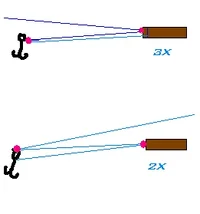
This is another slant on using not only your exerted force; but it's equal and opposite too. Set to pullies i've called it 2Handing when using 2 hands (1 at input position and 1 to reflect the equal and opposite force/direction into another input position) or with the more powerful leg muscles :220 volt force. This is the same as this insetting 1 pulley rig inside another on this ancient ship, by virtue of both ends of the smaller pulley system pulling on larger pulley system; not 1 end of small pulley system pulling dircetly on an anchor, as we are taught to multiply force from pulley system to pulley system.

i will be getting more done on this latest effort: Leverage Options hopefully over hollidaze. But here we see our lil'man SuperBob (our 13yr. old), taking the same theory to a lever, and using the capturing of the direction forces of his bodyweight, muscle effort, and the equal and opposite of his muscle effort onto the target load/ pretensioning; rather than letting any of their forces immediately terminate into the ground (like elctrical theory); 'wasting' their possible outputs. The lever could be a lever, both sides of a wheel on axle, a large stump on it's side (to initiate rolling, then get out of the way). As well as a pulley etc.; really any pivot that you can work thru to place effort on target load, and capture any run away equal and opposite forces and revert them to 'not be lazy'/ work on the target too. Also this allows you to for sure use body weight; applying it either in the idrection of load movement desired, or the equal / opposite direction.


i think rigging climbers are in an exceptional vantage point to use these strategies to pretighten line, or help with quick lifts to clear fence etc. When ground control is pretightening, jsut a climber getting off a more lively/leveraged laod reduces pretightening needed, but then helping out more by hanging dead weight down on line to pretightening groundies makes the whole action a 2/1 use of bodyweight to help. 1 unit of bodyweight off limb to have less for pretightening to fight, and 1 unit of bodyweight that is now pulling up on load with pretightening effort. Then, reach down and pull up on rig line to load, pulls up on load and automatically pulls down on rig line too; another 2/1!! Of course reaching out further on the load than the hitching, then adds even more than 2/1/ as a better leverage point to directly pull up on load (but pullup through rope stays same). Using my Pantin; allows doubling of the leg force instead of arm; but then more force is conducted through bad back; and of the compressing, rather than tensioned stretch type (when just hanging and using arms as equal and opposite of each other, gives back stretch through jsut body weight hang).

i first came up with these on farm as teen; pulling on both ends of line around a truck hitch to pull animals etc.; compounding pulley systems and getting old trailer with big wheels to initiate roll (stand on 1 side of tire in direction of travel, and reach to other side and pull up); trying to keep up with all the bigger guys(pulled a few of them over with rope around truck hitch as i describe in More Power to Ya; which quickly stopped them from laughing at my seemingly crazy efforts). Now, almost 50, am finally biggest kid on block!
tongue.gif
though, SuperBob himself is catching up quick!

i think naming and dissecting has allowed me to apply it more and investigate it too. More work output, for same effort; by allowing power/distance input on target from 2 points and using my massive body weight.
 
i think you are asking about the pulls in 2Handing a pulley system?

In a regular system i think we will find 3 points of force. 1 Input and 2 Output. The Input pull can match 1 of the Output pulls in a 1/1 etc. But, the Output pulls can't match each other(except pulling from the center pulley of a 1/1 etc.).

So a Zrig, has 1 leg of Input pull, and 2 positions of Output Pulls. 1 a 2x Output Pull and 1 a 3x Output Pull. But, if we 2Hand the Zrig as shown; both the Output Pulls will now match for 2 4:1 Outputs; rahter than a 2:1 and a 3:1 Outputs. So, you don't get an anchor pull from 1 Output that is either 1x greater or lessor than work done. Now, the Output Pull on Anchor = Output Pull on Load.

When we inset a rig inside another (kind of an extended Spanish Burton isometric)and 2Hand the inner/ inset rig; it doesn't matter which end of inner pulls on which of the 2 premium positions of outer etc.; nor which end of the Outer rig is on Load. But, if insetting and not 2handing, then once again it dies matter/ the inner/inset output pulls are different, as the outer/final outputs are different from each other too.

In last few years i've been able to test these things with Dynamometers under static loads for final prufs.
 
Without 2Handing the Load and Anchor Pull Outputs are different; so it does matter which is on which. If, you are Inputting Effort to move the same direction as you are moving load; you are pulling with the higher output (3x in this case) on Load.

If, you are Inputting Effort in the opposite direction you are moving load; then last stage of system is just a redircet (to pull on Load the directioin you want it to move), and you are pulling on the Load with the Output of the lessor multiplier (2x in this case)losing 1 leg of pull on Load and adding 1 leg of pull to Anchor.

With 2Handing; both Outputs are 4x; so it doesn't make a differance which Output is on Load and which is on Anchor; because the 2 Outputs match; both are 4x. Which direction you are pulling; except where you can apply bodyweight in Load pull direction, or leg force or ergonmically better etc.

A 5x system; with 5x on 1 Outyput and 4x on the other, becomes an 8x and 8x when 2Handed. However a 5x system that you are using the lessor Output; so it has 6x Output on 1 end and 5x Output on the other End(Load); becomes a 10x and 10x on the Outputs when 2Handed; as the pattern perserveres.

So, without 2Handing it does matter; but with 2Handing and it's pairallell 'insetting' it doesn't matter; which of the 2 Outputs is where IMLHO.


Orrrrrrrrrrrrrrrrrrrrr sumetin'like that!
crazy.gif
 
I have been reading your detailed posts for some time TreeSpyder and at times have difficulty understanding what you are on about.

You seem to like these pulleys a lot but I'm sure I'm not the only one who would like to see perhaps a measuring tool show the extra force applied by two handing. I do like the cartoon things you make but I also see elephants fly in cartoons and yet in the real world we all know they dont.

Couldn't you do a proper video demonstration showing you heaving with two hands on one end and showing the maximum pull exerted on a spring scale attached to something solid, then do your other 2 handing thing and lets see if in fact you do get extra and how much extra.

I think this is what we all want to see just some might not request it because they dont want to insult you, which I hopefully haven't done either.
 
Hello,
my name is KenCasey; i am an addict (too)....

i really don't have a video camera, beyond the 30 second video capability of the $200 digital camera we have.

But, i can personnally guarantee a lifetime of testing these things as the smaller man to keep up with the bigger; and in recent years being more scientific about it to reaffirm, learn, share, prove and exploit further.

On farms and loading docks in teens; i proved with the More Power to Ya example that a 120#kid could topple almost 300# man by not grabbing the truck hitch, but looping around and pulling on both ends as equal and opposite of each other. They'd make fun of some of my workplace ant-ics; but knocking a few down like this one day stopped some of their laughing! Even got some newer guys later to be 'set up' by those that once't laughed.

If we can see that the truck hitch could be an anchored pulley/ redirect (same bend, only less friction); then picture grabbing the free end and holding on to a non-moving/anchor with the other. Now, i hope that any of us could say definitively, if we we're pulling a 100# load; 200# would be on the pulley. This, to me is an 'open' circuit, that allows more than the laod force to be entered into the equation, and give the 2x loading on pulley; with 100# effort on 1 side and 100# load on the other. Letting go of non-moving anchor with 1 hand, and grabbing the line as shown, and exerting the same 100# effort; gives same 200# on pulley position; therefore must give 200# on load.

Proofs: We have now 'closed' the circuit; we have only a solid/ unbroken path between pulley and load; so they must have equal pulls on them; there is no 3rd party to take part of the force that pulley takes and load does not! Thus, 2Handing in all patterns tested; gives equal pulls on anchor and load ends of the jig/the circuit is closed so as to not allow force flow to Anchor position that doesn't also flow equally to Load position! Another way to view/ see this; is that if we are pulling force dead ending on anchor (open circuit); we can exert force, but not motion onto this position, and force distance on the load with other end. But, if we set up in this 2Handing shown; we can exert force distance on load from pull side and the anchor side too! We can take the equal and oppsoite force running away from pulling on load and revert it to pull on load again. Though, we use the same force input, the force output is higher on load, as both hands now move/input distance; rather than jsut 1. Classically leverage is all about modifying distance input, with same force, for higher force output (over set distance; whereby input distance is more 'dynamic'/moving than output distance).

Insetting is a rig inside of another is similair; as Tom once said; more of an isometric exercise (exercising left aganist right to make both stronger, rather than just right lifting or pushing against outside event to make only right stronger) of using exerted force and it's equal/opposite to target too! 2Handing and insetting are very similair/ closing of circuits to place more power on load from same effort. In pulley systems we customarily have 3 positions; Input Effort, Anchor Pivot and Output on Load in an 'open circuit' format. 2Handing and insetting are very similair; to increase Output Force on Load; but then slightly different. 2Handing gives you 2 Input Positions to pull on Load, Insetting gives 2 Output Positions to pull on Load! Regular pulley scenarios do not do these things.

Please rest assured, that i have tested this stuff with crane scales/ dynamometers etc. in past years and challenges. Even SuperBob (shown pulling upwards of 1500# on dyno) himself; has taken time from his busy schedule to show these things!

Indeed i have busted many smaller scales trying to prove these things in the past; and finally bought the 2 scales pictured off ebay. The animations; are the honest video my camera could not provide (less friction for clearer examples). Besides, even with camera running around, these things are hard to portray, as the Mayhem Pruf (another crazy theory) showed.

Really, these things are all around us; ya jsut got to squint like Clint to see'em! Check out the Spanish Burtons on my Pulley Drawings and see the force of the inset system providing 3 positions itself; 1 Input and 2 Output! See the martial arts movies where the engineer pushes down on one side of arm lever and pulls up on opposite side, to input force distance at both ends as equal/opposite of each other; to tourque on arm/lever more etc. Turning a common outdoor faucet handle by grabbing both sides of T or round to turn around center valve. Immagine a 2/1 pulling on a load, then where the anchor holding 1 leg is; place a pulley and allow that end of line to turn around and pull on load again for a 3/1! Sit in your climber's DdRT and pull 1 leg, to give yourself 2x power over lifting your own self. See my Mayhem Puzzle as the same only inverted... Backwards and forwards the same patterns exist!

i've done many tests to distill these things out from jsut feeling righter, to actual hard numbers. Brion Toss himself agrees with me, and has used some of these things in contest/puzzler questions.

Simply more power output by not throwing away the equal and opposite force of your effort. This works with standing on 1 side of a wheel and pulling up on opposite side, pushing down on 1 side of a lever as you pull up on the other side, the 2Handing a single pulley etc. Anywhere you can take a pivot and turn around the equal and oppsoite force to pull on the load too; rather than just dead ending that potential force where you can't input force/distance from it onto load. Ship's rig is specifically laid like that for more power, and i've done many tests with the scales/dynos in past to prove it/ and numbers i generated at bottom as answer.

i can set up whatever ya want. Generally, we have placed a come a long and 2500# scale as input, to read output on the other 3500# scale. This way; come along can pull 1 end on anchor; or both ends on system. Another way all this helps, is less pulley frictions, for same power; a big plus as we go to many sheaved systems.
 

New threads New posts

Back
Top Bottom