Linear Force as a Dimension Model

TheTreeSpyder

Branched out member
Location
Florida>>> USA
As i know them, these are the UNIVERSAL rules.
Linear Force as a Dimension Model; also fully implies the same rules about length or distance expressed, because force and (more visible) distance are reciprocals.
.
Distance expressed in part or full is displacement against freespace;
while force is expressed to displace against occupied space in part or full.
Distance is the simpler form, force is just quantity of distance that could have been/unrequited distance compounded thru leverage into smaller distance of greater density of force or met mate of equal/opposite as distance reduction.
Even in zRig where we take full distance and more nominal force into 1/3 input distance of denser 3x input force; force volume potential therefore the same, less conversion.
Or as confronted by equal opposite/mate in SAME dimension.
.
Each full potential dimension, has a non(e) dimension, each of these 2 dimensions exclusive of each other.
For vertical that is horizontal, as a pair, for more visually quantifiable look at this and L-earn from; to take that model then to where also exists in light/dark, sound/silence, volts/neutral etc. as goes into even waveforms. Actually even the expressions against of forces and distances can be shown as waveforms all the same.
.
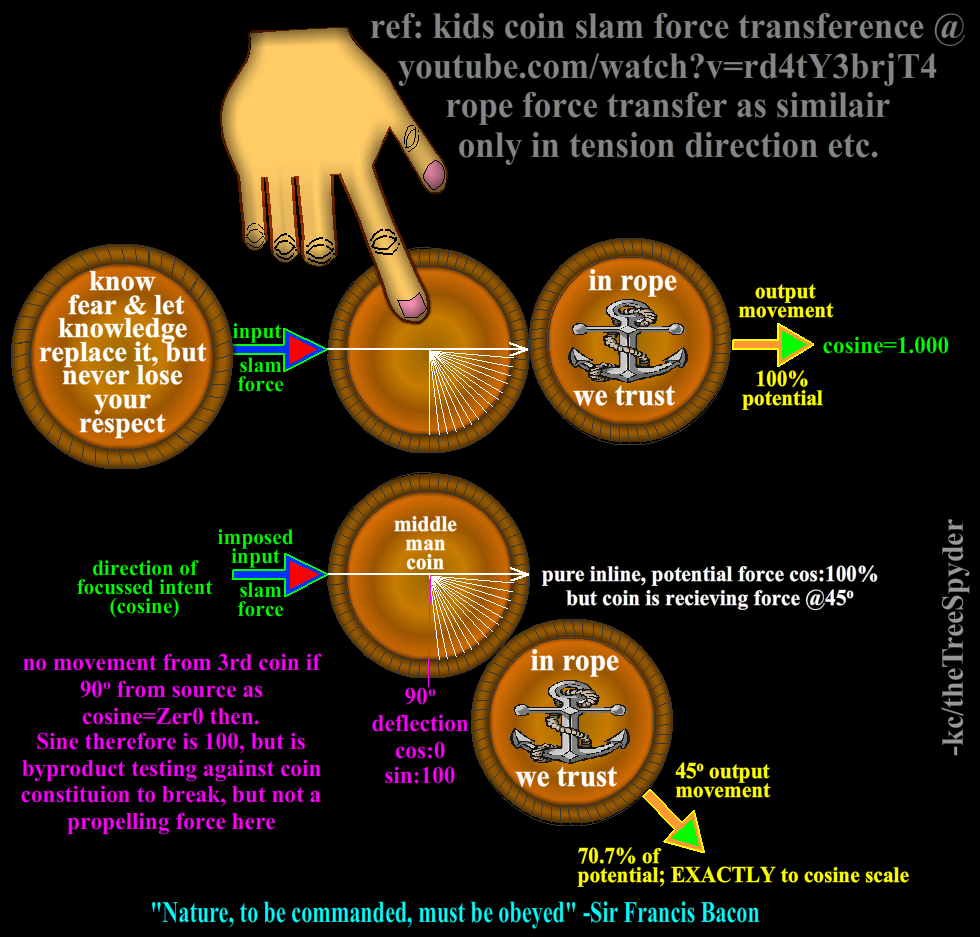
Simplicity in kid's experiments with coins here. When coin on output side of the force transfer, gets knocked most when straight inline in same dimension to equal but opposite side. This movement on the output side is reduced when drifts from the focused dimension of the input hit. This is to the same ratio of reduction from single unique peak potential of aligned to less is always the same ratio until 90° where is non(e).
This is NOT an even incremental of change, but a Universal bell curve of change, the same in all things.
is a waveform pulse of force transfer thru middleman coin, that plays out in all things of force.
Kids-coin-slam-force-wave-transference-1of3.png

Cosine is simply snapshots of even degree increments of the bell curve of change. The amount of transfer to move coin is Full Potential x cos100%(of pure alignment), at any other angle on opposing side of coin is still Full Potential x cos(but that is now less than 100%). Place output coin on even partially same side as input hit yields no distance as is not an opposite. 90° from hit is of neither opposing nor same, as is in different dimension.
.
The Universal Bell Curve defines all changes from full potential dimension to it's zero dimension even on other planets, even inside their atoms to even the galaxies that contain them. The small speck of Earth simply inherits this universal pattern. If the unique cosine is Yin, then sine Yang as non(e)s of each other to the sum of the whole story. The 2 co-ordinates required to plot in 2D as a waveform are cos:sine value pair of yin/yang to pull back the wizards curtain to how the whole story is controlled or read. "Nature to be Commanded , must be obeyed" is what engineers, chemists etc. do, as can't break these rules to go forward, especially as take such giant leaps
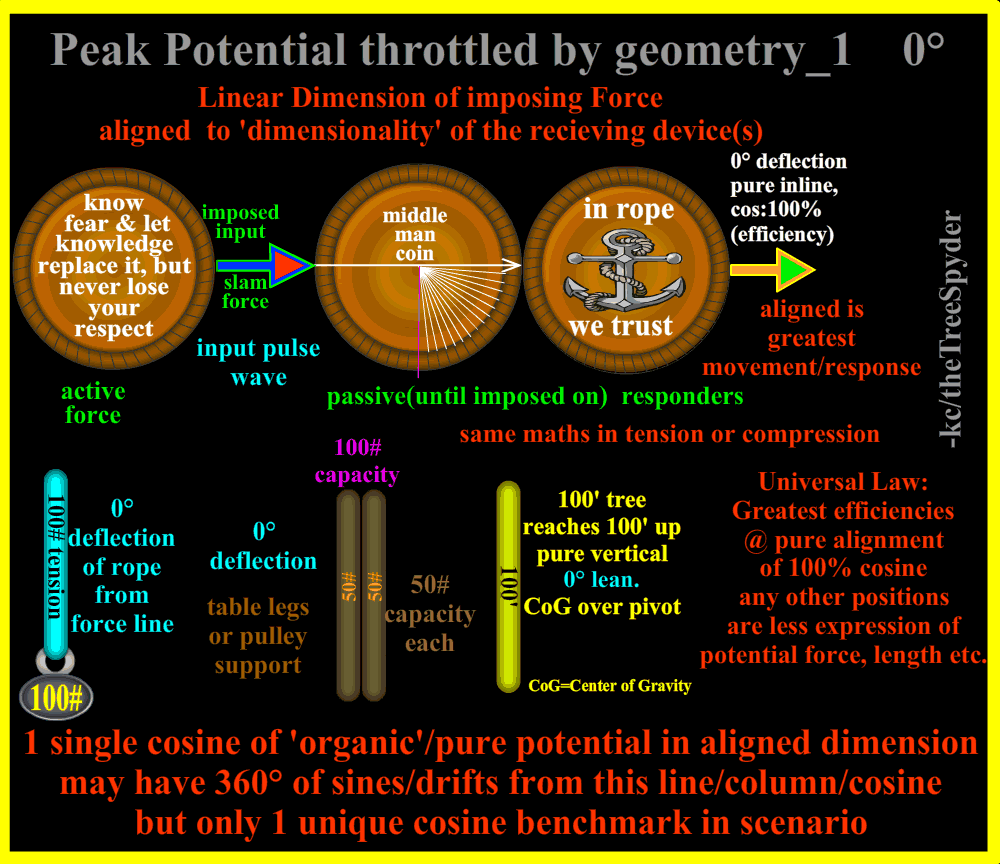
 
Everything has a (finite) peak potential for each of it's attributes: length, strength, force, speed etc. of a given material in scenario.
This peak potential is only fully expressed/revealed when at the unique full alignment of support against load 100%. Like bowling ball balanced atop a pure vertical telephone pole. Pure vertical force squarely aligned to pure vertical column of telephone pole. Or, just the CoG of the pole itself, as a contained vert force, aligned to the vert column of pole below.
.
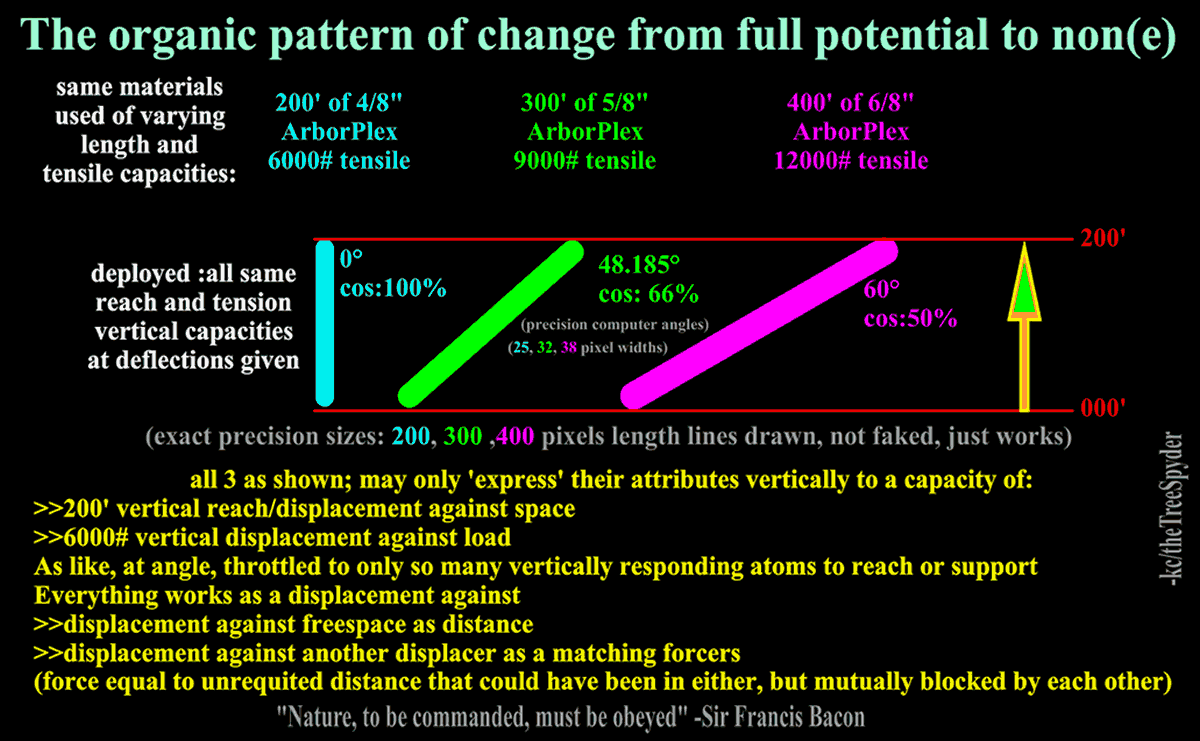
Otherwise, at lean, not all of support reaches to, nor supports in load dimension 100% to the CoG. As some of the support now reaches to and against the crossing dimension (such as ANY horiz amount to a vert gravity powered load). So, just as it takes more rope length to reach against down 10' at an angle, it also takes more tension to support against the same load at that angle. BOTH to the same % of their actual potential of length and tension attributes of the support device. The pole 'simply' has less of it's total potential contribution in same dimension as the invisible force line of the CoG as load. Thereby less of it's attributes of full length and full strength reaching to and in support of load, by Universal Law, that Earth inherits.

Just as the visible height reduced at lean, as the total potential height is throttled to be less in the vertical dimension as it increases expression in horiz dimension, so the does the capacity decrease, by the same cos ratio; by law.


0° deflection, so pure alignment, between load and support;
>>expresses the most reach to load 100% of length(as a potential).
>>avails full 100% tensile (or compression) strength (as a potential),
>>at minimal stress of matching loading , w/o byproduct of side force
Whether penny slam, rope tension, column compression, pulley support, reach etc.
>>is all the same math per degree deflection to forceline (or other target)
peak-potential-throttled-by-geometry_1of4_0degrees-deflection.png


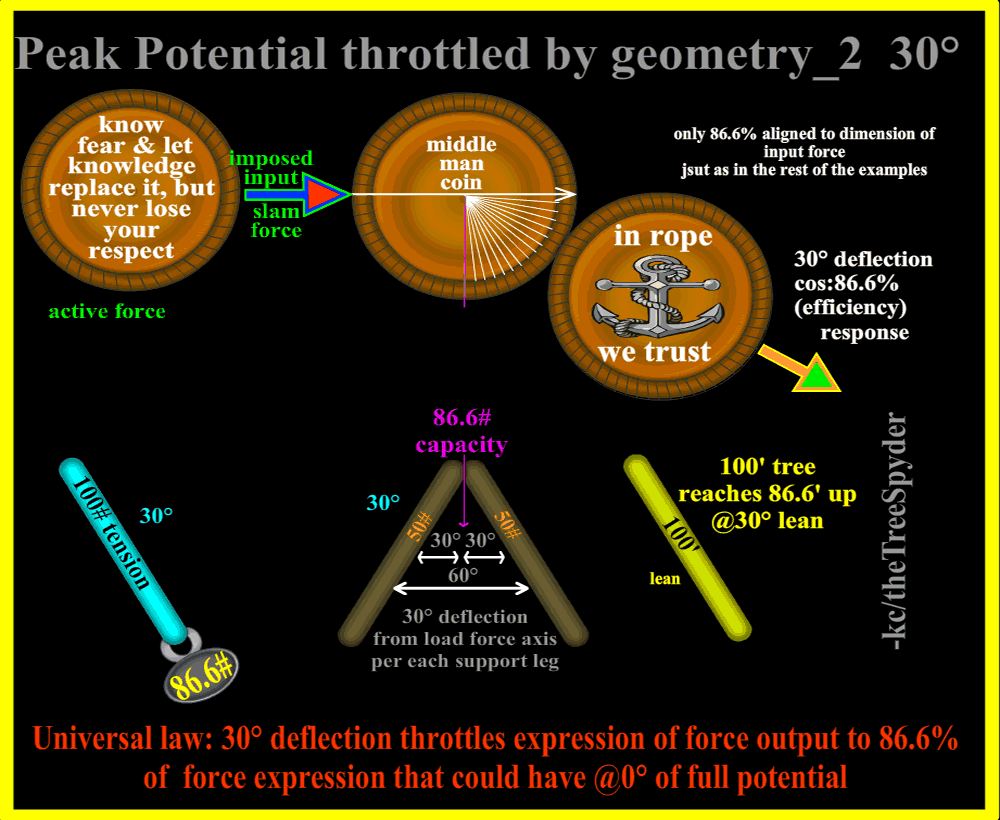
30° deflection (@1'oclock lean, to a high noon vertical load force line) between load and support;
>>expresses almost full reach to load 86.6% of total length, a drop in efficiency of length usage(13.4%)
>>avails just 86.6% tensile (or compression) strength. again a drop in efficiency of potential tensile availed to usage
>>increases loading stress to greater than load, w/some byproduct of side force(side force not usable in penny slam)
Whether penny slam, rope tension, column compression, pulley, reach etc.
>>is all the same math @30° of 86.6% of aligned dimension potential.
peak-potential-throttled-by-geometry_2of4_30degrees-deflection.png


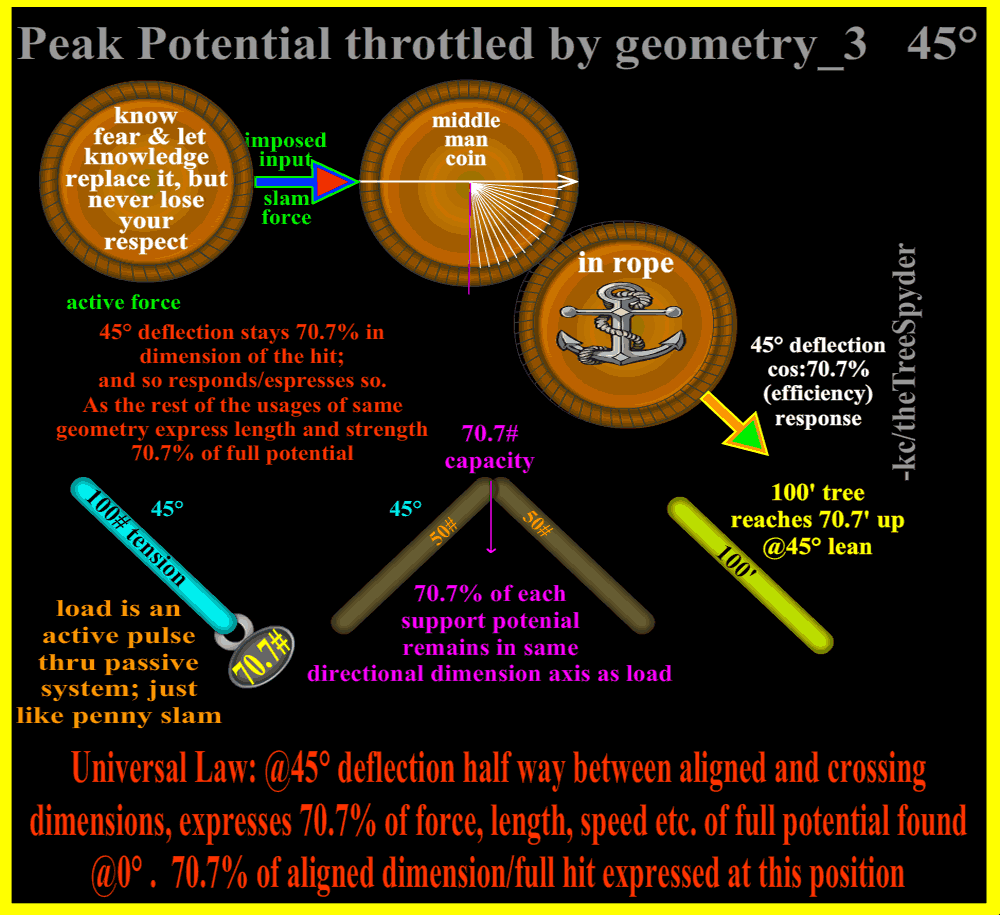
45° deflection between load and support;(@1:30 lean, to a high noon load)
>>expresses partial reach to load 70.7% of actual material length
>>avails just 70.7% tensile (or compression) strength
>>increases loading stress to greater than load, w byproduct of side force equal to imposed load
Whether penny slam, rope tension, column compression, reach etc.
>>is all the same math @45° throttles length and tensile potentials to only 'express' 70.7% of their actual present length and force to and against the load forceline dimension.
peak-potential-throttled-by-geometry_3of4_45degrees-deflection.png


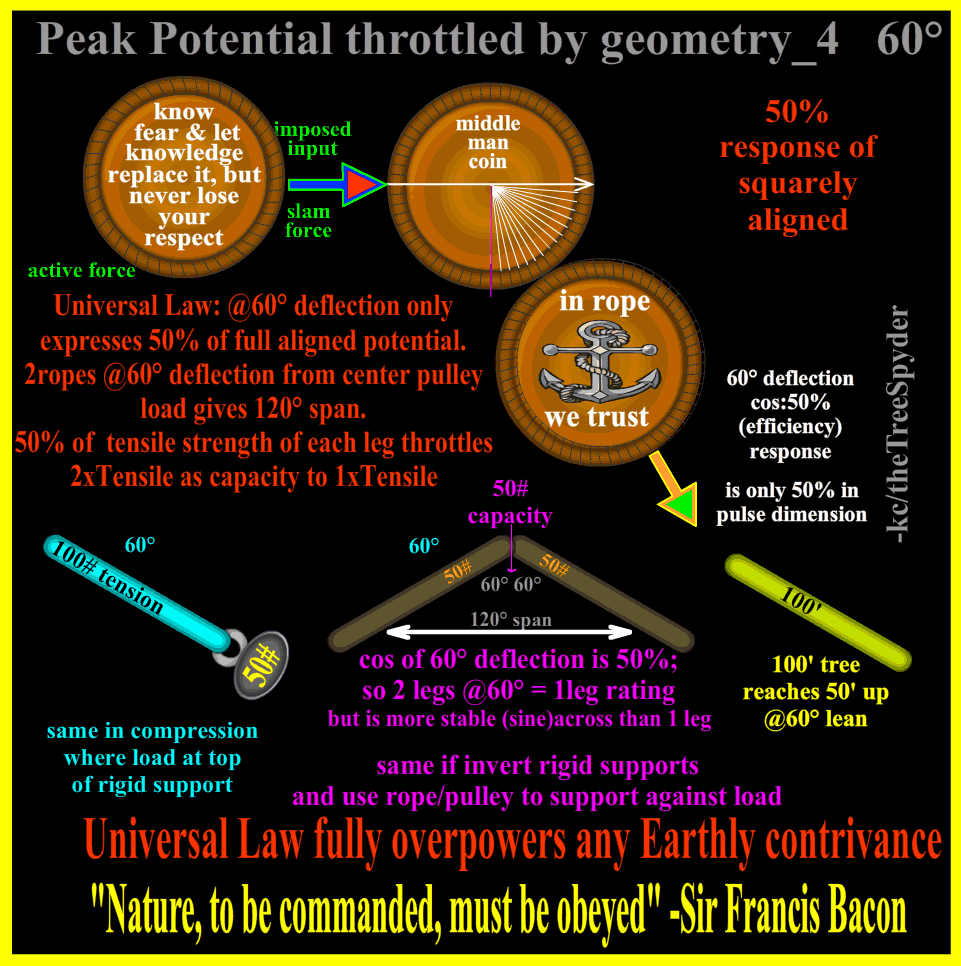
60° deflection between load and support(@2'oclock lean, to a high noon load);
>>expresses only half the reach upward to load 50.0% of actual available length
>>avails just 50.0% of the available tensile (or compression) at that time
>>All these past 0° increase loading stress to greater than load as supports load and vertically and also takes on side force byproduct too. But 60° being past 45° median gives GREATER byproduct of side force than force expressed against work load !!
Whether penny slam, rope tension, column compression, reach etc.
>>is all the same math @60°(again penny slam doesn't show sideforce like rope etc.)
peak-potential-throttled-by-geometry_4of4_60degrees-deflection.png

after 60° of 50% reach and support potentials asserted to/against load; the loss ratios of reach to and force against load falls off increasingly sharply. So in a pulley/rope system, 60° deflections of 120° span is the usual safe limit, easily calculable as the support of only 1 leg @ 0° deflection from (work)load.

UNIVERSALLY, everything works like this, even on unknown planets.
All static or dynamic models of atoms, trips to moon, planetary positions, galaxy movements etc. Even into rawnesses of tree work, as on miniscule Earth(to this universal context) humbly inherits these laws just as all else.
.
 
Last edited:
In a knot, rigging etc. just as in construction, engineering etc.
All Ways and Always, deforming from support dimension (vertical under gravity load etc.) decreases reach and support expressed to that vertical dimension per the cosine scale.
This answers many, many, many questions if can let eyes sift thru the fray to these points. If this saw us thru blindspots to the moon and back with a 17th century schoolboy's plastic sliderule as a computer, it can see in a knot.
.
the-organic-pattern-of-change-from-full-potential-to-none.png

.
The change from vertical support dimension against gravity to horizontal dimension ALWAYS follows the same bell curve.
Cosine gives us static snapshots of value reveals on the organic flow of the bell curve between these separate, mutually exclusive dimensions.
.
Sine gives value of the secondary/crossing dimension, of the relevant non of cosine at that position.
The cosine value and the non of the sine value together give the total sum of the whole, all ways and always.
 
Last edited:
Linear Forces etc. have 2 most relative matters: alignment and 90° crossing of totally not aligned.
Most organic example is gravity as a vertical force, so then horizontal as crossing, a totally different dimension of any change than vertical.
Any alignment dimension % is cosine of efficient column of support(vert)
vs. to the non(e), opposite dimension argument not to forget of
Any crossing dimension % is sine of efficient leverage expression given also(horiz).
.
Generally if support(alignment) is target, cross force is a byproduct.
>>as any, this byproduct may be capitalized on as to be for or against ye.
cos:sine value pair gives both sides of the argument to the total sum of the whole.
The percentage of peak potential of alignment: (to)
The percentage of peak potential of leverage across.
>>inherited to the 'hybrid' position for the 'purebred' parental extremes of possible influence alignment dimension influence %: crossing dimension influence %(cos:sine).
"What?">> tis all geometry of how much% of force etc. is throttled from the source's potential at full alignment and) full crossing.
The focus and the (blind)opposite to cover all, as if yin/yang, to the total sum of the whole expression; with the piercing crispness of a zen koan ('language of the dragon').


Usually, as the most raw loaded position of linear force input, the SPart (Standing Part) deformity determines the retained 'strength' of passing thru the deformity from pure alignment of full capacity. The rope has a lowered to less than 'Max Headroom', so just like in audio the lower ceiling giving lower SWL when it can really count. The capacity is lower.
.
The 2nd most loaded position (to be easy assume round host starter example) deformity is to the equal/opposite side of host (from SPart input)of the 'primary arc'. If this is intense enough, even in the more buffered position from input SPart, especially where SPart deformity is closer to Zer0; the host arc section can then be the 'fuse'/weakest link in chain.
.
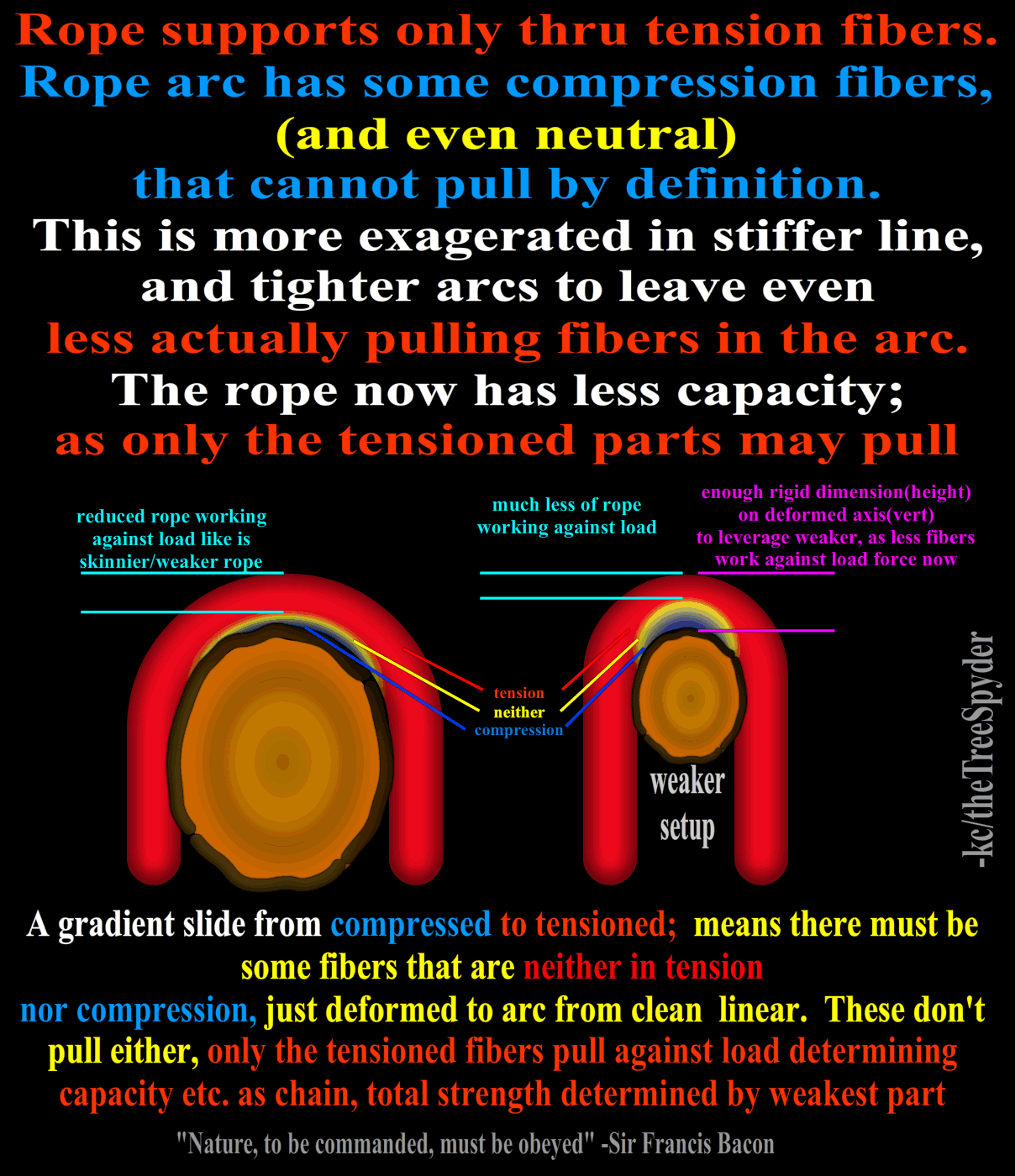
This weakened support capacity also works by reducing the amount of fibers working on load, but not like the SPart. The supporting fibers are lessened by some of them held as compression, not tension. To me if rope or hinge fiber moves from a most compressed to most tensioned fibers must have thru the gradient shift a section that is neither nor.
BUT of the 3 distinct phases of the gradient slide from one extreme to other; ONLY the remaining 'soldiers' in tension; labor against the linear load force input to the machine thru the SPart. These maths have no 'leaks', all may be accounted for on the 'balance sheet'.

rope-fibers-compressed-in-arc-due-not-support-only-tensioned-fibers-do.png


These things of geometry and all that it may command, cosine and sine are not some small adjuncts , annoyances applied to rope framework but rather the universal framework/laws that the rope is applied to, as like any other loaded material.
 
Linear vs. Radial matters in all things, hear we see it in rope choice and considerations.
Force displacement needs at least a single Equal & Opposite pair
>>Linears give this to a single, focused axis, not the same; all around.
>>Rounds give this to diffused, NOT focused, dispersed axises, generic around.
.
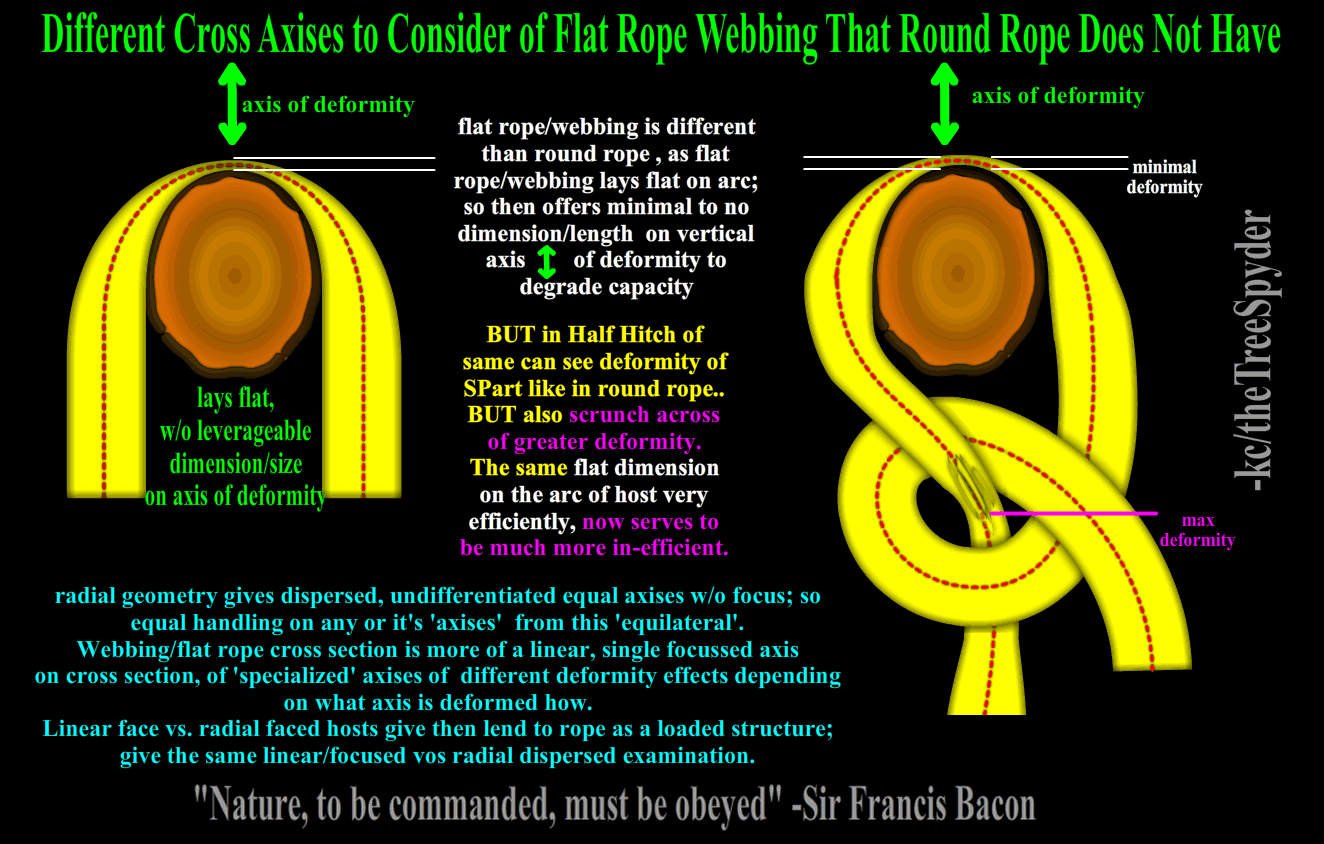
Standard Round Rope and Flat Rope / Webbing each have a major linear axis. But on cross section, round has equivalent deformities at any angle; but the cross section of flat rope favors a specific lone axis.
So Rope Round is more consistently predictable in handling the same for deforming at any axis. Flat Rope/Webbing is very specific on how an axis takes a deformity, as it is specialized to 1 axis as a linear.
.
different-cross-axises-to-consider-of-flat-rope-webbing-that-round-rope-does-not-have.png

We use mostly Round Rope; only show Flat for those usages, but mostly to show why round is special and chosen. As also overall point again to the geometry that rules across all as the consistent framework for flows of change that force, distance etc. are applied to in varying amounts(instead of perhaps reverse common view).

.
i prefer round host(s) for same reason as a logic. Might say round on round meaning round rope on round host. Host as like a form for molten plastic or metal, that then poured plastic/metal takes on a specific geometry of potential force loadings when hardened/rigid. Only the host form pour more 'liquid' state of rope around, when rigid(loaded) rope state is achieved, still must have the the form/host in place unlike metal/plastic. But, still the universal laws of geometry play out under load exactly to same ratios in all materials, as percentages of their individual material's properties.
 
Last edited:
We see/even rate the rope to break sooner under tighter arc and/or stiffer line on host ?
Can see wrinkled inner arc of rope on host sometimes, yet hyper-stretched on outside of same arc i think on smaller hosts i think. Some ,more coreless like 12's may flatten. Then, too also as this evolves beyond simple hitch examples, we find the rope bending around it's own diameter in 1:1 ratio, which some stiffer ropes do less well than others inside knot microcosm/ parts for whatever rules we find in open(here) to extend inside with. Tighter arc imposes cos:sine w/more impact of change, stiffer line organically resists deformity; both less likely to lend rope to the task as fully.
.
Theory: i find this as a parallel to wood hinging of a fiber compression, neuts, then actually pulling tensions as a gradient slide across hinge, but only the tensions bank pulls(that is all rope has supportwise)... Wood fiber is as like rope fiber, only stiffness turned up on 'volume knob' as a factor in wood fiber. Here the fibers most opposing load are most stretched: extreme positions, long, tall, pulled fibers standing proudly in rear field on front of Dent's book,
41dvgBMIXJL._SY445_SX342_.jpg

as like they(screechingly, hyper-stretched fibers ) and sawyer are saluting each other over a job well done. For these hyper-tensions are the control, and hyper-compressions 'only' the pivot. i think hyper-tensions are to one side of rear, would make me think had some lean to opposite side of fall, so most stretched fibers at most extreme leveraged position from side lean force. And so a great lead in to the book topic, pronounced loudly on front cover, tif can see from that this is the book to pick. The models inside even work in tree seeking more across path so the 'off-side' pull is downward as a set up to Dent's model.
.
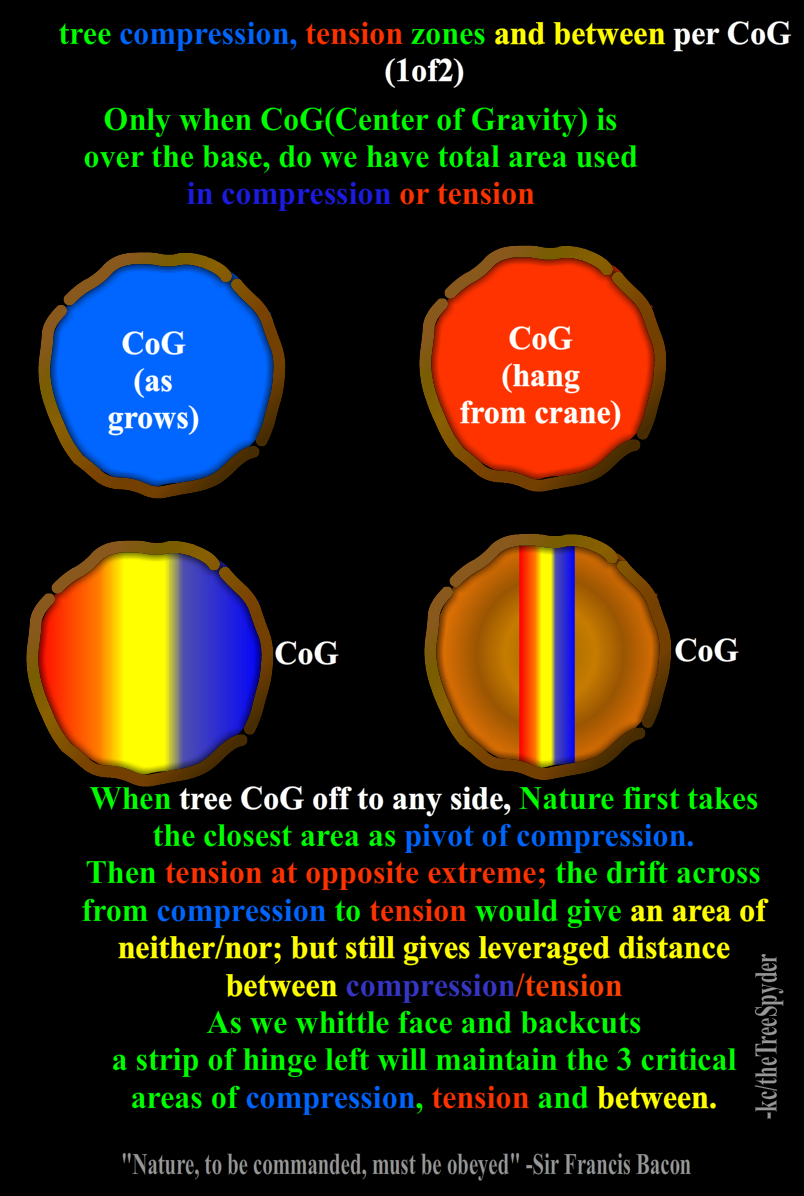
Going from most extreme compression of pivot as casts across fiber field to opposite most extreme tensions. Seems as a gradient slide to me, so draw as that would have no man's land of neither/nor between; only leveraged distance between torqueing pair of compression and tension to support. Wood is rigid enough against compression to capitalize on compression as support, rope only expresses rigidly against load to support where in tension by extreme contrast.
.
Peace.
 
Last edited:
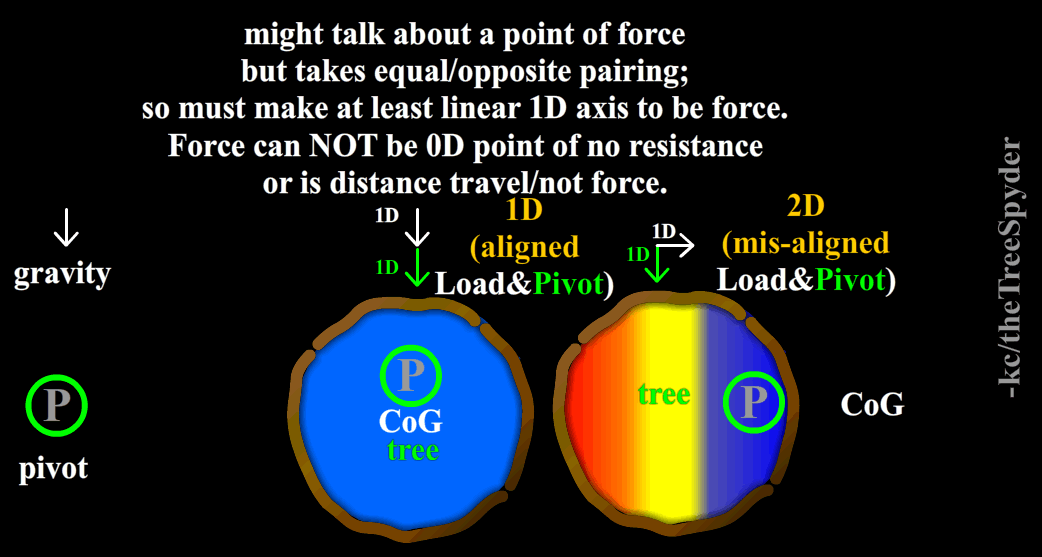
This is how i imagine internal tree forces, per CoG;
and how the 3 fields populate, and then reflect as same into hinge after face and back cuts.
tree-compression-tension-zones-and-between-per-center-of-gravity-1of2a.png


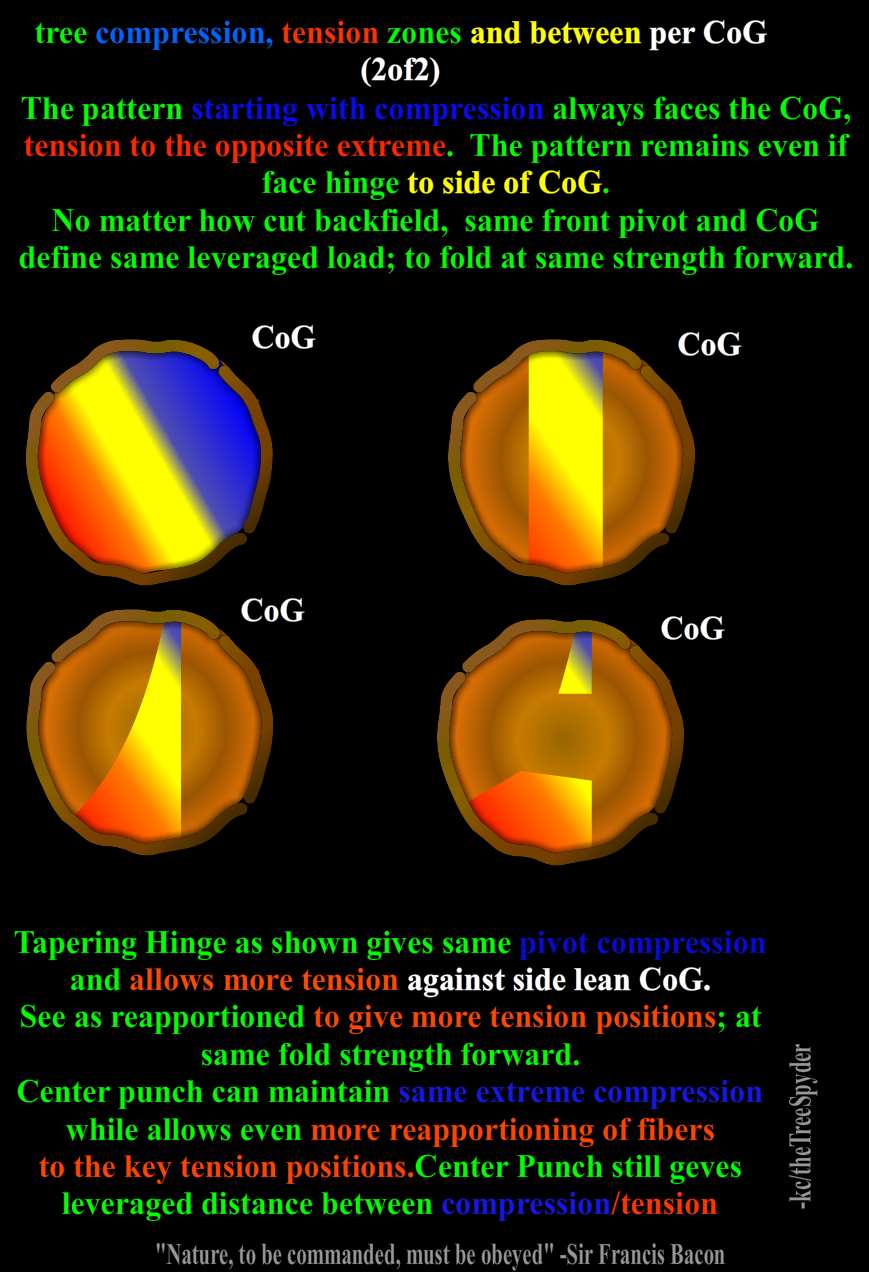
As we go to further complication of sidelean; we see the same pattern broadcast Naturally per the CoG.
Irregardless of how intervening human cuts; Nature maintains the same pattern of loading.


tree-compression-tension-zones-and-between-per-center-of-gravity-2of2.png


The different areas should load in these patterns per CoG positionally ;
but not necessarily at the same ratios to each other as approximated hear.
 
Last edited:
more of thoughts as i would cut (and rig) :
hinge-force-pairs.png


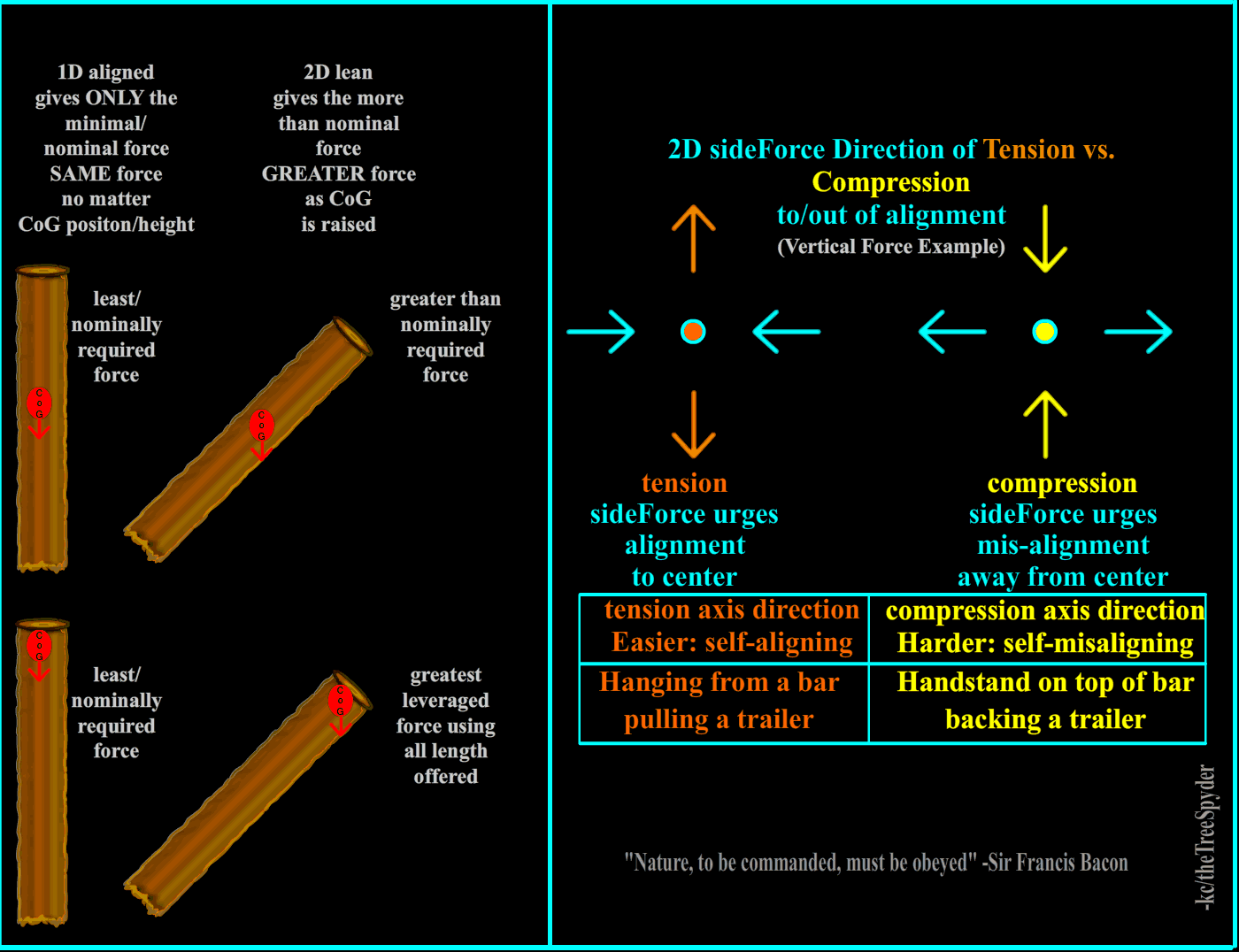
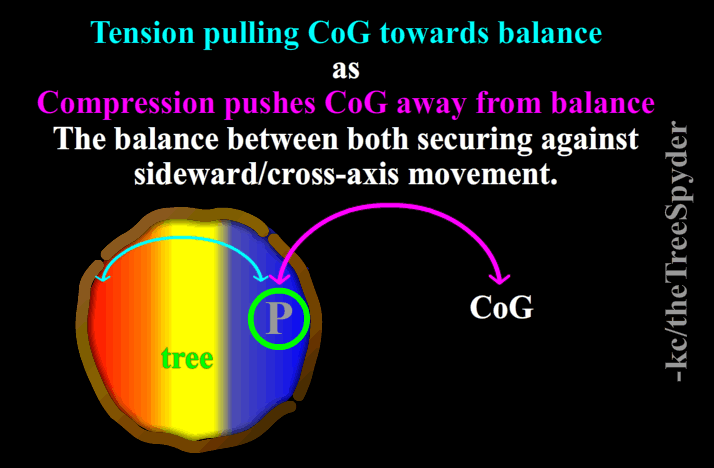
Almost a liquid opposite response on cross-axis direction:
Compression together forces on aligned axis to center
>>gives cross-axis force direction away from center
>>and vice/versa of opposite direction on opposite axis (vert vs. horiz axises):
side-force-directions-of-tension-vs-compression_1.png

side-force-directions-of-tension-vs-compression_2.png


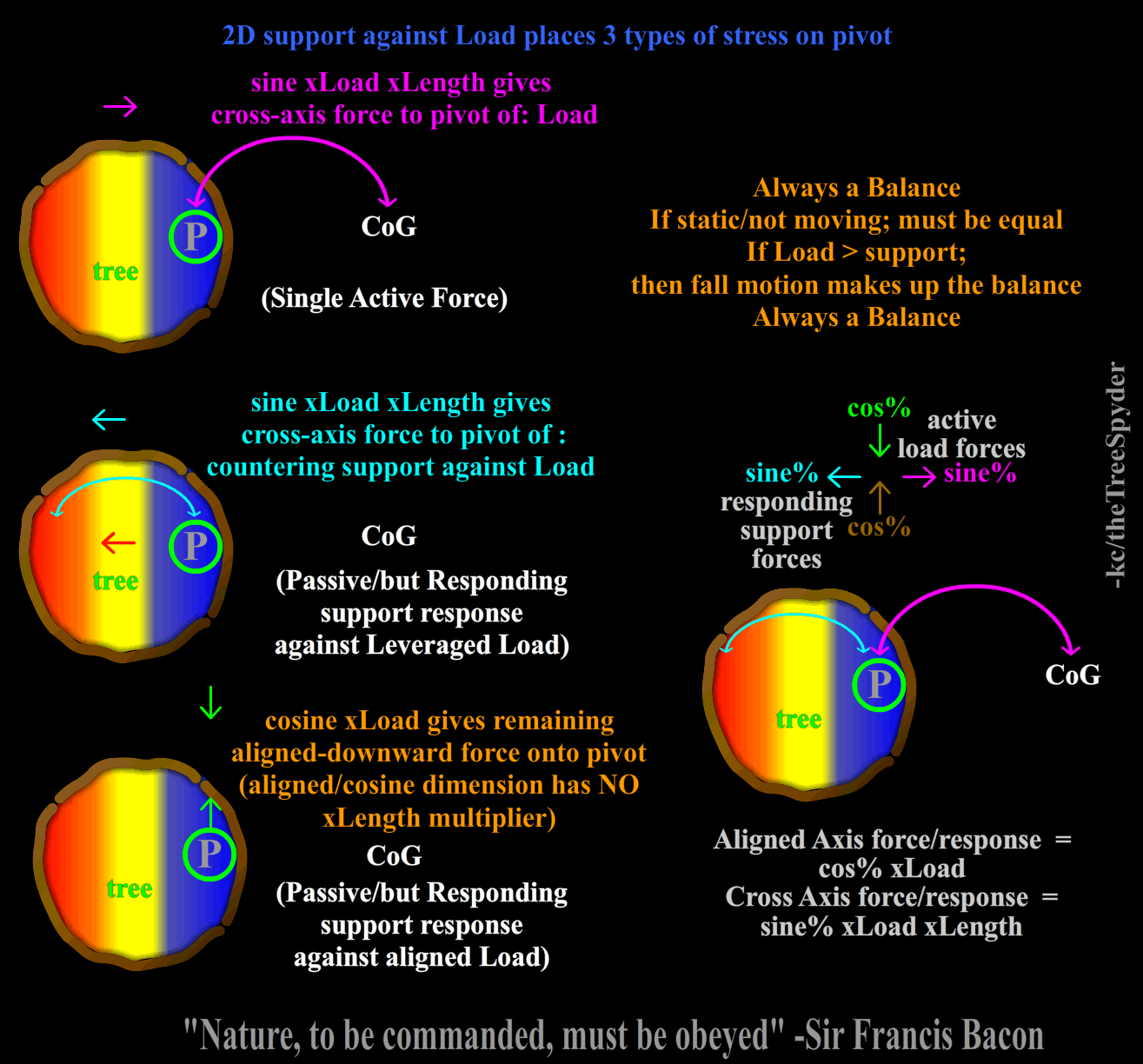
2d-support-against-load-places-3-types-of-stress-on-pivot.png


i picture the bellcurve formed by cos:sine pairs flow as the framework;
>>that loads, speeds, lengths etc. ride on in lil'boxcars
>>along the roller coaster framework of consistent bellcurves.
The rollercoaster framework of possibilities is the pre-existing universal flow from full potential to non(e) in a dimension of influence
>>shown in aligned and crossing mutually exclusive dimensions to express in
The framework is the rigid domain, the loads, speeds, lengths etc. attributes ride as visitors
>>cos:sine flow does not change, is the pre and post existing element
>>loads, speeds, lengths etc. attributes are the occasional variables
.
As often seen; i find a reverse view of assumed to highlight different aspects, perhaps previously unseen, while re-affirming others.

>>hear, see totally new light; approaching from know cos:sine view
>>and adding/finding rest input/outputs of all else into this 'machine' as the afterthoughts

>>not cos:sine as the afterthoughts...
 
Last edited:
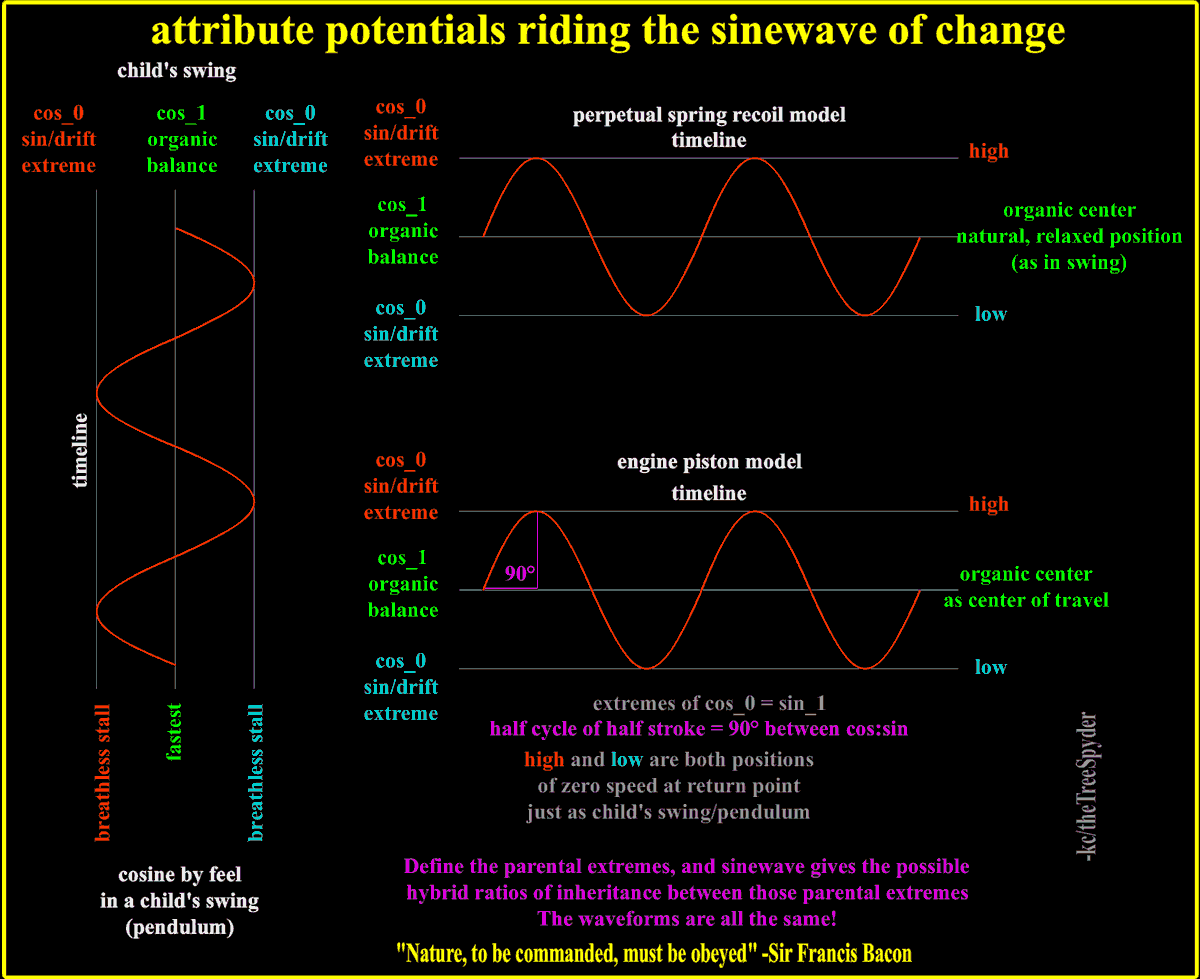
cos:sine ratio/waveform show all the organic possible values for an attribute's potential between full hero and flat zero of every knot, rig, load, hinge, distance, force etc. etc. as the dimensions of organic alignment to input force and the non of non-alignment too. Yin/Yang of both sides of the flipping coin at once and even predict accurately.
attribute-potentials-riding-the-sinewave-of-change.png
 
Hey Cory!-Been getting along fine ty, even tho not still riding beloved ropes. Hope you and all t/here doing well also?
.
UNIVERSALLY organic change from full expression to non(e) of zero expression (full hero to flat zero) for an attribute(length, distance, speed, vibration, electro/magnetism, wind, water etc.) always follows the same waveform of change. Like waveform is a slide an attribute rides from 1 end to the other. This also then happens in geometry from cos 100% to 0% too, as probably the most visible, tangible and enumerable way to see this waveform of organic UNIVERSAL path of change. If know the 100% and 0% ends/benchmarks as parent extremes, the wave form stretched between these extremes gives all the hybrid ratios of inheritance from each of these parent extremes to the hybrid position between. We call these hybrid ratios of how much of each parent extreme inheritance %'s: cos:sin. cos of alignment to force% and it's % of non to crossing dimension to tell full story. A Yin/Yang to the total sum of all, as like accurately showing both sides of the flipping coin at once.
.
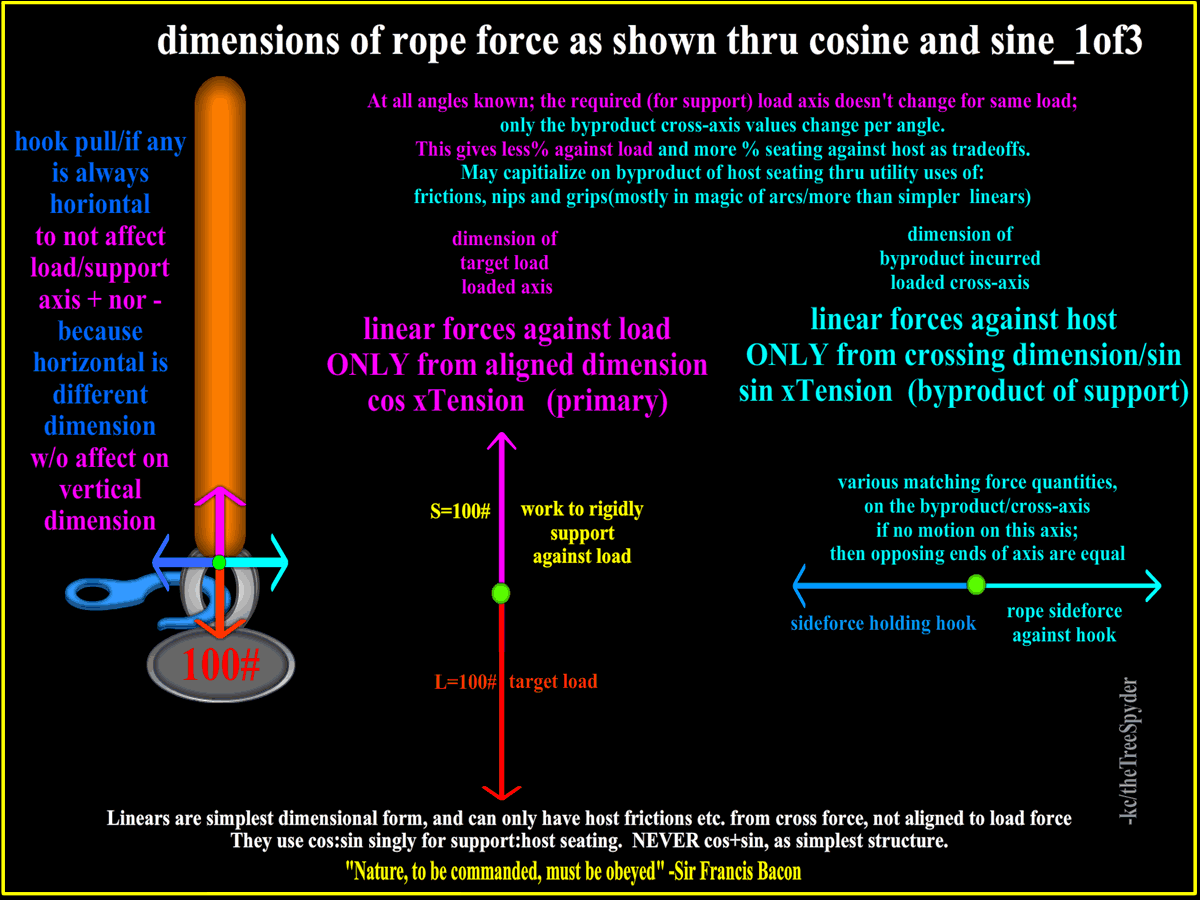
When port force into a ropework thru a SPart(stolen from knudeNoggin to mean Standing Part) that direction becomes the initial benchmark cos dimension, then find full sin as perpendicularly crossing. If hanging load it finds cos_1:sin_0, if pull load some to horiz side to slant rope, cos(efficiency of use of length and tension against load's dimension of pull) drops as sin rises. Not all of rope, nor then it's attributes are responding in/to the load dimension anymore. Like have less of same material working on that dimension, like a thinner rope etc. Still to hold 100# load as target work, system must give 100# upward pull against load in balance or load moves. But cost$ more tension, less efficiently used (per dropping cos) for the same work of 100# pull upwards by the 'virtual column' of support from cos xTension. BUT, the sin of cross axis force, as a byproduct to work of support, increases as the angle does while dropping cos/what is to the cause(my mnemonic). In linears it is this sine only byproduct that can capitalize on for host seating for frictions etc.
.
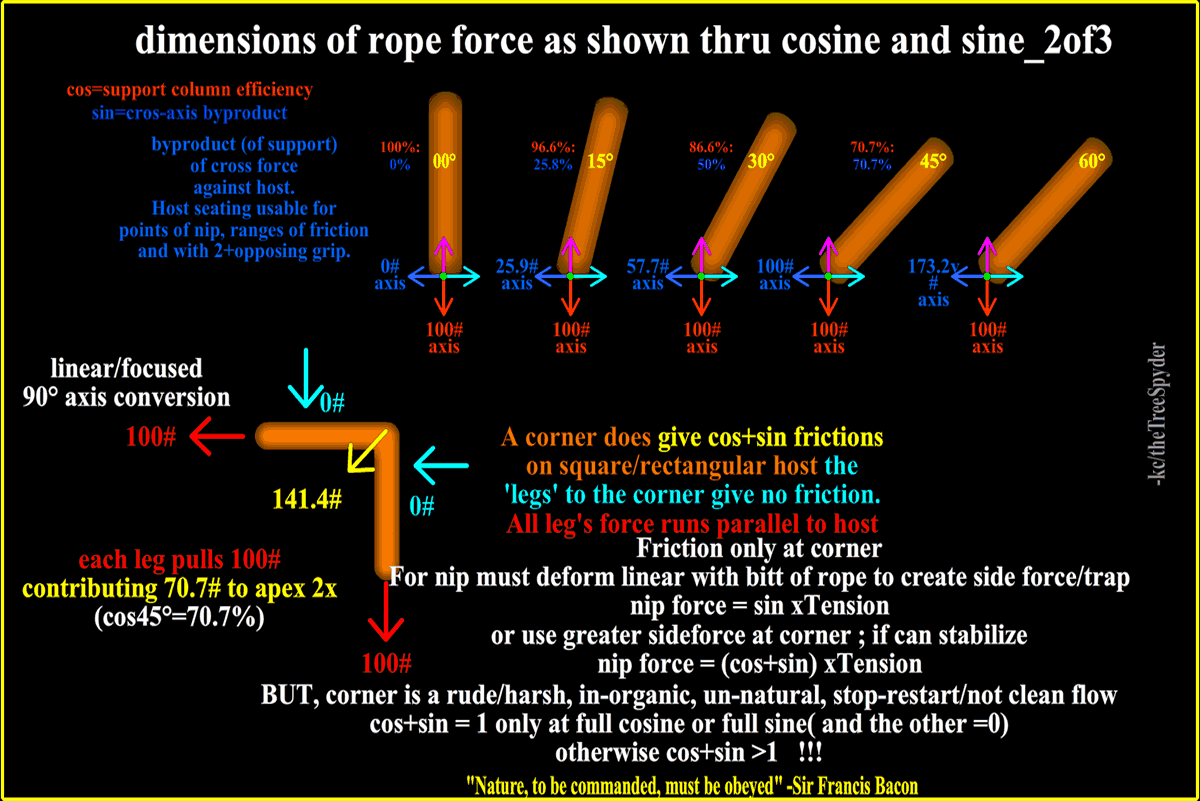
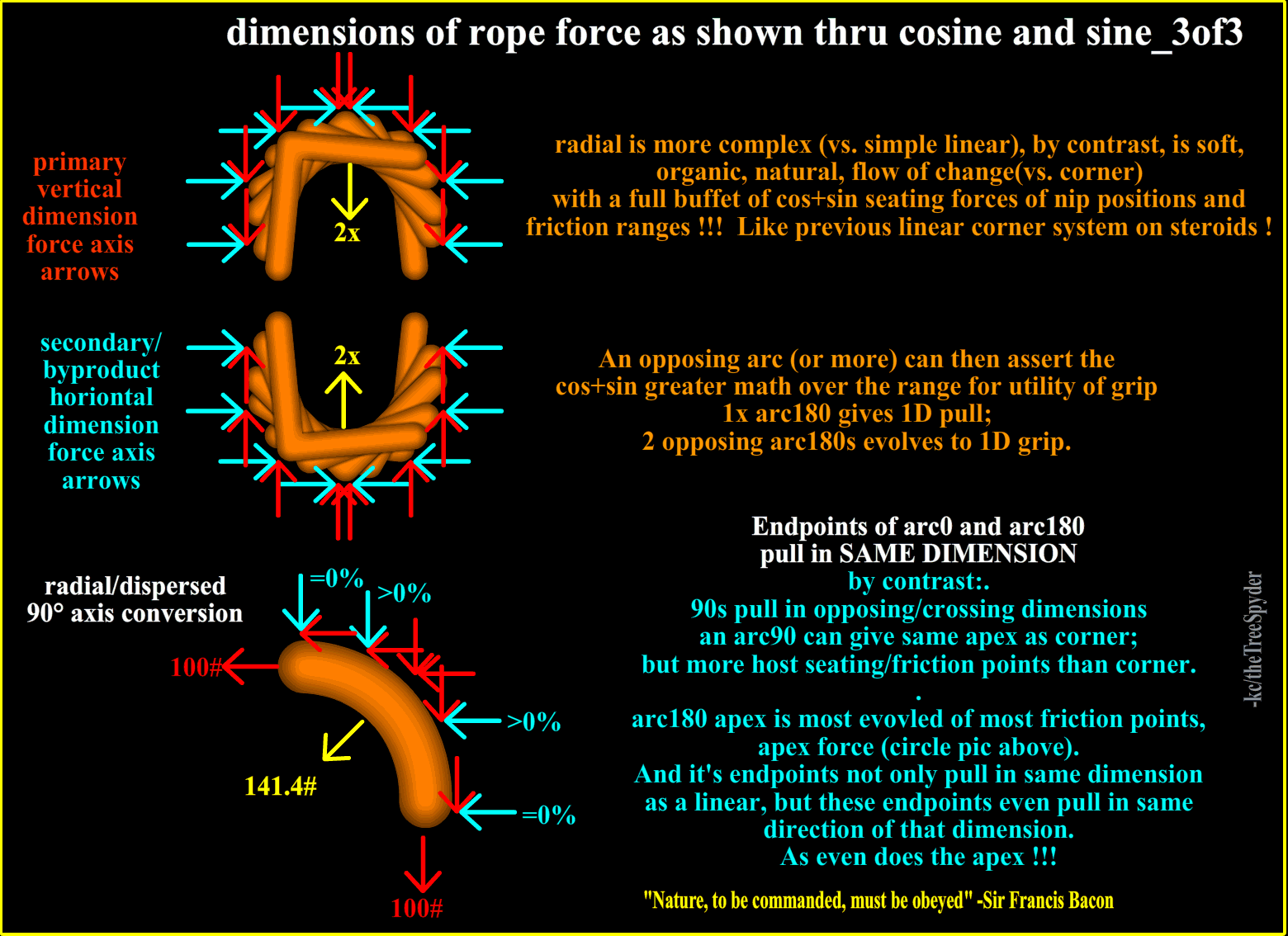
But a corner, can use cos+sin for frictions; but just at one point of each corner of a 4x4 host example. A corner is a rude, inorganic, unnatural, sudden change from vert to horiz etc. of flow/stop/artificially turn/start flow again. An arc for same usage is a 1 part organnic, natural, gradual, clean, smooth change as like a series of corners getting cos+sin over a range. This buffet of cos+sin positions puts corner example on steroids for frictions and leaves nominal frictions of linears even way further behind.
.
dimensions-of-rope-force-as-shown-thru-cosine-and-sine_1of3.png

.
dimensions-of-rope-force-as-shown-thru-cosine-and-sine_2of3.png

if tight and slanted rig line is far out towards CoG on long near horizontal , easing down some on hinge while maintaining rope, will tighten rope more as also increases the side pull off the roof/obstacle as a byproduct force attained to capitalize on.
.
dimensions-of-rope-force-as-shown-thru-cosine-and-sine_3of3.png


The power for support, frictions, nips, grips etc. must come from finite input total volume of force ported thru the SPart , cos:sin shows how can be used and where. All must be accounted for to even balance to be stable; imbalance results in motion >> until satiates at balanced forces rest again. As the motion itself temporarily makes up the imbalance to balance the formula.
.
All organic/cornerless loaded ropework is of 3 repeating directional elements:
arc0 : connector nonArc/linear ends in same dimensionality, but opposing directions
arc90 : converter to cross axis, ends pull into different dimensions, therefore directions
arc180: compounder , miracle of arc in bridges repeats same magic in ropes
>>BOTH ends pull same direction in same dimension, as even so does the apex !!!!!!!
Half-hitch-arcs-and-linears.png

The SPart is not a pure linear here as feeds into the arc.
>>but find(after much head scratching and forehead palming) that SPart here is linear
Because/by virtue of: input from load and output to arc are in opposing directions; therefore for this model in same dimension. If SPart were to further distort to arc90 or arc180 (or corner for non-organic part of model); then becomes that elemental form; but linear part to this point is still SPart, just not at/thru such change to new element point.
 
i think that when the Babylonians presented calendar, clock, circle all on one device, the lesson was/is cycle; not the separate utility functions. i can calc on the fly cos:sin ratios by minutes on the clock, from doing iron crosses staring at a clock across the gym. Vision blurred and there were 2 clocks, one for each arm. i have carried that clock everywhere to read many things au'naturel on the fly init's own environment. And L-earned much from even the numeric progression.
.
i believe in those times months were of 5weeks(hash marks between clock numerals) of 6days(6degrees of circle to 1 hash mark between numerals). Just as from 12-3 is 90degrees as a quadrant, was also 1 of 4 seasons of 3 months. Babylonians had base60, and favored 5,6,12..
Going from sin_0 at high noon as aligned against hanging load.
(note: 6 is used 2x in 2nd month sin, and 2 is skipped and 1 used 2x in 3rd month sin of each 'season')
The sin increase per 'minute' for the 1st month (until clock number_1)
>>is +10% per minute, thus 50% sin at the 1 for 30degrees
The sin increase per 'minute' for the 2nd month (until clock number_2)
>>is +9,+8,+7,+6,+6 respectively per minute ~86% at the 2 for 60 degrees
The sin increase per 'minute' for the 3rd month (until clock number_3)
>>is +5,+4,+3,+1,+1 respectively per minute 100% at the 3 for 90 degrees.
Run backwards for the cosine losses from 100% @12 then -1,-1,-3-,4,-5 is ~86% at the 1 for 30degrees
.
These number scales repeat for each 'season' shown as 4 90 degree quarters of the clock.
They have lit my way well thru many lessons, re-affirmations, insights, explanations numbers of times a day for half a decade.

Calcs-of-sine-using-clock-numbers-and-degree-slants_1of5.png
 
Last edited:
Still may seem a lot, but have taken it down from 360° of considerations to a repeating just 90, to only needing to know 15, forwards and backwards.
The minute hashes/slashes on clock give the proper slants/angles.
Align high noon to force reference, of the load pull etc. and read the clock.
.
But, can simplify even further, by ignoring the middle 'month' and just working the 1st and 3rd months as extremes(middle has it's own extreme will cover later).
If gonna play w/power, should make the extremes stack chips on your side, not against ya!
Then work the minutes from full cos/aligned or from full sin/crossing
>>and read very simply, especially 1st month
>>and especially 0-50% for cos and sine scales as the mirror each other.
Can instantly own this part !!!
A most often use for me was judging sideforce rig off roof/other below obstacle.
This part is just too easy especially inside first month of 0-30°deflection from high noon benchmark set to ruling force/load:
Calcs-of-sine-using-clock-numbers-and-degree-slants_2of5.png

For sideways pressure from rig, every minute in this range is 10%.
So rigging from farther side of support, and then to farther side of horizontal load (to sweep sideways) can make a 10%, 20% etc. difference instantly !!
.
Tighten rig as tight as can, lock off w/friction on ground;
then press load some DOWN to tighten rig even more some.
This is more dramatic the more leverage between hinge pivot and hitchpoint on load.
(still CoG should be to the outside of this, so no flip).
Any load force on rope before tearoff reduces shock of sudden rope load at tear off
>>and handles 'lighter' on the hinge.
But, the side force in rope builds and tells that horiz limb to come here !!
Turn saw some sideways across some and let rope pull pull load across, but make rope work for it hard to force stronger hinge in response to start. then with strong rope and hinge work it out/over/down to ground.
.
The numbers have an Universal effect just simply work here, just as everywhere else!!
 
Last edited:
The parlor trick of knowing both low ends of sin and cos per minute is not much, compared to if know how to use the tool and it's relevance. Especially here the sin(e), to suddenly w/high impact of change topple handstand, sway backing trailer, sweep rig sideways etc.
.
The low end of sin (and cos)scale(s) are the most volatile as system rages back from 0% w/attitude vs. near 100% of each (cos,sin)where minute by minute changes on the clock are more nominal to negligible. Most things fail not from the aligned dimension weakness to load(lack of cos), but rather the cross force that shears across column of alignment(from too much sin).
.
In rigging we can employ the sideforce to pull off a roof or from over other obstacles below. Just line up the marbles right, and let the math play out. Every increased minute of slant is 10% xTension more side force (until 30°, but next minute is 9% xTension more, next 8% xTension more. More angle xGreaterTension can make magic happen at some point..
i favor super tight line linearly, sweat across it tighter if can; then lay horiz limb down into that super tight rope some to pre-tighten even more. Greatest effect with length between hinge pivot and hitchpoint (before CoG) as a lever to pull harder sideways with this rope force and support better too. Any force handed off to rope before tearoff reduces rope shock/impact when dump rest of load on rope at tearoff. Or sometimes just so butterfly light load from most force on rope already, just separates and glides away. Always want angle, and relief to pull away from climber.
.
We know the sidepull will try to self-align the parts for us because is tension, compression has opposite direction of out of alignment direction on cross axis.
so easier in self aligning tension:
>>to hang from highbar; as a tension pull
>>to pull small trailer forward; as a tension pull; trailer follows along like lil'puppy.
vs:
but harder in self mis-aligning compression to do:
>>handstand on top of same bar; compression side force serves out of alignment, needs constant management
>>back same small trailer; compression side force serves out of alignment, needs constant management
In all things; the value of the sideforce grooms into(tension) or out of(compression) alignment of main axis.
The forces feel harder to control thru handstand or backing trailer are the sin value, and it's relevance.
.
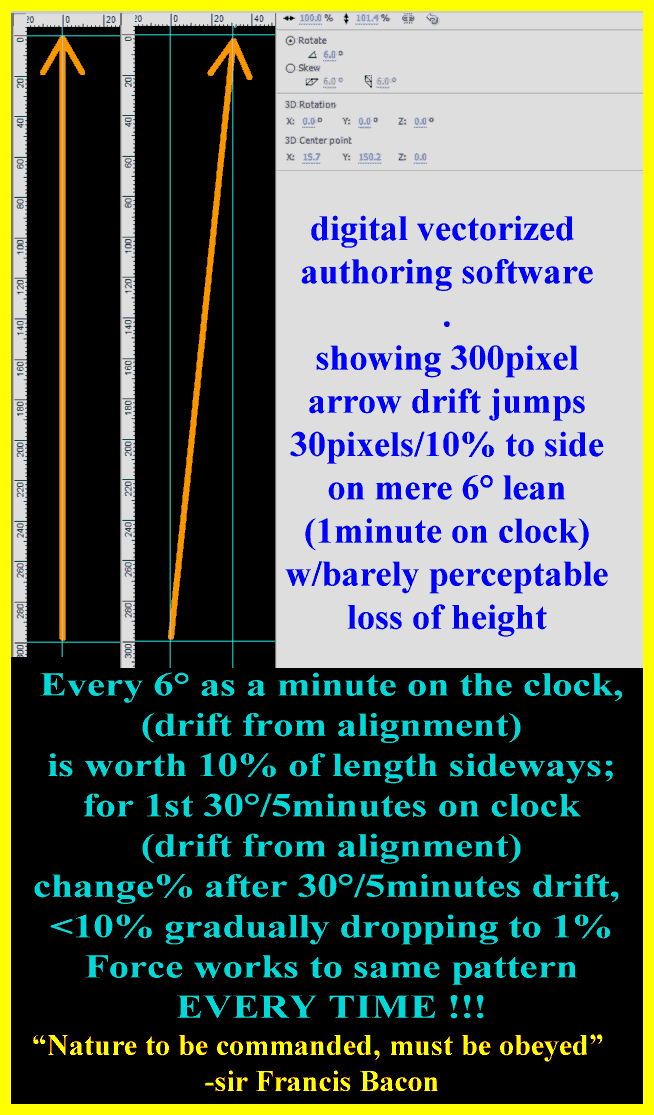
Sideforce is so dramatic in early stages near alignment, of near 0 sin that we can use self aligning plumbob as guide(tension self aligns), or long straight edge; even eye to some extent and catch the drift from alignment very dramatically. A 1foot/12inch ruler mis-aligned 1minute on clock/6degrees jumps 10%/1.2inches to side, can't miss that!! Especially with longer straight edge to express same mis-alignment, but more dramatically! The loss of cos in the lower deflections is very nominal by comparison, especially first 2 minutes of the clock of 1% change on aligned axis, as cross axis changes/jumps 10%!!! Such as below.
sine-gain-very-dramatic-in-first-6-degree-minute-on-clock-while-cosine-loss-is-nominal.png

You just can't miss that drift even at just 1minute deflection; or even half so...
Very powerful even volatile end of changing scale to use if can employ correctly(instead of it employed against you)!
cos:sin 'simply', cleanly defines all things; and clock face a great decoder ring for it !
This allows you to visualize the change in force across as same jump also, in 1st minute of deflection
>>BUT, virtually without loss to support column strength, only 1% drop !!
 
Last edited:
Sorry, been awhile, buried in work and family etc.
But still maintain this model answers all rigging, hinging, leans, knot architecture etc. etc. queries by putting numbers to them to read.

This concept goes farther beyond these geometries, but geometry is a most visible and tangible way to see, by enumeration this Universal pattern.

In simplest forms
•everything has a non; and rigidly displaces against it's non for any change (+or-)
•only things expressing in the same unique time, space and dimension can add to or subtract (slow down, support against or move in opposite direction) as change

So, a weight hanging on a column of rope, or on top of a column
•ONLY the forces expressing in the same time, space and dimension; but opposite direction can support ( or lift) against the weight. The weight has it's own UNIQUE dimension in this particular time and space.
•everything in same space and time relates to that dimension(pure cos)
• or it's crossing dimension(the non of alignment) at the parent extremes; (pure sine)
•OR a hybrid mix of these 2 parental extreme dimensions of pure alignment or crossing of the weight's dimension(hybrid mix of cos:sine)

These 2 dimensions of alignment and non(e), and their potentials define everything. We show cos:sin ratio as a mathematical reveal. But in terms of force, there are not only the amounts of force shown differently to these dimensions; but also the patterns to which those revealed forces populate. These forces are also very particular definitively to if is cosine or sine, aligned or crossing, forces.


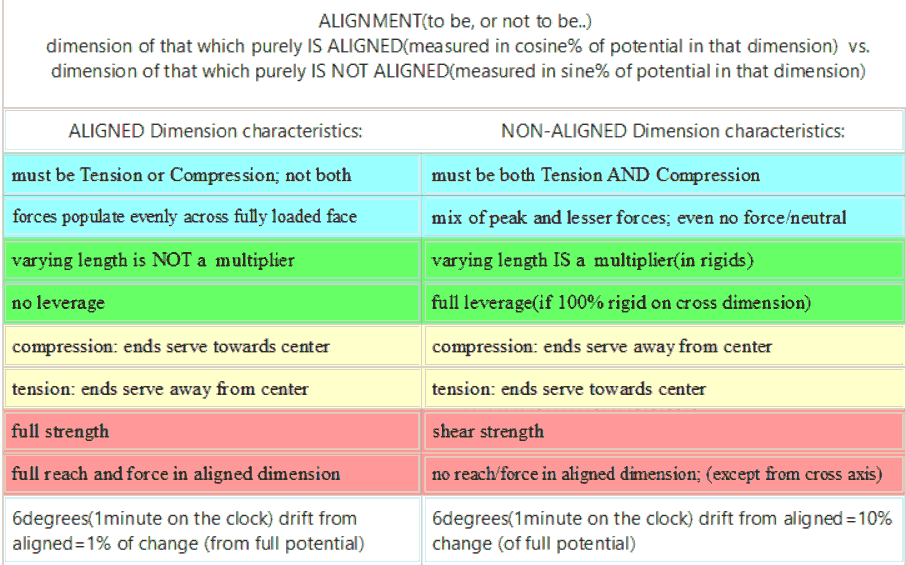
ALIGNMENT(to be, or not to be..)
dimension of that which purely IS ALIGNED(measured in cosine% of potential in that dimension) vs.
dimension of that which purely IS NOT ALIGNED(measured in sine% of potential in that dimension)​

table-of-aligned-in-same-dimenional-space-or-not.png


ONLY the aligned force pattern can express to support load(left, cosine)
ONLY non aligned force pattern can express against across forces(right, sine)
In the above chart each of these patterns are opposite the other in the horiz pairing shown. The dimensionality makes all the difference.

This isn't meant to add to any confusion of all these numbers etc. But rather to focus and define that these dimensionalities rule on many levels, as the principal thing to watch...

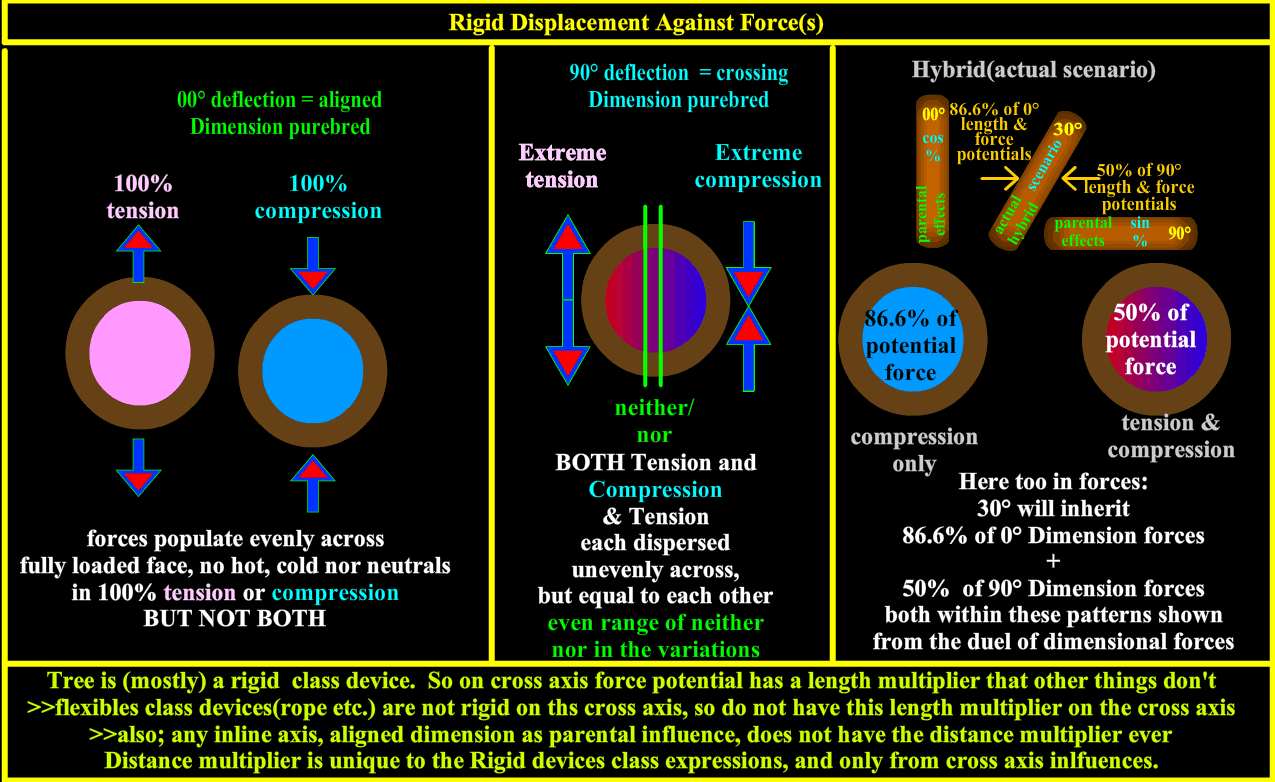
The positions of compressed vs tensioned wood fiber in whole tree or hinge is revealed, defined by these dimensional rules.
such as 2 first patterns on the above chart:
1764376177380.webp
rigid_displacement_patterns_against_load.png


If can find and know these things;
•these forces can be your minions
•if not, you can be their minion.
Only by working with Nature(knowingly or unknowingly) can you win...
"Nature, to be commanded, must be obeyed" -Sir Francis Bacon"


Happiest of Holidays; and Peace to ALL !
 
Last edited:
I was wondering where ya been! It's a shame your website is no longer up, it was the best hitch site out there.
 
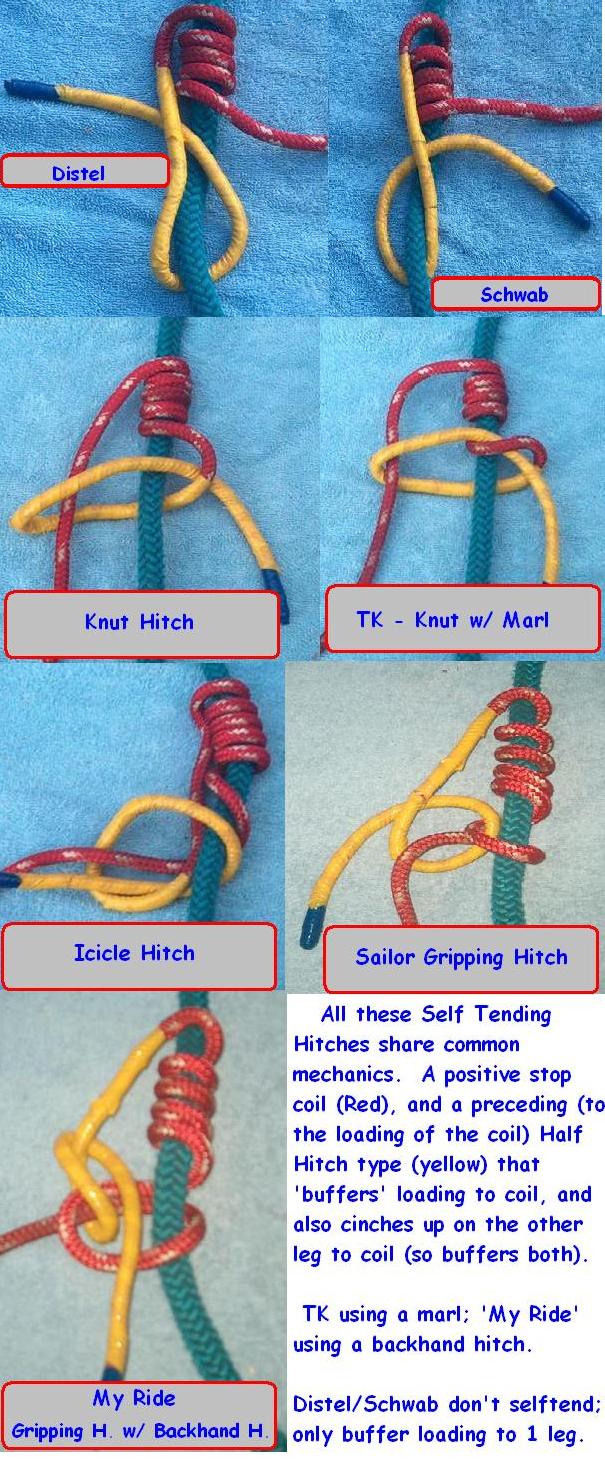
Hey Cory, thank you for remembering my humble site; it got infected 2x and other ups and downs, never monetized/always a cost. But when looking for some lost files recently i did find a number of Friction Hitch pix from it. i can put together some on a 'ropeForceLogic' thing been playing with, mebbe Wikipedia(?). But can put something together.
some-closed-system-friction-hitches.jpg

Note all the arc180's pattern common in many Friction Hitches!
Friction Hitches have always been amazing example of rope architecture/system/knot to me. i would not have gotten this far on these points without one sitting in front of my face so much, and took so much trust/focus! So much so, that after awhile realize this must work, how can it be anything else!

These dimensional aspects i fumble to show hear, totally work in all aspects of rope/knot/rig as ropeForceLogic. These numbers and patterns try to show here, help define only 3 basic rope made structures :
• 0°(ends pull in same dimension as ends pull in opposing directions in that dimension)
• 90° arc(bridge of ends pulling in crossing dimensions)
•180° arc(ends pull in same dimension AND same direction!!!)
The 180°/arc is the most powerful, evolved rope part both ends work in the same dimension and pull in same direction
•as magical as 180° arc in bridge etc., same ruling geometry
chart-3-elements-of-organic-ropework.png

This matching Dimensionality vs not is a Universal concept in all things on any Planet or open Space. Geometry is just a doorway to highlight and understand it, by enumerating it; to decode it. I don't say that to befuddle, but rather bring to light; the depth and firmness of these principles that power and limit these things.

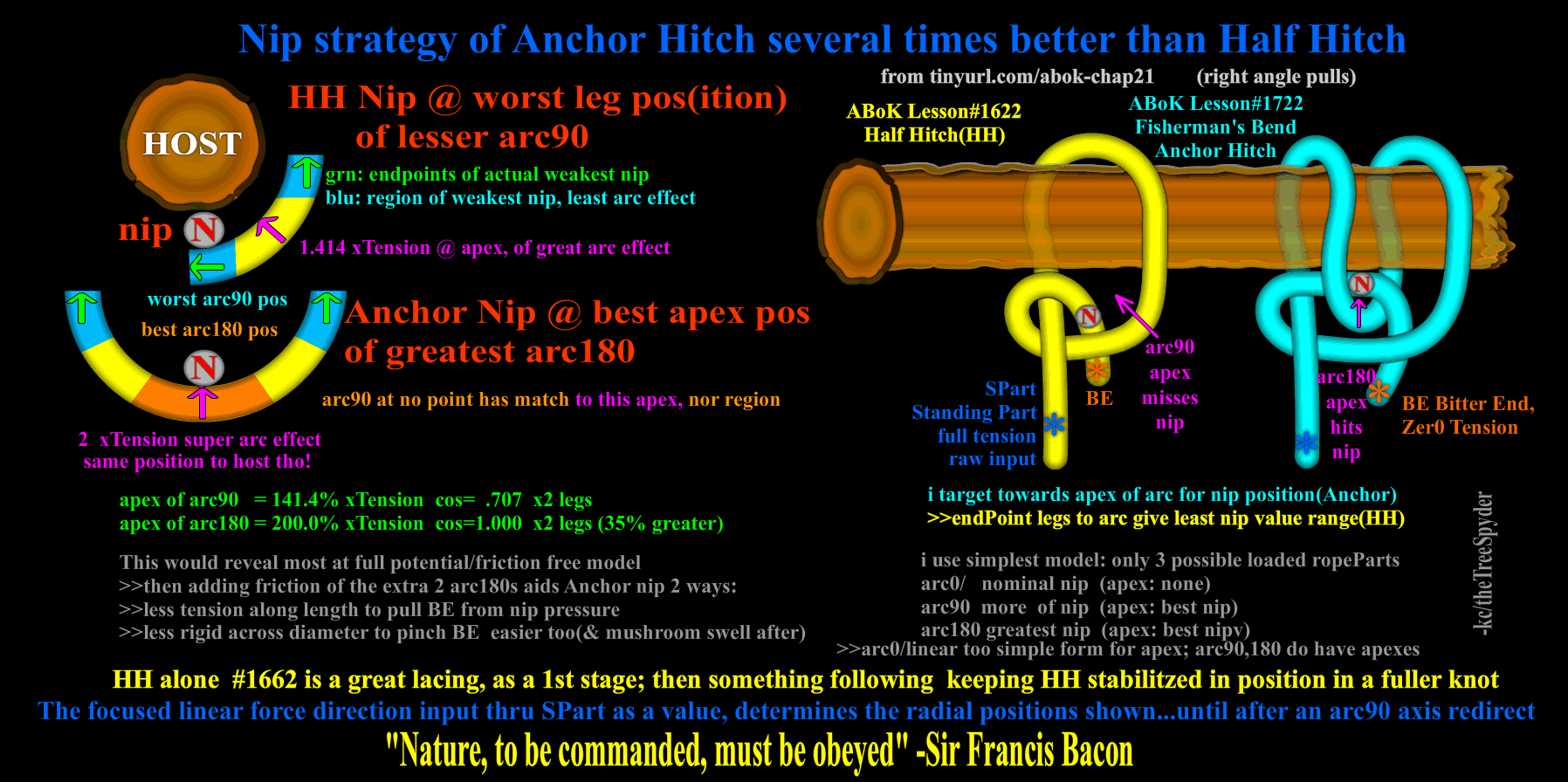
The difference between a Half Hitch and Anchor Hitch is
•Half has 1x180° power arc and only a 90°nip point, that is close to the 0point/end
•Anchor is much different creation, it has 3x180° (Round Turn/RT) power arcs(!!!) by contrast
AND the nip is one of those 1x180° power arcs(!!!)
Anchor has a RT(knudeknoggin*-ism) base(3arcs), and RT's are where we start to see 2D grip
nip-strategy-of-anchor-hitch-several-times-better-than-half-hitch.png

An RT (3x180°arcs can afford 2D grip AND great frictions to decrease the flow of tension force at the same time
•More Turns increase the frictions as just extend the 2D framework.
ALL this in knots and rigs is defined by these Dimensional (and Friction) models
•The unique alignment(or % of) in same space and time as load
vs.
•The opposite value of non aligned %
to sum of whole story of both combined: benchmark alignment and anything not.

* i believe knudeNoggin means knot head/or similar; moniker of a very smart contributor hear and there.
 
Last edited:

New threads New posts

Kask Stihl NORTHEASTERN Arborists Wesspur TreeStuff.com Teufelberger Westminster X-Rigging Teufelberger
Back
Top Bottom