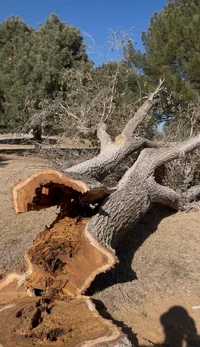
Hollow codominant

Be careful. Do you do any kind of tree assessment before lighting into it with a saw? Smacking the trunk a couple of times with a axe or mallet is an easy way to detect hollows. But being it was rotten and not hollow yet there may have been other signs, insect litter, shrooms, slim flux, are a few things to look for.
 
Be careful. Do you do any kind of tree assessment before lighting into it with a saw? Smacking the trunk a couple of times with a axe or mallet is an easy way to detect hollows. But being it was rotten and not hollow yet there may have been other signs, insect litter, shrooms, slim flux, are a few things to look for.
Yes, on these sketchy boogers. Siberian elms again. The hollow plus codominant didn’t click as soon as it should have though. Should have just cut the stems off with their lean.
 
Hollow is usually the result of an unhealed too-large stem removal.

Another one : I bore cut it through the face for grins and it was somewhat hollow/rotten. Could have collapsed on me if the back wood was compromised, dummy.
 
If you suspect a commonly occurring species like happened this time, how about becoming a cheap human resistograph drill? Use a small bit like 3/8 or 1/2 and probe with your holes where the hinge cuts are going to be so you aren't removing extra strength. Just an idea. Glad you're ok.
 
Yes, on these sketchy boogers. Siberian elms again. The hollow plus codominant didn’t click as soon as it should have though. Should have just cut the stems off with their lean.
I always give a hard whack with the back of an axe before putting in a face.
If it sounds bad a vertical bore to confirm.
Always walk the length of the tree in the direction of lay (and again in lean/crown weight). I’ve found some shit I would have smashed otherwise.
Always have a axe and wedge handy. Almost always a second saw.


Had a snow loaded Doug fir bent over a road one year. Thought it would be a quick easy, shallow face and bore/back cut.
Made the first cut of my face (always horizontal first), just got about 1.5” inside the bark and it pinched HARD. Managed to wiggle the saw out and the stem imploded/exploded all at the same time. Damn thing only had less than an inch of wood all the way around inside the bark.
So that’s where that smack with the axe ritual came in for me.
 
Last edited:
I always have all my gear.

I learned some stuff from a pro hazard faller a while back. One thing was on sketchy trees, start with the top angled cut of a conventional first, and very shallow and close to vertical angle. Inspect and repeat. This gives a sample of the wood as you progress deeper, and is less likely to pinch hard. Also, easier to cut or chop a pinched saw out of. I’ve found included knots/stobs in my hinge several times lately so I try to remember to check the face for them.

On my first round with these Siberian elms, I researched that they do not hinge well. I observed they tended to be hollow and have widowmakers from pruning rot. I knew codminants tend to separate, and that curly root flare grain doesn’t hold well, so I cut them around waist high in the best wood and where I could keep on my feet with my eyes up. Many of them required push and or pull/tether.


This round was supposed to be the easy ones, so my mindset was a little off, more whack n stack, until that unexpected hollow.

Regarding checklists, I saw a vid in jest by a timber faller where he makes a big deal out of following all the safety rules to the point where there was no way he could make any kind of economically viable production. We are not usually doing production, but sometimes I am trying to get as much done as quickly as possible. These trees I only had so many days to get them down while I was in town.


So off the top of my head:

Wood fiber: species (brittle or not), living, dead, rotten, hollow, find the good fiber.

Lean, limb weight, widowmakers.

Targets and value.
 
Is there an existing crack or bark inclusion on a codom, how much wood/trunk is below the union? Would it be better to cut off one of the leads? Would it be better to treat the codom as separate trees? Is it safer to bind the trunk with chains?
These are a handful of things I go over before flopping a tree.
 
On the human resistograph drill bit - maybe red nail polish (durable "paint") on the first 3" of drill web, next 3" orange, another 3" yellow as a visual "how deep is the shell/good wood" gauge. an idea
 
I think that different environments create different manifestations in a given species. We remove a lot of Siberian Elms here in Detroit and it is rare in my experience to encounter a hollow one, or even a cavity. There must be something about the desert that leads to this maybe. That tree of yours reminded me of one I did this Summer. It was a codom as well, no rot inside, right along a main road here in Detroit at rush hour. I was keen to get it on the ground and at first glance it looked neutrally weighted. Put in a pull line and a 5:1, face cut, back cut went along nicely until the hinge was about 4" thick and it sat back on me right towards the street. I hammered in wedges, set up a second pull for the existing line so we could use our mini without giving up any existing progress but that was a stressful 4 minutes. It was at least half again as big as that one of yours and it also split when it hit the ground, but largely because it was so spready and just levered itself apart. My gut told me to remove weight from the street side before felling and I should have but didn't. I thought the 5:1 was enough but she was solid and HEAVY. It landed in the right place but took some doing. Never been so relieved in life hahaha. A lesson cheaply learned. I have grown to like the smell of them I have to say. Doubt anyone else will second that though

 

New threads New posts

Kask Stihl NORTHEASTERN Arborists Wesspur TreeStuff.com Teufelberger Westminster X-Rigging Teufelberger
Back
Top Bottom