Jehinten
Been here much more than a while
- Location
- Evansville
Follow along with the video below to see how to install our site as a web app on your home screen.
Note: This feature may not be available in some browsers.
Absolutely no dynamic picks.I don’t think it would be a good idea to try to take loaded dynamic picks with a crane. Who knows what the added forces would be.
Just for conversation sake I could potentially see a crane being utilized to pick some of the weight and support a tree while it’s being dismantled my more conventional means.
Those dead on hung up trees can be a real puzzle, more so when the limbs are locked like Velcro.
Any chance you have a actual photo?
I assisted with one not unlike this but it also had the neighbors house as a target. We used the ole Earsted yarder, to winch it up supporting the tree while it was limbed and a non loaded portion of the top was removed. We then picked it up more, put a big ole face cut and let the cable free spool out to get it to swing to the side.
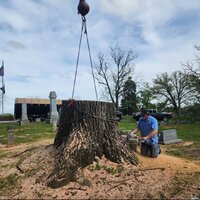
What do you think the volume is?It's wild to me how much species can change the weight of trees. Granted the diameter is larger here, but this short chunk of Oak was 6000lbs. View attachment 98436
Probably the case with maple...but with ring porous trees (oak, for example) the opposite can be true... I'd have to dig, but there was a paper specifically looking at Red oak. Since faster growing trees put on more wood throughout the growing season, the have a higher portion of latewood which is more dense than the porous early wood. In slower growing trees that ratio is closer to 1:1. In really fast trees each ring may over be 75% latewood.....
I'm guessing denser than average for this based on the growing area (old forest). It does have lots of water, though.
Trust your gut and Godspeed.I may go today or tomorrow and climb it.
Exploratory climb to develop a workplan? If you are just going for it, I wish you the best. I will be thinking about you and holding positive outcomes in my mind's eye.Absolutely no dynamic picks.
That estimated log weight feels too light in my head. Stump wood seems to me to be denser.
The 22102 Manitex, at that distance, couldn't handle anything close.
I think a crane would increase the risk.
Could be 15 minutes of cutting on the ground or hours on the ground or in the tree.
I may go today or tomorrow and climb it.
Typo? Gaging or gouging?Starting with a no-commitment inspection.
Getting it down is very do-able.
Getting it down without gaging the support tree is going to take more care.
Working in the forest takes a load of pressure off of me compared to being over utilities or hardscaping.
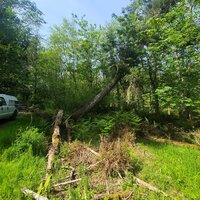
Is there any goal of preserving the supportive tree?I've got a large doug-fir in a wet area leaning hard and bent into another large doug-fir. It fell a few weeks ago. I looked at it last week. It's away from obstacles, along the driveway. Crane access would be possible, not good. $1200-1500 minimun seems avoidable for a no-obstacle, no clean-up job. Not sure how a crane could/ would help until it's untangled.
They are both about 30" dbh.
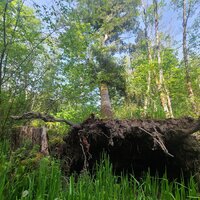
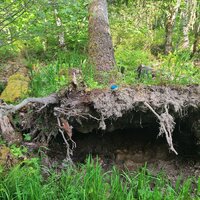
The root plate is 35⁰-ish. The failed tree is strongly bent against the support tree. The root plate (roots broke next to the gravel driveway) is about 3-4' lifted in the high side. The failed tree is laid very squarely into the support tree. Big have large and strong branches, possibly laced together.
I can't see compression side roots to address if they are broken or springy.
There is a lot of bend in the failed tree in thick wood... easily 12" diameter, maybe a good bit more.
The limbs obscure the interaction between the trees.
I can climb up the support tree from the back side If I take time to get a good TIP that doesn't No evidence of domino-uprooting observed.
Its also possible to spur right up the failed tree.
Because of the sizes and amounts of branches, coupled with the lean, I don't expect the leaner to slide/ shear branches in a dependable way.
I can't tell if the failed tree is whittled off the support tree. If it will want to straighten and lift off the support tree, or continue to fall.
I was considering a sloping cut to the side to get it to slide off while the root- plate falls down and back.

This is going to need a 100' lift or a decent climber.Is there any goal of preserving the supportive tree?
Use a high reach aerial lift to buzz off all brush that is free then reassess the plan?
I would need to pull it the failed tree up with a lot of force, I think. Holy Backleaner, Batman!!Set some back stays to hold the trunk until you free the crown and then release?
Super-sketch. Lots could fly lots of directions.Use a lift to make a directional cut mid way up the failed tree that would force things in ideal directions without potential for harm to you or the lift?
The support tree is a significant tree. It definitely can be preserved.Fell them both with a clear exit route strategy?
Dynamite???
Ooooo... now you're on to something!Just pull it back up and replant it?