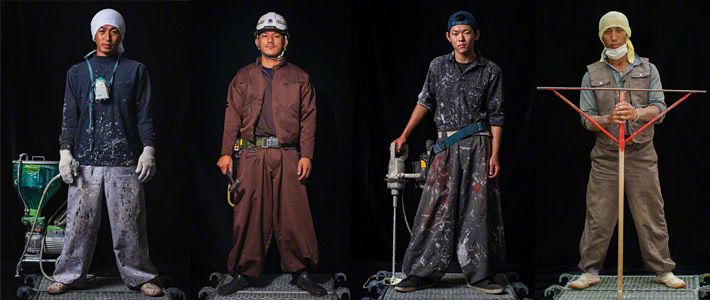
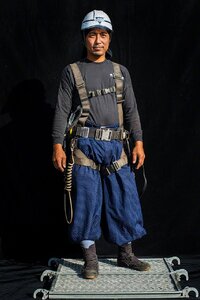
"Loose trousers are comfortable for construction site work, which requires repeated standing and squatting. They are particularly important for high-rise tobi workers who are constantly climbing up and down scaffolding. But keeping them tight at the hems prevents them from catching on equipment or tools and causing an accident."
“Strong wind can be hazardous for tobi,” photographer Matsuda Tadao explained, “but some say the baggy material ensures they are immediately aware of it, and that they can even tell which direction it’s blowing in. Others suggest the pants act as an extension of their sense of touch to help avoid anything dangerous sticking out around their feet in a tight space. I’ve even heard crazy stories about them reducing the impact of falls by catching the wind like the flaps of skin used by flying squirrels. But I think the truth is that a lot of construction workers like festivals and showy clothes, so the pants have got wider and longer to make them stand out.”
The Problem with Current Options:
I’m fed up with poly-blend pants. They may wick moisture away, but they leave behind a lot of gunk and end up smelling terrible after a day's work. I don’t want to have to wash them every single day. Hiking pants? They’re single-stitched and the pockets rip way too easily. Kevlar panel climbing pants have a straight or skinny cut that doesn’t fit my thighs or inseam (or muscular builds in general). And saw pants? They’re heavy and get dirty really quickly.
Could We Learn from the Japanese Workforce?
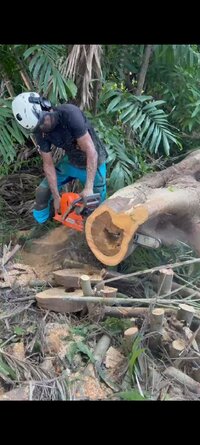
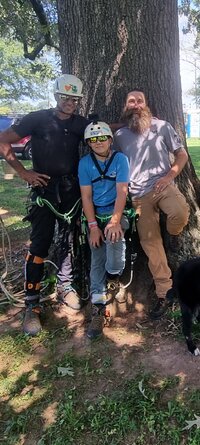
Here’s my thought: what if we had a pair of these loose trousers made with double or triple stitching, maybe with a Kevlar or extra panel knee for durability? They could be made from pre-broken-in Carhartt duck canvas or hickory, as a nod to logging Americana. Ideally, the stitching would be strong enough to avoid the need for rivets, which tend to dig into your skin when you’re wearing a harness or work boots.
Maybe some of the arb brands out there could test a design like this for those of us who value utility over appearance (or for climbers who want to look like ninjas)?
What do you guys think?
Article:
 www.nippon.com
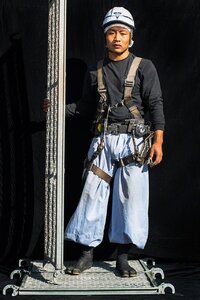
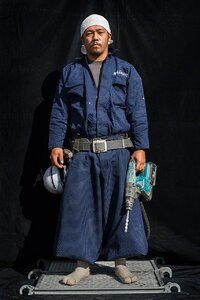
“Strong wind can be hazardous for tobi,” photographer Matsuda Tadao explained, “but some say the baggy material ensures they are immediately aware of it, and that they can even tell which direction it’s blowing in. Others suggest the pants act as an extension of their sense of touch to help avoid anything dangerous sticking out around their feet in a tight space. I’ve even heard crazy stories about them reducing the impact of falls by catching the wind like the flaps of skin used by flying squirrels. But I think the truth is that a lot of construction workers like festivals and showy clothes, so the pants have got wider and longer to make them stand out.”
The Problem with Current Options:
I’m fed up with poly-blend pants. They may wick moisture away, but they leave behind a lot of gunk and end up smelling terrible after a day's work. I don’t want to have to wash them every single day. Hiking pants? They’re single-stitched and the pockets rip way too easily. Kevlar panel climbing pants have a straight or skinny cut that doesn’t fit my thighs or inseam (or muscular builds in general). And saw pants? They’re heavy and get dirty really quickly.
Could We Learn from the Japanese Workforce?
Here’s my thought: what if we had a pair of these loose trousers made with double or triple stitching, maybe with a Kevlar or extra panel knee for durability? They could be made from pre-broken-in Carhartt duck canvas or hickory, as a nod to logging Americana. Ideally, the stitching would be strong enough to avoid the need for rivets, which tend to dig into your skin when you’re wearing a harness or work boots.
Maybe some of the arb brands out there could test a design like this for those of us who value utility over appearance (or for climbers who want to look like ninjas)?
What do you guys think?
Article:
“Nikkapokka” Pants in Style on the Construction Site (Photos)
Photographer Matsuda Tadao’s portraits of Japanese construction workers are taken on site, capturing the reality of their jobs with the sweat and grime of a hard day’s efforts. As well as being fitted to their work, distinctive, baggy nikkapokka pants help these laborers to stand out in the crowd.
www.nippon.com

 .
.