












Navigation
Install the app
How to install the app on iOS
Follow along with the video below to see how to install our site as a web app on your home screen.
Note: This feature may not be available in some browsers.
More options
You are using an out of date browser. It may not display this or other websites correctly.
You should upgrade or use an alternative browser.
You should upgrade or use an alternative browser.
Today....
- Thread starter Mark Chisholm
- Start date

Bendroctanus
Carpal tunnel level member
- Location
- Springfield
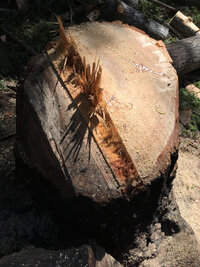
Textbook.More burnt firs on step ground in the CZU


Rico, what attributes to the long holding fibers on half the hinge and not on the other?More burnt firs on step ground in the CZU
I can see where the wedges were pounded in. With that particular stem, did you lay it uphill, downhill, sidehill?

Serf Life
Been here much more than a while
- Location
- Maine Island
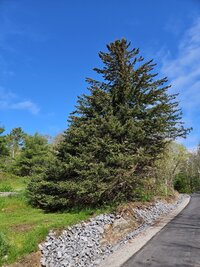
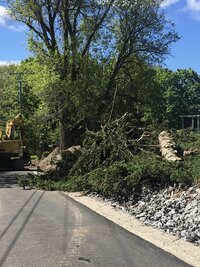
Started today with make a mess and walk away project for a construction company, called last week with short notice “could you please?” etc. Maybe 50’ and 30” on the butt brushy pig, started with top handle and quickly changed my mind, ~1.5hrs from pulling up and chatting. So I head out and pass the project guy.
Him: “Thanks, about how much you thinking?”
Me: “~$500 with drive time”
Him: “How’s about $800 for squeezing it in?”
Gotta love fellow quality trade folk.
Him: “Thanks, about how much you thinking?”
Me: “~$500 with drive time”
Him: “How’s about $800 for squeezing it in?”
Gotta love fellow quality trade folk.
Trying to learn here and want to compare with my own experience going forward…was a conifer so regular cells and compression cells. Were those longer fibers compression or regular?Sent it straight uphill as sidehill or downhill were not an option.
This tree had a pretty decent downhill and sidehill lean so I imagine the long fibers are a result of reaction wood.

isn‘t that quite normal? i thought that is because the front half of hinge fibers becomes compressed and the back part pulled apart.Rico, what attributes to the long holding fibers on half the hinge and not on the other?
I can see where the wedges were pounded in. With that particular stem, did you lay it uphill, downhill, sidehill?

Treemuel
Branched out member
- Location
- Hancock, ME
Homeowner: “I’ve got a ladder set up that you can use to get down the cliff”
Me: “hmm, I think I’ll tie in”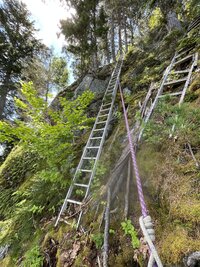
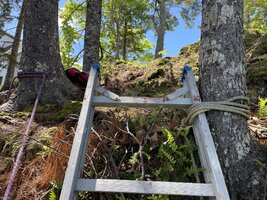
Me: “hmm, I think I’ll tie in”


Maybe to get up...while still tied in. And still better than the "stairs" just to the right.Homeowner: “I’ve got a ladder set up that you can use to get down the cliff”
Me: “hmm, I think I’ll tie in”View attachment 94010View attachment 94011
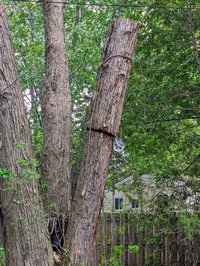
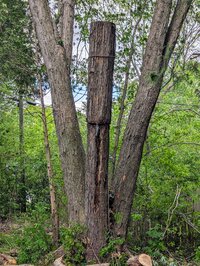
Should have taken more pics, but this was a butt puckerer. 60ft silver maple lead pointed directly at the house, deck, and service wires. About 20" at the girdled point with SIGNIFICANT decay for 5 or 6 feet above it. Had to do some light rigging from it to avoid the wires and fence. Thankfully my ground guy was extra smooth today.
Treemuel
Branched out member
- Location
- Hancock, ME
Yeah, I did use it once on rope, but didn’t love the idea of trusting a ladder someone else placed who knows how many years ago, especially starting from the top.Maybe to get up...while still tied in. And still better than the "stairs" just to the right.
My gaffs seem to find every rotten tree in my and surrounding counties.View attachment 94012
View attachment 94014
Should have taken more pics, but this was a butt puckerer. 60ft silver maple lead pointed directly at the house, deck, and service wires. About 20" at the girdled point with SIGNIFICANT decay for 5 or 6 feet above it. Had to do some light rigging from it to avoid the wires and fence. Thankfully my ground guy was extra smooth today.

Have a look at Rico’s photo and maybe you’ll see what I mean.isn‘t that quite normal? i thought that is because the front half of hinge fibers becomes compressed and the back part pulled apart.
Short fibers along the “face cut” hinge edge and taller fibers along the “back cut” hinge edge is definitely normal. That’s not what I’m seeing in his photo.
While I see typical fibers across the entire hinge, I’m also seeing lots of taller fibers from the pith out to one edge much more so than the other. Perhaps the hinge is slightly wider toward the edge with the taller tension fibers?
Last edited:

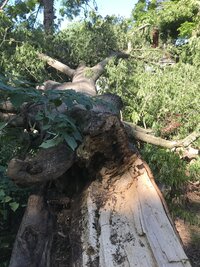
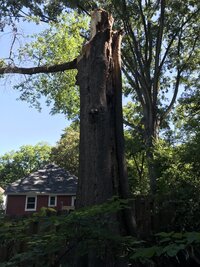
Would this be the same as black willow?This willow oak destroyed this yard, but not the house thankfully. Cleanup today
View attachment 94023View attachment 94022
Or, is that just a slang name I was taught? I've never heard it called willow oak before.
yes, i see what you are talking about. looks like the hinge is slightly fatter on the side where the whiskers stick out of the stump but there is also fibre-pull visible on the other side and they probably protrude out of the butt-log. maybe it has something to to where the fibres break under tension first, due to a slight weakness?Have a look at Rico’s photo and maybe you’ll see what I mean.
Short fibers along the “face cut” hinge edge and taller fibers along the “back cut” hinge edge is definitely normal. That’s not what I’m seeing in his photo.
While I see typical fibers across the entire hinge, I’m also seeing lots of taller fibers from the pith out to one edge much more so than the other. Perhaps the hinge is slightly wider toward the edge with the taller tension fibers?
Graeme McMahon
Participating member
- Location
- Cockatoo
Hi Rico, long time since chatting. Great pic. Was there a slight bias of lean to one side of the felling direction?More burnt firs on step ground in the CZU
Not a willow at all! Common name misnomer.Would this be the same as black willow?
Or, is that just a slang name I was taught? I've never heard it called willow oak before.
Querqus phellos
Extremely common oak tree here. Grows fast and they can get massive












New threads New posts
-
test
-
-
-
-
 Light 14 or 16" narrow kerf bar for 200t or 201t
- Started by southsoundtree
- Replies: 9
-

-








