Structural pruning

macrocarpa

Branched out member
Location
Midwest
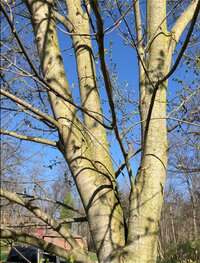
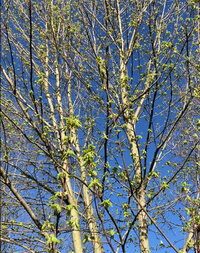
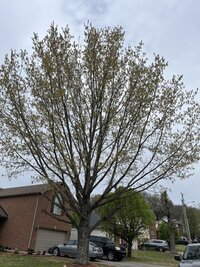
Some trees are simple to know where to make reduction cuts or if caught early enough, remove an entire leader (best case scenario).

But what would you do with this mess? Would you even bother trying to develop a central leader?

This is also one of those cases where I wonder if bracing without cabling would help? Just to give the most susceptible union extra support.
 

Attachments

  • IMG_6614.jpeg
    IMG_6614.jpeg
    162.1 KB · Views: 62
  • IMG_6615.jpeg
    IMG_6615.jpeg
    186 KB · Views: 62
  • IMG_6616.jpeg
    IMG_6616.jpeg
    232.1 KB · Views: 62
You can subordinate competing trunks back to laterals in order to reduce weight/leverage on the bad unions. I have noticed that this practice over time can stunt the growth of the competition while increasing the growth of the desired central leader. If one of the trunks is facing a house/target, then I will usually choose that one for reduction. As you mentioned, catching them early makes a huge difference.
 
It’s red maple. I’m going to subordinate the left side, but it seems like these situations require annual pruning to make any real progress. And in the meantime while the reductions are taking place, I’ve often thought a bracing bolt could help regardless what ANSI standards say that bracing should never be installed without cabling. (unless they’ve changed that?)
 
I’ve occasionally pruned codoms to grow back into the crown with the hopes of grafting or countering the weight on the bad union. It’s not as pretty, but there’s only so much polish a turd can handle.
 
I’ve braced quite a few trees without cables. Always above the union, I know 1 stem diameter is often the recommended place but I’ll go higher if not installing a cable. Frequently double the stem diameter height.

Frank Rinn seems to advocate this quite a bit even for trees that I’d cable. He has a YouTube lecture about it.

If possible I try to assess the side of the tree with the highest target and subordinate that side. One of the main codom stems bifurcates again, can you take out one of those? About half the load and half the foliage on one side?
 
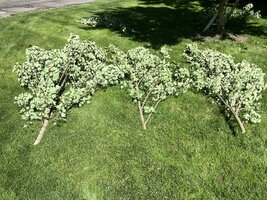
I took three 11ft reduction cuts for this cycle.

It’s only a 7 inch DBH dbh red maple.
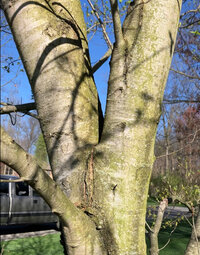
what is the diameter of the main union if it's 7" DBH? I'd guess 3-4" per stem above union. Prob best to not injure the what you will have for the main trunk. I'd likely just to a staged removal of the co dom stem you don't want. I've been whittling my horse chestnut with this in mind, and waiting until mid summer to finally take it all off, its been a 5-6 year process.
 
what is the diameter of the main union if it's 7" DBH? I'd guess 3-4" per stem above union. Prob best to not injure the what you will have for the main trunk. I'd likely just to a staged removal of the co dom stem you don't want. I've been whittling my horse chestnut with this in mind, and waiting until mid summer to finally take it all off, its been a 5-6 year process.
I’d say the stems above the union are 4 inch. Its flares out where they meet above dbh.

I definitely took a lot of weight off of the one side. But it’s going to be a process. I don’t care what they say about if we make the perfect reduction cuts we won’t trigger suckering. There is always suckering when taking that much off the tops with certain species.
 
I’d say the stems above the union are 4 inch. Its flares out where they meet above dbh.

I definitely took a lot of weight off of the one side. But it’s going to be a process. I don’t care what they say about if we make the perfect reduction cuts we won’t trigger suckering. There is always suckering when taking that much off the tops with certain species.
Agreed, If I'm doing a staged removal of a defect I worry less about proper pruning cuts. The goal would be to starve the defective part with a heavy reduction of mass, then hack on it some more the next cycle 2-4 years, and finally remove. hopefully within 4-8 years the main stem will be 50% larger 6-8" diameter and the removed part will be 4.5-6" diameter.

The tree is small and young I worry less about dosage. Would you think twice about removing one 4" branch on a 12" trunk? I wouldnt if that is the only cut being made...
 
This is a tough call, I feel like I get to a tree like this occasionally and it really does make my head scratch... I don't think there's a strong case in my mind for working towards removing one of the stems entirely at this point. A brace is a good idea but I probably wouldn’t bother.
If possible I try to assess the side of the tree with the highest target and subordinate that side.
Yes. If you remove the apical dominant stem(s) on that half of the tree, it will get the message- put the energy elsewhere, namely the upward section of the half of the tree to remain, and the lower / mid branches on the half that is being subordinated. If we are keeping on the tip weight reduction model, we can effectively reduce the leveraging weight on the tight union- I would expect a 3-5 year follow-up to further reduce the subordinated stem would be all that would be needed long term to train the tree.

Evo also raises an important point, what are the targets.

Tight unions like these are also just so common in red maples and less of a red flag than if we saw it in another species.

I spent too much time in years past ‘training’ ornamental sugar maples and red maples to have one dominant stem- I look back now and think that’s hogwash… let them be a big bushy bubble filled with dozens of tight unions, none of them will amount to a large failure.
 
This is a tough call, I feel like I get to a tree like this occasionally and it really does make my head scratch... I don't think there's a strong case in my mind for working towards removing one of the stems entirely at this point. A brace is a good idea but I probably wouldn’t bother.

Yes. If you remove the apical dominant stem(s) on that half of the tree, it will get the message- put the energy elsewhere, namely the upward section of the half of the tree to remain, and the lower / mid branches on the half that is being subordinated. If we are keeping on the tip weight reduction model, we can effectively reduce the leveraging weight on the tight union- I would expect a 3-5 year follow-up to further reduce the subordinated stem would be all that would be needed long term to train the tree.

Evo also raises an important point, what are the targets.

Tight unions like these are also just so common in red maples and less of a red flag than if we saw it in another species.

I spent too much time in years past ‘training’ ornamental sugar maples and red maples to have one dominant stem- I look back now and think that’s hogwash… let them be a big bushy bubble filled with dozens of tight unions, none of them will amount to a large failure.
I like that approach!

But I have to say I do see large sections blow out fairly often to the point where the homeowner ends up removing the tree.

Red maples are one of the shittiest trees to plant imo and it just happens to be the most common tree planted where I am. Root dysfunction, included bark/poor structure, chlorosis, etc.
 
I like that approach!

But I have to say I do see large sections blow out fairly often to the point where the homeowner ends up removing the tree.

Red maples are one of the shittiest trees to plant imo and it just happens to be the most common tree planted where I am. Root dysfunction, included bark/poor structure, chlorosis, etc.
Yeah, I’d say blowouts of Red maples with included bark are one of the most common storm damage failures in my area.
 
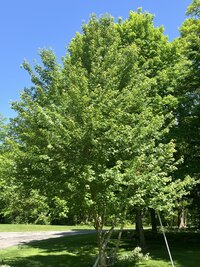
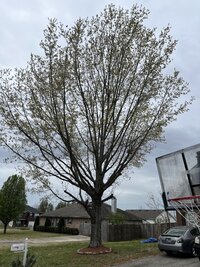
I’m not sure what to do with this tree that homeowner says is an Oak. The existing structure isn’t Oak like. Is this a case of doing the Gillman pruning. Going out each branch and pruning the larger limb? Homeowner wants it reduced and not hacked like the one in the picture background. It has long branches and I’m going to rent a lift if I do it. Any guesses how long it will take? I really haven’t done an overall pruning like this but, willing to give it a go. Advice?
 

Attachments

  • IMG_4949.jpeg
    IMG_4949.jpeg
    1 MB · Views: 32
  • IMG_4948.jpeg
    IMG_4948.jpeg
    1 MB · Views: 36
I’d focus on thinning and minor reduction on the scaffolds. Larger reduction on the narrow attachments of the central leader, train sprout growth on the stubs.
If it needs reduced to control the size it’s probably the wrong tree in the wrong spot
 
You may have an undoable task. Note the long leaders everywhere. Nowhere good to cut back to without looking like a hack. Also there's the possible interpretation of reducing the density of the tree structure/content - don't do this it's an invitation to wind breakage. The other interpretation of shortening leader length to shrink the tree size doesn't look promising. How much size reduction does the customer want - without the result looking like a hack? Lucy you got some 'splainin' to do to this customer :)

oh - IMO this can't be Gilman pruned every "leader" is roughly codom to each other
 
Last edited:
I’d focus on thinning and minor reduction on the scaffolds. Larger reduction on the narrow attachments of the central leader, train sprout growth on the stubs.
If it needs reduced to control the size it’s probably the wrong tree in the wrong spot
Wrong tree in the wrong spot?! Poppycock! Whoever heard of such a thing?!
 
You may have an undoable task. Note the long leaders everywhere. Nowhere good to cut back to without looking like a hack. Also there's the possible interpretation of reducing the density of the tree structure/content - don't do this it's an invitation to wind breakage. The other interpretation of shortening leader length to shrink the tree size doesn't look promising. How much size reduction does the customer want - without the result looking like a hack? Lucy you got some 'splainin' to do to this customer :)
But Ricky, I want it to look like I've been maintaining the tree for a long tiiiiiiime!
 
I’m not sure what to do with this tree that homeowner says is an Oak. The existing structure isn’t Oak like. Is this a case of doing the Gillman pruning. Going out each branch and pruning the larger limb? Homeowner wants it reduced and not hacked like the one in the picture background. It has long branches and I’m going to rent a lift if I do it. Any guesses how long it will take? I really haven’t done an overall pruning like this but, willing to give it a go. Advice?
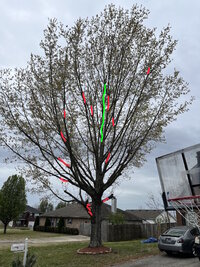
I've heard Gilman talk about branches being "too high from down too low". In other words, the tallest parts of the tree shouldn't originate as branches from the bottom half of the canopy. I think you can start to move towards something resembling a leader. Granted, this is looking closely at one angle, but I think I'd look at something like:
(green line = leader? I think its the same one that looks good from the other pic as well)
(I think the red lines take out the tallest pieces that are higher than the leader - that's a main goal with most of those cuts...its just a question if I traced them back in the picture enough)
It really helps to have somebody on the ground understanding what you are trying to accomplish to communicate back and forth.
oak.jpeg
 

New threads New posts

Kask Stihl NORTHEASTERN Arborists Wesspur TreeStuff.com Teufelberger Westminster X-Rigging Teufelberger
Back
Top Bottom