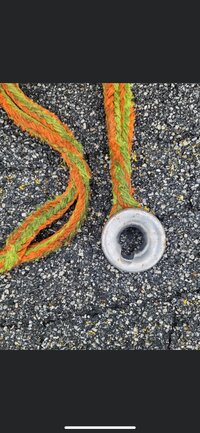
Rigging ring as primary rigging point for negative rigging.

To me this is a propaganda talking point from the anti-ring people. No, I don't believe that running a rope through a ring, from whatever height and at whatever speed, could ever melt a sling. If anyone has a case study example of this ever actually happening, I would love to hear about it.

Do rings get warm? Yes. Hot even? Yes. Hot enough to worry about melting a sling? In my experience no. If worried about that then just use a block. I prefer extra friction for negative rigging, and rings are a nice compromise between natural crotching (too much friction) and blocks (almost no friction), so I use rings.
David has a ton of data on this. Unfortunately I doubt he'd want to revisit the conversations.
 
I bet blocks are better on rope. Rope is a consumable.
High quality, anodized x-rings are gentle on rope. If you don't like rings, then use blocks. No sense in wasting time or energy trying to sell people on the idea of rings when they've already made up their minds on the issue.

For myself, I use blocks up top for most overhead rigging, with rings down below for setting up better vector angles. Then I switch over to rings for negative rigging.
 
You will never ever melt a sling, throwing anything at a ring. I have many well used rings, all original xrings. Taken nuff big wood negative rigged. They still rolling along. Slings have been replaced once in 9 years about. I have had rings I could not touch after a rig, but slings fully intact and those are all 5/8th tenex.
 
High quality, anodized x-rings are gentle on rope. If you don't like rings, then use blocks. No sense in wasting time or energy trying to sell people on the idea of rings when they've already made up their minds on the issue.

For myself, I use blocks up top for most overhead rigging, with rings down below for setting up better vector angles. Then I switch over to rings for negative rigging.
Rings are far better than some methods for rope life.

I mostly use rings, but more often natural crotch, regular or double- whip tackle. Bunch of lowering devices in the stable, but only occasionally do I need to negative rig wood.
My market often allows armoring the dropzone, or dirt and gravel to catch logs, if a forested spot isn't available (minding neighboring trees root zones).
 
If it’s at all possible to avoid neg rigging I do it.
lawns, shrubs whatever can get stuffed, a bag of dirt is not worth my safety.
Rings or block pulleys makes no odds to me. I always operate well within safety limits on neg rigging, I price accordingly.

I understand west coast conifer workers operate with different metrics and are consequently more practiced at this stuff.
 
I think many, many West Coast conifer climbers are good at cutting rounds and chucking, standing in spurs for a long time.


Advanced climber/ riggers are more practiced.

Some are crane-dependent climbers.

Conifer firewood is easy to leave/ haul.

You need a lot of logs to make commercial hauling more cost effective. Short logs pay less per board-foot.

A commercial log truck carries about a maximum of 5000 board-feet (1x12x12"), needing a log loader or big excavator on-site. Self- loaders carry about 3000. Someone, please chime in with better accuracy. I've only hired a self- loader for one job, using a friend's smaller kboom on an F800/ 33,000 gvwr for a lot.
 
I have a couple plain aluminum rings, I don't mind them. Anodized is better.

Someone is being dishonest, whether intentionally or not, about the ring in that picture being damaged like that from rigging a tree. There's no way.

"Yeah man, we let this thousand pound top run on this 7000 ft tall redwood we were working, and now look at this ring!....... Also, we were using steel cable not rope....."
 
Last edited:
I have a couple plain aluminum rings, I don't mind them. Anodized is better.

Someone is being dishonest, whether intentionally or not, about the ring in that picture being damaged like that from rigging a tree. There's no way.

"Yeah man, we let this thousand pound top run on this 7000 ft tall redwood we were working, and now look at this ring!....... Also, we were using steel cable not rope....."
A lot of lying goes on in social media arbworld. I sniff it a mile away. That there is bullshit.
 
Just a guess but it looks like that ring was used as a redirect for some kind of winching setup. Or several.
...with steel cable. Or many, many pulls. I have seen some stupid shit go down, and it takes a whole lotta friction to cut that much aluminum; that didn't happen quickly.
 
Winching on sand dunes?


When cutting invasive tamarisk in the desert, NPS Invasive Plant Management Team crews would have somewhat like- new cutters, and have to shorten chains due to wear. Maybe each rivet hole wearing some, plus maybe stretching chains from heart and softer steel.
Our conservation crews only worked along side them a little while, and used Stihl chain, without anyone bottoming out their tensioners.

I got to work in the desert wash where Edward Abbey wrote off the Moon-eyed Horse in Arches NP in Desert Solitaire. Found some quicksand while scouting, solo. Only one step in, as I was trotting along.

 
  • Like
Reactions: evo
Winching on sand dunes?


When cutting invasive tamarisk in the desert, NPS Invasive Plant Management Team crews would have somewhat like- new cutters, and have to shorten chains due to wear. Maybe each rivet hole wearing some, plus maybe stretching chains from heart and softer steel.
Our conservation crews only worked along side them a little while, and used Stihl chain, without anyone bottoming out their tensioners.

I got to work in the desert wash where Edward Abbey wrote off the Moon-eyed Horse in Arches NP in Desert Solitaire. Found some quicksand while scouting, solo. Only one step in, as I was trotting along.
Even with a rope that was intentionally coated in 40 grit sand paper, you'd have to either not be paying attention or just pushing past that point where you know bad things are happening, but it must or something worse will happen.
 
If someone tried to cut that profile with a dull end mill it would take a while. Or with a round file. Bend radius would not cooperate with a steel cable, they're picky about bend fatigue and it wouldn't leave such a clean cut. Maybe extensive use with severely grit infused rope like mud or sand. multiple pulls without inspection. Aren't even plain rings 7075 or are they mostly 6061? I've lost track.

I've always figured the friction heat gets divvied up between the rope and the bollard/ring. Never yet found an answer as to quantitative proportioning. In machining I think it's known how much goes into each of the piece, the chip and the tool. So it could be figured out (measured).

BTW, has anyone ever got the scoop on the machining procedure to make a rigging ring? I've never clearly visualized it. Best I can come up with is a reach-around boring bar for the backside inner curve while the stock is still in the lather before parting off. Or a special collet to hold the ring after outer grooving, flip the ring to front cut both inner curve faces. ?
 
Last edited:

New threads New posts

Kask Stihl NORTHEASTERN Arborists Wesspur TreeStuff.com Teufelberger Westminster X-Rigging Teufelberger
Back
Top Bottom