












Navigation
Install the app
How to install the app on iOS
Follow along with the video below to see how to install our site as a web app on your home screen.
Note: This feature may not be available in some browsers.
More options
You are using an out of date browser. It may not display this or other websites correctly.
You should upgrade or use an alternative browser.
You should upgrade or use an alternative browser.
Today....
- Thread starter Mark Chisholm
- Start date

i is
The only advice I have on using snipes is to always remember that they can and will influence your lay, so you want to make sure they are squared up with your undercut.. I do this by simply using a log tape to measure out from the intersection of the undercut. Scribe a line and the snipe is perfectly squared up and will not have a negative influence on your lay.
I used the snipe on this spar for 2 reasons. Since I had to high stump (shorten) this spar to clear a water line the snipe helped the butt to sit down. Secondly the spar was fat, but short, so the snipe help the spar get enough forward momentum and speed to power through the hinge. The snipe combined with a slightly gutted hinge mitigated the chances that it would come to a stop as the undercut closed up.I notice you are using some snipe cuts in addition to a conventional notch in a few of your photos @rico
Would you mind sharing some tricks and opinions about its use?
The only advice I have on using snipes is to always remember that they can and will influence your lay, so you want to make sure they are squared up with your undercut.. I do this by simply using a log tape to measure out from the intersection of the undercut. Scribe a line and the snipe is perfectly squared up and will not have a negative influence on your lay.
Last edited:
Shadowscape
Been here a while
- Location
- far north
I swear you mark it with a laser level before you cut.Another 200 ft menace gone.
View attachment 90975
View attachment 90977
View attachment 90978
View attachment 90979

And I could have told you that your negative rigging setup was going to let it hit the ground.

Right on, thanks for the explanation for that situation and the advice on its need to be square to the face.i is
I used the snipe on this spar for 2 reasons. Since I had to high stump (shorten) this spar to clear a water line the snipe helped the butt to sit down. Secondly the spar was fat, but short, so the snipe help the spar get enough forward momentum and speed to power through the hinge. The snipe combined with a slightly gutted hinge mitigated the chances that it would come to a stop as the undercut closed up.
The only advice I have on using snipes is to always remember that they can and will influence your lay, so you want to make sure they are squared up with your undercut.. I do this by simply using a log tape to measure out from the intersection of the undercut. Scribe a line and the snipe is perfectly squared up and will not have a negative influence on your lay.
I have wondered how much an obtuse snipe can influence the lay- purposely or accidentally
Last edited:

southsoundtree
Been here much more than a while
- Location
- Olympia, WA


Bendroctanus
Carpal tunnel level member
- Location
- Springfield
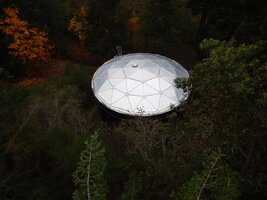
Pretty much sure that there’s one of ‘em UFO’s…Kind of an odd one, looking down on a water tank as I was doing some work nearby.
View attachment 91069
southsoundtree
Been here much more than a while
- Location
- Olympia, WA
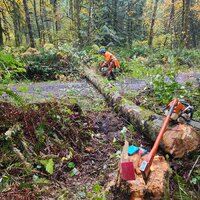

chiselbit
Been here a while
southsoundtree
Been here much more than a while
- Location
- Olympia, WA
What kinda jack do you have/ like?
chiselbit
Been here a while
chiselbit
Been here a while
I’ve got a few, that one is a Borntrager 53 ton. I really like it. Small, powerful,,What kinda jack do you have/ like?
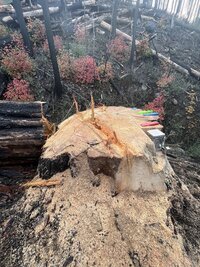
Beautiful work at the stump Dan, and kudos to you for working in that burnt up wasteland for so long. You are a tougher man than me bro. I spent a few days last week back in the CZU area climbing and fallen some burnt firs on some crazy steep terrain and I couldn't get out of there fast enough.
chiselbit
Been here a while
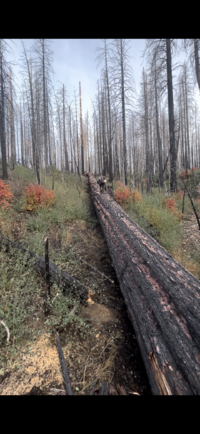
Thanks Erik, yeah it’s pretty unpleasant sometimes but it feels good to do if you know what I mean. This portion is roadside hazards, cutting everything that will reach the roads, so we are making it safer for everyone and it actually looks a lot better after the machines go through and pull the logs and pile all the debris. Once they burn it and replant we can get a forest started again. Feels good to be a part of that.Beautiful work at the stump Dan, and kudos to you for working in that burnt up wasteland for so long. You are a tougher man than me bro. I spent a few days last week back in the CZU area climbing and fallen some burnt firs on some crazy steep terrain and I couldn't get out of there fast enough.
southsoundtree
Been here much more than a while
- Location
- Olympia, WA
I took a small hemlock top!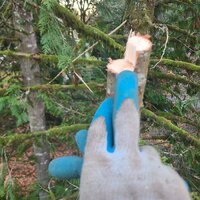
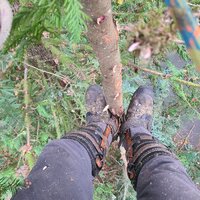
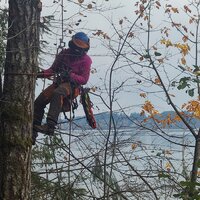
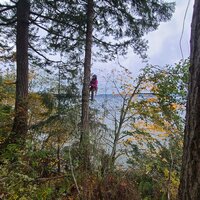
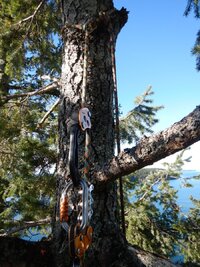
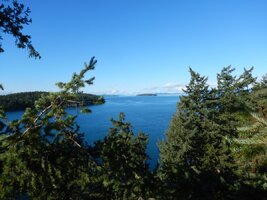
I was up in this fir the other day when my ground guy said he heard whales (when you are close to the shore you can hear the exhale), so I stopped working and saw a few orcas swim by, which was pretty awesome. Wasn't fast enough to get my camera out and take pictures though.
southsoundtree
Been here much more than a while
- Location
- Olympia, WA
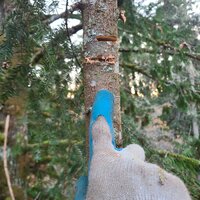
Not a day for tree spurs!I took a small hemlock top!View attachment 91146View attachment 91145
That to held my entire weight on the lanyard.
Smallest top I've ever cut.
Newer climbers would benefit a lot by doing this. My finger is actually touching the trunk.
I'm tied into about another tree, above and left.
This is the regrown top (hemlock, so with a rot pocket) that is about 25' tall, slow growing in the shade of a lot of trees, winding it's way up into a cedar.

Matias
Been here much more than a while
- Location
- Butte County
My foreman challenged me to go as high as I would to take the top on this little 35' Doug fir in between a house and fence, and I got to that diameter. I totally agree that new climbers should try to go to the highest they can go; small tops are easier to manage.Not a day for tree spurs!
That to held my entire weight on the lanyard.
Smallest top I've ever cut.
Newer climbers would benefit a lot by doing this. My finger is actually touching the trunk.
I'm tied into about another tree, above and left.
This is the regrown top (hemlock, so with a rot pocket) that is about 25' tall, slow growing in the shade of a lot of trees, winding it's way up into a cedar.View attachment 91157




















