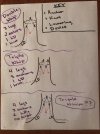
Double whip vs triple whip configuration question

Seth McPherson

New member
Location
Cincinnati
0A33E8A2-B4AD-4FAB-A804-25F5729D850C.jpeg
I’ve done a bit of double whip tackle for negative rigging (and solo rigging but that’s a different animal). Ive never used the triple, 5:1 or 6:1 setups etc. I’m aware that these rigging techniques aren’t often absolutely necessary but I work in an urban environment that’s full of steep grades and I would rather rig and cut less than chunk with a big saw.
I’m wondering if anyone can help me out with the diagram in this thread. If the third one is not a true 4:1/triple whip then I would appreciate some help in understanding why. It takes the knot out of the rigging line and also adds more rope into the system which are good things and doesn’t necessarily require a man for each lowering device if you lock off one side (or both sides). Any feedback would be greatly appreciated!
 
I like where you are going with this. To be honest thinking through a mechanical advantage system that gets built vertical and then fold as the system take the load kind of melts my brain. So for quick reference I went back to my rope rescue training. Perhaps some of the illustrations will help you get to where you are going.


let me know how it works out!
 
So from what I see there, your last drawing is no longer even a double whip, it’s basically two parallel single blocking setups. While the load is shared between the two LDs, assuming they are running exactly in parallel (highly likely in reality) your load would be split between them evenly giving you the equivalent of a simple double block system, but with far more gear. In reality though, your loading is probably going to be very uneven because you’ll never get the two LDs to run exactly in parallel, so your forces will not be as evenly split.
 
I agree with @Reach

It’s a cool idea, though. It may have an application in an odd span rig. You could tension and lower from both sides. This would theoretically mean that you could crank more force into your system if you are using a rope that stores energy (like polydyne) because of the increased total rope and redirects. You could also let it down a lot faster, if that ever mattered. Lots of setup, however. Pendulum rigging would probably be more versatile in the same situation.
 
So from what I see there, your last drawing is no longer even a double whip, it’s basically two parallel single blocking setups. While the load is shared between the two LDs, assuming they are running exactly in parallel (highly likely in reality) your load would be split between them evenly giving you the equivalent of a simple double block system, but with far more gear. In reality though, your loading is probably going to be very uneven because you’ll never get the two LDs to run exactly in parallel, so your forces will not be as evenly split.
So the third scenario or even the second scenario are not the ones I’m going to choose if I want any kind of a run. I figure 4:1 (and greater MA) negative rigging systems are for when a run isn’t possible any longer. That said, the rope needing to move through the LDs at a similar rate is not really a concern to me but I have seen dual systems work well in tandem by mirroring the friction on the LDs and joining the ropes together.
The part I’m not sure about is what you mentioned before about the breakdown of the third configuration. To me it looks like 2:1 next to a 2:1 in the same system supporting the same load. In my understanding, which is where I need help, I thought this equated to a 4:1 by adding the MA. When MA is stacked then it’s multiplied (not an expert, just stating what I think I understand - happy to be corrected)
 
I like where you are going with this. To be honest thinking through a mechanical advantage system that gets built vertical and then fold as the system take the load kind of melts my brain. So for quick reference I went back to my rope rescue training. Perhaps some of the illustrations will help you get to where you are going.


let me know how it works out!
Thanks! I definitely will be looking through that.
 
I agree with @Reach

It’s a cool idea, though. It may have an application in an odd span rig. You could tension and lower from both sides. This would theoretically mean that you could crank more force into your system if you are using a rope that stores energy (like polydyne) because of the increased total rope and redirects. You could also let it down a lot faster, if that ever mattered. Lots of setup, however. Pendulum rigging would probably be more versatile in the same situation.
Gotcha. Thanks for the response. Can you elaborate on pendulum rigging? I’ve not heard of that. I have an idea from the name but a drawing would be awesome
 
The second one is a 3:1

last one is two 1:1 that split the load when magically running evenly together if the top ‘À’ is a knot/friction-locked termination to the piece that folds down.

If the anchor to the piece is a rigging-ring/block etc, then you have two parallel 2:1 (two to one if mechanically lifting using one leg of the rope, or again two 1:1 if magically lifting both legs of rope at the same time but seeing half the load)
 
My reply was more of a tangent on the application’s potential use in canopy rigging. Mr. ADD here (me).

Just as double-whip is to span rigging, your last configuration could be used with more distant anchors. Pendulum rigging is the use of two separate high-angle lowering systems on a single piece of work. Usually each system is terminated at a separate end of the work piece, which allows it to maneuver the work. The stem-rigging equivalent of Pendulum rigging is double-blocking. Just for clarification.
 

New threads New posts

Back
Top Bottom