













JeffGu
Been here much more than a while
- Location
- Osceola, Nebraska
...every climber needs to have double of everything...
That's silly. I need THREE of everything I own. You say that like it was a bad thing!
Follow along with the video below to see how to install our site as a web app on your home screen.
Note: This feature may not be available in some browsers.
...every climber needs to have double of everything...
The rope management and bridge attachment issues are potentially huge and will no doubt dominate the climber's mind to the detriment of his concentration levels.
This is exactly my concern. Unless the rules are highly tuned to tree work, perhaps phased in as an overall plan to develop better, safer systems, it's doomed to be little more than a major nuisance that most climbers will ignore.
This is exactly my concern. Unless the rules are highly tuned to tree work, perhaps phased in as an overall plan to develop better, safer systems, it's doomed to be little more than a major nuisance that most climbers will ignore.
Whether a removal or a prune, I set multiple lines from the ground, with a plan to be able to move from one system to another without dragging systems all over the place in a disorganized way. Shorter ropes more conducive to not having 120 feet of tail lying on the ground, TIP placement that allows better access to where the work needs to be done. This doesn't mean trying to keep these systems all attached to me... I just need to be able to get to those lines when I need them. That, in turn, allows better access to more of the tree, because it's much more of a three dimensional space you're working in... not as two dimensional as one rope, one lanyard.
Currently, I'm still on one system until I need, or arrive at, the second line. A third line might be on the other side of the tree, when I drop one line and move to it. This is NOT what this rule would entail, and that might be it's downfall. I believe that most climbers would love multiple systems if they just played with it... without any demand to be tied into them all the time. So, ideally, you would allow single-line movement while you navigate to other systems placed where they will allow the most time on dual systems while the work is being done. More of the work will get done on two lines, because it opens up amazing work positioning options and better safety.
It doesn't help much to just negate their reasoning, without offering a better alternative. My only suggestion right now, is perhaps this: After climbing your ascent line to the TIP and verifying a good, solid anchor (or fix/move it at this point) then a single line is OK to get around to where you need to work, and tying into a second system while working. Since access and positioning options are both greater and safety is greater, most of the work will be done in accordance with what they are after! Much less time spent on a single line, and at least we can use our own judgement as to the risk involved with that line. I have climbed to my TIP many times and reworked it a little... moved it a bit or even quite a bit... configured it to wrap the trunk and be supported vertically by the limb it was originally on (I do this a LOT) or whatever.
This just strikes me as a better option. It's an opinion, and I don't expect anyone to agree with me, but I'm trying to point out that we all could probably be instrumental in developing a better set of rules than simply adopting other rope access principles for working in the monstrosity that is tree work.
Skip to 4.25 in this vid, Rich Hattier is using twin wrench SRT lines with a lanyard for work positioning. I know Kevin has run twin lines this with his Roperunner.
Food for thought.
.
... It doesn't help much to just negate their reasoning, without offering a better alternative...
I see a couple of other issues - for example do you recommend having totally duplicate systems - same ropes, same prussik cords or two RR's on two of the same ropes so you don't run the risk of coming down at slightly different rates? If so, you're into generally buying your chosen rope system X 2. Anybody messed around with different gear used concurrently? (in this video Richard had two different rope colours).
Another issue for me really is the time it takes sometimes to set a second rope system in some trees - forget about just firing something up into a couple of wide open deciduous tree unions - I'm talking about say conifer messes where you can run the risk of setting the world record number of attempts to set a line and looking like a prat to your customers anyway (been there, done that). This is based on some of our high powered scientific trials on even setting a second line into another conifer tree in the normal course of business (mature thick canopies with a tangled mess of crowns up high everywhere). Who was it a long time ago that said if their foreman pulled up and didn't see cuttin' goin' on after the lads were on site for 30 min there'd be more than questions?
So to me this has to progress way past it's a really cool idea and into some widely documented and demonstrated standard practices. Please don't try and sell me on something without considering and working thru all the variables the folks in the industry will encounter - tree work varies all over the world and the genus/ species you're working on/ tree condition, etc. influences what work style is practical tremendously. Industrial worksites are engineered and consistent, so we can SPRAT'ly on there. Trees are anything but.
I've climbed with multiple different systems combinations, and add long as you're semi proficient with each of them on their own, it's not an issue at all. Even things as different as the akimbo, hitch hiker and zigzag/chicane your brain and hands just intuitively make it work smoothly. Even on long descents with speading anchors, you can easily feather one vs the other and float between them.
Pro tip to make it brain dead easy to descend... load into one system, slack off the other; completely collapse the hitch and hold it there while you descend on the other primary system
Thats a fair point. I climb in the north east us and rotate ropes in the winter to allow them to dry and avoid most freezing issues.It IS an issue for me because I always back up the decsender with a munter below on my leg loop to strip wet crap off my rope - habit from ice climbing. And to say that your decender won't fail now because we have two, well can't two slip on two icy snowy ropes just like one - it's the hitch or the ATC or the F8 that is all rhimed up. Hence the use of the twisty thing to get the glop off the rope! Just sayin' - havin' that right hand on the rope way below the descender, whatever it is, gives this cowboy great comfort comin' earthwards. Now I'm just working two different devices. (this ice thing isn't probably an issue in southern US but it sure can be up here in the Great White North - also arb ropes aren't dry coated like alpine lines are)

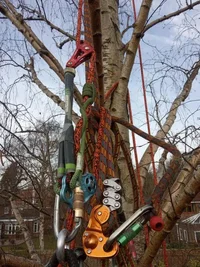
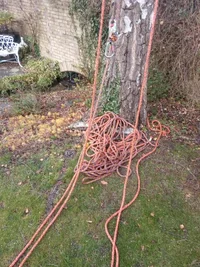
If we can't manage our tails and also cut ourselves mb you we shouldn't be in the tree.
If we can't manage two ropes/systems and perform the work mb we shouldn't be in the tree.
With that said, I said to myself today once in the top centre of todays climb this is bad fuckin idea mostly because my help didn't want to drive in the storm, so by myself.
Did the whole day in large spreading Walnut two systems 150 and 200' ropes, lanyard, cabling rope/two spans, dw and prune dragging around a chainsaw and 22'hyuachi, serious climb and tip change overs x 4, most of day on ddrt alternating between devices,in snow squal 50km with wind chill minus 18. no jam, no pickles, no back to ground, no dropping tools except a sling and chain saw scabbard. very enjoyable climb cause you have to
Normally I would of been done by noon, today on the ground at 2pm. no ground help made me loose time with rope management.
Early in my career with one system and lanyard this tree would of taken an hour or two longer.
resist the change all you want. The truth is this is faster and safer. not all the time but you win some you loose some.

Remember when single line climbing was suggested years ago for tree work and everyone lost their minds about how it would never happen and how it was dangerous or how it was so impractical for work? Then a bunch of climbers quietly went about making it a thing and safe and now something that is a norm..... yea, funny how things start as absurd and end as a norm. That doesn’t mean everyone may like it or do it though. Just a thought.
Best answer anyone to my knowledge or experience can give you to that last question would be “if you feel three, four, five lines, a helicopter, a crane, or going to bed waking up and starting over is safer.... then that’s what it is”. Some things should be sufficiently attempted prior to having strong feels one direction or another about them. Even in Rope Access they give room for times that two ropes are not “safe”. Although you have to prove it’s not first. No different then not using a lanyard and we all know someone that will tell you a lanyard is just a waste of time in a job that has pressures to get things done fast due to money. I get the pressure of work, and I get the feeling of being barked at to go faster. I also get what it’s like to take a 40 ft whipper and spend the night in a hospital. I get what it’s like to tell someone there loved one is dead or badly hurt. Change is always difficult in many levels. Giving change a shot though is of the utmost importance, even if in the end it’s not adopted.Agreed, even five/six years ago there were climbers around here free climbing many trees before tying in, to avoid time penalty for isolating a crotch. Now almost no one does it unless a climber does it to throw some excitement into a job he now finds boring.... some bosses must tear their hair out...
Now we have SRT and the need for that has decreased quite a bit as techniques and equipment has developed to make ascent quite quick now and few could justify free climbing for any reason...
But if the job is 10% safer (guesstimate for arguments sake) with twin ropes, why not make it 13% safer with three ropes? At what point is the job sufficiently safe?





















