UK. Two ropes at all times(USA next?)

  • Thread starter Thread starter TC
  • Start date Start date
I just love my base anchors. I just can't see how they could be considered a waste. I feel like they give me so much. Canopy anchors have their place. Removals, but removals are boring anyway. Nothing like spreading a base anchored web through the canopy.

One thing about rope access work. Being on a ledge or having three points of contact counts as an attachment. Lots of time in trees is spent in this scenario of being essentially secured to the tree with a solid three points. Two ropes in rope access is when you are in free air.
 
I was once screamed at doing an abseil descent after changing over ropes because the mandatory gloves they gave me were too long in the finger and the tip of the right glove got stuck in the device.

the traditional left hand lock on an abseil device is to grasp the rope and device in the left hand as a soft lock (as opposed to a tied off lock off) so I could pull my hand out of the glove and tie off so I could free the glove.

The supervising safety instructor watched all this and then screamed at me for taking my right hand off the rope. Obviously made situation worse by saying I had a left hand lock applied (which he already knew).

He subsequently said issued gloves don’t get stuck in descent devices, and I was in violation of rules. I was supposed to call in a rescue (for shaming purposes) rather than safely self extricate, and he reframed the facts as he saw fit.

Sometimes bureaucracy is helpful. Sometimes totalitarians disguised as bureaucrats are another monster altogether. I fear the OSH authorities driving the twin ropes regulations are of the latter variety...
 
One thing about rope access work. Being on a ledge or having three points of contact counts as an attachment. Lots of time in trees is spent in this scenario of being essentially secured to the tree with a solid three points. Two ropes in rope access is when you are in free air.

When you are cutting with the saw, your hands are not being used as an attachment, your feet, legs etc maybe, but every time you're cutting you're essentially in free air, your main rope and lanyard/flipline holds you in the work position.

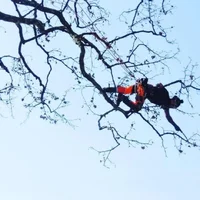
In this scenario, there are 3 points of contact with the tree, the feet (knee) and left hand. But anything happens to that rope and he's gone. Not that anything should happen to it. Our problem is that HSE use the industrial rope access guys (along with IRATA) as a comparison and they look at us and ask, why no second line?

233237263-0baf8c16-0b1f-4ba7-aee4-c5fc65282a6d.jpg
 
Last edited:
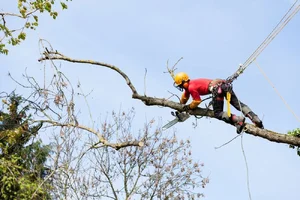
Better example, the 3 points of contact as an attachment argument (in most tree work situations) would count for nothing (in the eyes of the UK's HSE). They would just argue that if his main line fails he's falling, caught by his flipline but how many lateral branches we work on will hold the climber's weight in a dynamic fall situation? not many, especially the further out on the limb you are. We use the lanyard or flipline primarily for work positioning to stop a pendulum swing not to save us from a fall.

The HSE now want to see two full length climbing ropes (DdRT or SRT) coming from a top tie in point in this scenario. EDIT (the top rope in this pic looks like a light rigging line, not a second rope)

Tree-surgery-fencing-8.jpg
 
Last edited:
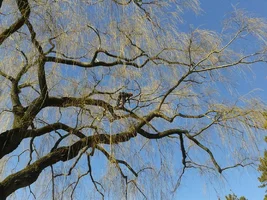
Ok, final pic, HSE wants this climber on two full length climbing lines anchored preferably at two different anchor points high in the tree. Now imagine working this tree DdRT (which the vast majority of UK climbers are on). The rope management and bridge attachment issues are potentially huge and will no doubt dominate the climber's mind to the detriment of his concentration levels. Add in a lanyard for change overs as you always have to be attached to the tree twice at any one time and it almost makes climbing unworkable. The additional time this will add to the job is off the scale.

Professional_tree_climber.jpg
 
I know one climber personally that cut his own basally anchored line, so its not just the idiots on the ground. There is potentially an idiot in the tree.

Any climbing line means a trailing rope...

"ANSI Z133 7.1.4 Workers shall maintain a safe working distance from other workers when using hand tools and equipment." What a "safe working distance" is will have to be answered by each individual unless there is a larger company policy being followed.

Was this person looking at the rope that they cut, or making 'blind cuts'?

A trailing rope alternative is a rope-bag. Having different lengths of rope helps this, and/ or using a base-tie so that the standing end of the rope just reaches the ground. The standing end then just needs a little bit of rope end managed to keep the rest off the ground, whether bagged, tied up to the base-tie so it can't dangle, possibly attached back to the base of the tree, so it can't get pulled into a nearby chipper by poor judgment.
 
Was this person looking at the rope that they cut, or making 'blind cuts'?
A "blind cut" as you're calling it. reached around the trunk for a stub I think and cut his own rope. To be honest, that guy deserves to fall out of a couple of trees, but a valuable lesson nonetheless.

The arguement of "training" people how to use questionable techniques is a red herring. Like training someone how to "properly" one hand a chainsaw. Better to teach them how to choose the climbing/cutting techniques that limit their exposure to risky behaviors.
 
The arguement of "training" people how to use questionable techniques is a red herring. Like training someone how to "properly" one hand a chainsaw. Better to teach them how to choose the climbing/cutting techniques that limit their exposure to risky behaviors.

Everyone has a different list of ‘questionable techniques’. Training to understand the shortcomings is proper training
 
When problems arrise, it's always the fool, and not the tool, that's at fault.

From Limbwalker's perspective, basal anchors are riskier than canopy anchors, because the climber's life support system takes up that much more space on the jobsite. Now it's easier for a ground worker to cut the climber's rope (happened to a friend of mine... lived to tell the tale), easier to drop a big chumk and have it damage a basally anchored line (happened to another friend), or even for another climber in the same tree to cut the other climber's line.

Like I said, we do allow basal anchors for access, and then require changing it to a canopy anchor. Also, we allow it if the climber AND Crew Leader agree that it is the safest option and it will generally be anchored on an adjacent tree. Option 1 has been used regularly since we added the policy. As far as I know option 2 has never been used.

The most interesting anecdote to me from implementing our restriction on basal anchors... I assumed that I'd get a fair amount of blow back since we had a lot of climbers using SRWP. The ONLY climber that complained was a DdRT holdout that like to float a pulley and base tie the anchor line. He ended up embracing the Rope Wrench and never said anything about missing the basal tie.

Honestly, I think SRT makes the work SOOO much easier, that it may just be laziness that keeps people using basal anchors. Its harder to establish a canopy anchor, so its equivalently hard to fail the system. It requies learning a few anchor options and learning how to mitigate the friction that can build up on SRWP systems with a lot of natural redirects.


Everything has changed in the last 15 years of climbing. OSHA and ANSI don't give any help in the way of guidance... thank god! I'd say it falls squarely on the company the climber works for to understand the tools and techniques out there and be able to train their people to discern the good from the bad. I am a climber, so I don't mind slapping other climbers in the face when they deserve it. I know climbers that do stupid shit and use janky cobbled together tools, but they don't work for my company or use that shit if they ever visit.

I assure you, it is not for the company that I work for to know all of the ins and outs of my job. I don't want to have the extra workload of paying that guy's wages, and I'm a competent tech.
I would say that it falls squarely on the guy whose life is on the line to know what is going on in the tree. If those around you don't know not to avoid or even not to cut your rope, make good decisions. It's hard to argue with the ease of setting and retrieving a basal anchor for very movement-heavy prunes. It's not lazy to not do avoidable work in favor of doing the work that we are there to do.
A "blind cut" as you're calling it. reached around the trunk for a stub I think and cut his own rope. To be honest, that guy deserves to fall out of a couple of trees, but a valuable lesson nonetheless.

The arguement of "training" people how to use questionable techniques is a red herring. Like training someone how to "properly" one hand a chainsaw. Better to teach them how to choose the climbing/cutting techniques that limit their exposure to risky behaviors.
I wasn't sure if I knew who you were talking about. I'm still not sure, but I have a good idea. He's not that bad... and tying in twice to (blind) cut would have prevented that fall.
 
Back on topic, there are few words that will be as inappropriate for what we do as "never" or "always". Mandating two climbing lines at all times when climbing is not a well thought out mandate. SPRAT and IRATA statistics, as impressive as they are, are no more relevant to tree work than tree work is to them.
 
It wouldn't have prevented the incident.

I disagree about Ol Boy. I know of several states that are on the lookout for him if he's passing through.
I must be thinking of someone else, although I am now really curious about the circumstances if another rope wouldn't stop a fall where he cut his rope.
 
Skip to 4.25 in this vid, Rich Hattier is using twin wrench SRT lines with a lanyard for work positioning. I know Kevin has run twin lines like this with his Roperunner.

Food for thought.


.
 
Last edited:
Yeah see it ain't that bad. He makes it look doable.. watch someone who runs dual systems quite frequently and its comparable, dare I say faster certainly, sometimes;). #Dsrt4life
 
Not overly surprised that ISC is endorsing this technique...or any gear manufacturers for that matter. What it truly means is that every climber needs to have double of everything they alreadt own. I am willing to bet that the producers of such fine climbing equipment were very interested in this decision and were lobbying for a much "safer" industry. I believe that double SRS systems does have a place, but it is a tool that the climber should choose to use and not be forced to use. The video also demonstrated a big, broad and beautiful canopy. How about when it is the proverbial cluster fuck. Spend more time clipping biners on and off your bridge then getting any work done.

Just my .02

Cheers
 

New threads New posts

Kask Stihl NORTHEASTERN Arborists Wesspur TreeStuff.com Teufelberger Westminster X-Rigging Teufelberger
Back
Top Bottom