












Navigation
Install the app
How to install the app on iOS
Follow along with the video below to see how to install our site as a web app on your home screen.
Note: This feature may not be available in some browsers.
More options
You are using an out of date browser. It may not display this or other websites correctly.
You should upgrade or use an alternative browser.
You should upgrade or use an alternative browser.
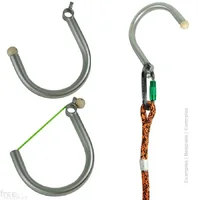
DMM throw hook.
- Thread starter Huskyman
- Start date


Acerxharlowii
Branched out member
- Location
- Greensboro
Less weight???

rope-a-dope
Branched out member
- Location
- Asheville
And less balance. Nose weight makes it easier to flick it off of branches, i think because it tips around better front to back. Heavy ropes give a stronger whip to get it off the branch.

Greg_L
Participating member
- Location
- Bloomington, IN
I think the idea may not have been so much the ability to remove the weight--which as mentioned already really helps the hook work properly--but to allow adding additional weight to the nose if desired. Could help with positive hooking, longer throws, etc.
theatertech87
Branched out member
- Location
- Rochester
Had anyone actually added or removed the weight? I took it out and to me it just looked like a long bolt never did anything else with it

Jimmycrackcorn
Participating member
- Location
- Boston
The Safeguard just came out, and definitely would be better for tree climbing.
The Lifeguard locks up reliably, but because of the spring , it releases the rope as soon as any weight is taken off of it.
Both put a bend in the rope, so you can't use a foot ascender.
Forgive me y'all.. i went & brought this up & never followed up..
That last line by Brock is something i didn't consider hard enough before purchasing mine.. I kinda bought it on a whim.. it was the last peice to a puzzle i wanted to be done with.. I should have realized that before but was too ignorant & just wanted to be done with it.
It would seem that the non-spring version is now known as the Safeguard and it's only available in black.
Yes, this is 100% correct. Only the black version is "Springless" as they would say.
I got my Safeguard and did some low and slow practice maneuvers using a throw hook/lanyard.
1st impression was that the moving parts rattle around a bit when unweighted. When lightly weighted, pushing down inadvertently or intentionally on the cam releases the climbing line, allowing it to slide freely in a bidirectional way. This helps when tending, but raises concerns as far as it being able to slip on the rope when inadvertently or intentionally unweighted. When properly engaged and weighted, it performs very well, as expected. I really like the compactness and the range and the feel of the metal lever. The shorter (90 degree) distance on the arm's reach, makes it easier to dial into the sweet spot. While I have not yet used this as a primary rappelling device, it seems to perform much like the GriGri and it can be a bit jerky when it initially releases the climbing line, making it all the more important to retain control with your breaking hand. The orientation of the lever makes it align in a more user friendly way than the GriGri, as well. It seemed to work well on my 1/2" Vortex and 7/16" HTP Static, even though the 1/2" slightly exceeds the recommended rope size. The device also tends much like the GriGri, and performs well in a 3:1 Rad configuration.
The Safeguard will most likely replace my GriGri2, as a multicender on my DMM Captain lanyard, for the main reason that it's all metal, slightly lighter and smaller than the GriGri, and it seems to be as good as the Cinch, while working effectively on a 8.9mm to 11mm size range of climbing lines.
The low cost in comparison to similar devices is compelling, but the device may not be as ruggedly built it and may tend to wear out sooner. I feel confident using this as a lanyard adjuster, in both a SRS and MRS, but I would not feel comfortable using this device solely as a primary multicending device, like the HH, RR, RW, or Uni. If asked whether an existing GriGri or Cinch owner might be compelled to buy the Safeguard as a replacement, probably not, unless it's time to upgrade a similar worn out device, in which case, the Safeguard is a strong contender, IMHO.
Although i can't confirm the reports on the larger 1/2”, i concur this is a very accurate analysis, nice write up John!
Here are some pictures with 10mm Reep & 11.8 Dreanaline with the device closed & open to see the fitment within the cams.


Very nice review! Sounds like they need to make another model with a cam spring that keeps it engaging the rope, the opposite of the Lifeguard, which releases when just about any weight is taken off of it. It might help to keep it engaged if there was some weight below it, to rotate the device. Or set it by hand each time you want to stop.
Yes, maybe something with some positive pressure.. I'm not sure how it would affect everything else, but i don't think i would mind if it had it.
Anyone have any issues with the Bolt being too long and causing the hook to bind up? I experienced this twice today in an oak with some branches that were right one the limits for the hook. Still, twice and I started looking at it. Might have to take the grinder to it.
Mine sticks out a bit but i think i removed it to examine the super thin, super flexible splice at one point. Judging by the other pics, if i did take it off, i over tightened it going back on.. This may also be partially the reason they claim it is s one time used type if bolt. Thats alot easier than explaining how to get it together far enough & tight enough without making it stick out too far in the chance you dissasemble..

Can you turn the shackle around, with the protruding end of the bolt aimed out inside of to the inside?
Looking at it right now in the moment, i can't see right off the bat why someone couldn't do that. Sounds like an easy fix.

CanadianStan
Branched out member
- Location
- Western Australia
That safeguard is tiny !! holy crap. @TREEfool you're going to like it
Jimmycrackcorn
Participating member
- Location
- Boston
Yes.. it truly is small.. i think Camp Saftey has a couple similar devices in size.. but very expensive & full of features we wouldnt typically want. Good features for falling, but not necessarily working..That safeguard is tiny !! holy crap. @TREEfool you're going to like it
Here's the Safeguard in my hand with some other contrasting items.. mingya I just realized I have way too many lanyard devices.. half I haven't even had the time to try yet! Hibernating in the winter doesn't help that.. Haha..


ghostice
Been here a while
On this Friday afternoon, me and my scotch will go this far if I may: I like the cinch on the stem. I personally though, try and throw/ keep any supplementary anchor points like the choked line always above me (overkill?) - to try and keep any mythical fall factors down (if there's ever any slack in your tie-in to the other tree). And could slack in this choked line be tended more easily by something like a Uni rather than a hitch and pulley (there's lots of tail)? Dunno. That said, I've gone to two hitches and two rope wrenches in my own hook-ology - with a shorty tether on the line to the throw hook, just to keep the devices "the same" although I'm sure others find a D4 etc. whatever, OK too. Thanks for this - you've made me think some more on this Friday afternoon. And on a note from the biologist in the room THANK YOU for using cambium savers. Save our trees. These are not static things, but life forms we really don't fully yet understand, I think.
Mark C (never met, but) I've thought a bit about Mark Bridge's Blog comments about training/ NATS, etc, and I'd say after years of picking up bodies in industry, these kinds of videos, and forums, are really important, I think - safety in climbing may well be iterative - that is it can't come from a "course" and "certification" and "training" or "forehead stamping" although where a foundation doesn't exist it certainly will help - but does it really come from incremental changes to your "system" and daily getting better and better and challenging your own experience and the paradigm you've been taught. Educated Climber? Iterative Climber?
Anyway thanks again BB for, yet again, something to think about.
Mark C (never met, but) I've thought a bit about Mark Bridge's Blog comments about training/ NATS, etc, and I'd say after years of picking up bodies in industry, these kinds of videos, and forums, are really important, I think - safety in climbing may well be iterative - that is it can't come from a "course" and "certification" and "training" or "forehead stamping" although where a foundation doesn't exist it certainly will help - but does it really come from incremental changes to your "system" and daily getting better and better and challenging your own experience and the paradigm you've been taught. Educated Climber? Iterative Climber?
Anyway thanks again BB for, yet again, something to think about.
TimBr
Official Well Known Greeter
- Location
- Northern Virginia
A warm welcome to new forum member @hanis943! I think you are going to like it here! Don't be shy about posting, there are a lot of really nice folks here. I hope to read something from you when you feel like sharing your experiences.
Thanks for signing up to be a member!
Tim
Thanks for signing up to be a member!
Tim
- Location
- Kuala lumpur
A warm welcome to new forum member @hanis943! I think you are going to like it here! Don't be shy about posting, there are a lot of really nice folks here. I hope to read something from you when you feel like sharing your experiences.
Thanks for signing up to be a member!
Tim
Hi TimBr,
Thanks for the welcome greeting. I just know how to splice and now doing eye stitching by guidance from @moss . For still waiting for my customize epple throw hook done.
TimBr
Official Well Known Greeter
- Location
- Northern Virginia
@hanis943; That is great news! We need more splicers on this forum. I still need to take the time and effort to learn how to do it, so having folks like yourself around is a great thing. I think you are really going to like using your new hook, once you get it. Nice job with the posting of the images of the Epple hook. I hope you have a ton of fun with it!
Congratulations on making your first post on this forum!
Tim
Congratulations on making your first post on this forum!
Tim

RyTheTreeGuy
Branched out member
- Location
- Canada
Got a chance to test out my Captains Hook today. Very cool tool, but will most definitely need some practice. I run a DMM small axis swivel on my rope bridge, but found my bridge to be too long for my rads system on my hook to be as efficient and effective as possible. I am using a gri gri with hand ascender/revolver and footie. I have to 2018 version of the SRT Sequoia and was thinking an open ring on the ventral attachment would make a nice option for the hook as well as possibly ascent. Just wondering if anyone has tried this and any thoughts or opinions would be greatly appreciated. Thanks
theatertech87
Branched out member
- Location
- Rochester
Why not just use a swivel biner? That way there's less clutter when your not using it... Also if you haven't used that attachment before, give it a try, it's definitely different than a rope bridgeGot a chance to test out my Captains Hook today. Very cool tool, but will most definitely need some practice. I run a DMM small axis swivel on my rope bridge, but found my bridge to be too long for my rads system on my hook to be as efficient and effective as possible. I am using a gri gri with hand ascender/revolver and footie. I have to 2018 version of the SRT Sequoia and was thinking an open ring on the ventral attachment would make a nice option for the hook as well as possibly ascent. Just wondering if anyone has tried this and any thoughts or opinions would be greatly appreciated. Thanks
RyTheTreeGuy
Branched out member
- Location
- Canada
Why not just use a swivel biner? That way there's less clutter when your not using it... Also if you haven't used that attachment before, give it a try, it's definitely different than a rope bridge
I have not used that attachment for tree work before, but for rescue work we only have ventral, sternal and dorsal. Great idea with the swivel biner. Thanks for the tip. Woo hoo, more shiny toys to buy

moss
Been here much more than a while
- Location
- Carlisle, Massachusetts, U.S.
Got a chance to test out my Captains Hook today. Very cool tool, but will most definitely need some practice. I run a DMM small axis swivel on my rope bridge, but found my bridge to be too long for my rads system on my hook to be as efficient and effective as possible. I am using a gri gri with hand ascender/revolver and footie. I have to 2018 version of the SRT Sequoia and was thinking an open ring on the ventral attachment would make a nice option for the hook as well as possibly ascent. Just wondering if anyone has tried this and any thoughts or opinions would be greatly appreciated. Thanks
After many climbs using the Captain Hook i’ve come to the conclusion that a straight-through path is best for whatever progress capture you’re using for the hook. BDB, Rope Runner or Akimbo seem too much money for the use but they work so well on the hook. To go simple and cheap just use a hitch and a pulley tender. You can take load off the hitch with a hand on the tail below (or above) the hitch for shorter downward movements, THRWT, the human rope wrench technique ;-) With a straight path through device or hitch you don’t need a RADS and bridge length ceases to be an issue.
-AJ

theatertech87
Branched out member
- Location
- Rochester
Never really thought about it that way, but it definitely aligns with what I found worked best for me as wellAfter many climbs using the Captain Hook i’ve come to the conclusion that a straight-through path is best for whatever progress capture you’re using for the hook. BDB, Rope Runner or Akimbo seem too much money for the use but they work so well on the hook. To go simple and cheap just use a hitch and a pulley tender. You can take load off the hitch with a hand on the tail below (or above) the hitch for shorter downward movements, THRWT, the human rope wrench technique ;-) With a straight path through device or hitch you don’t need a RADS and bridge length ceases to be an issue.
-AJ

Burrapeg
Been here a while
- Location
- Puget Sound
I started using a Stiched Distel on my HELL lanyard some weeks ago when the Stich hitch and its various mods were being discussed. I added a second ring to take chafe off the crossed hitch cord and also a small strap (the cream coloured short one) to keep the ring and crosses from working up too high towards the Distel. Works great. I think the short Eye2Eye strap was sold by WesSpur as a tending strap for the early HH. I sometimes take the hook off and just have a heavy steel biner on the end. I can toss the steel biner quite a ways up and have its weight drop it down over a limb. I don't have much luck tossing the hook straight up. Depends on the tree and the climb.
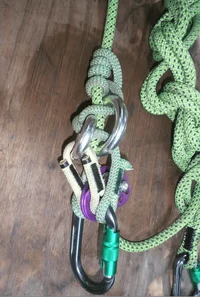
At first look, I thought your hitch wouldn’t work for long, everything was different than the original. You used a large ring, there’s a crossover instead of a twist, and it’s backwards.
But after looking at it more and trying it out, it works great! I think the small strap is key to stopping it from binding up, the slack can’t transfer from the top of the hitch to the legs.
But after looking at it more and trying it out, it works great! I think the small strap is key to stopping it from binding up, the slack can’t transfer from the top of the hitch to the legs.












New threads New posts
-
test
-
 Free CEUs: February 05 & March 05 - 'Urban Forestry Today' Webcasts @ Noon (Eastern)
- Started by UFT
- Replies: 0
-

-

-
-
-








