Eastern Red Cedar Root System

MikePowers321

Carpal tunnel level member
Location
Leeds, Ny
I was reading an interesting article about unknown old growth trees in Canada.

https://www.atlasobscura.com/articl...nnia-in-north-america-without-anyone-noticing

Near the bottom of the article, it speaks about the root systems in Eastern White Cedar Tree...

"It wasn’t a coincidence that these aged trees were cedars. Most trees use their root systems to feed the entire tree, so if one part of the roots are damaged, the whole tree suffers. In cedars, each part of the roots system is connected to a certain part of the tree. If those roots die, that part of the tree dies, while the rest continues on. In Larson’s lab, they showed how stark this mechanism could be by feed three different sections of roots water dyed three different colors. When they peeled back the bark, the tree looked like a barber shop pole, with the colors swirled separately up its length."

I hadn't known this so I tried to find some supporting information online with no luck. Anyone have any good info to share on this topic? Any other trees that share these characteristics?
 
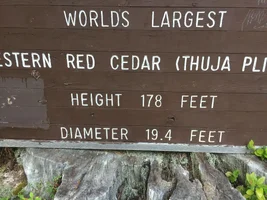
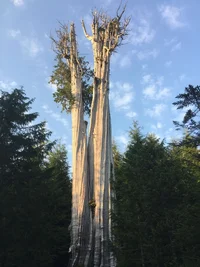
I’d bet it’s right. I visited a giant western red, loved to death with only one live root and a strip of live bark to just a few live limbs.
I’ve heard where this holds true for some species while not for most.
Good thing the forest around it was clear cut for a good photo. Not to mention a few roots cut and compacted gravel installed around the circumference of the flare for a foot pathDAB94AD3-17BD-4F72-BC05-71E28EA7820C.webp94292214-791E-4D9B-A043-82FC619E6399.webp
 
There is a small Christmas size cedar tree right next to moms gravel drive. the top half died and turned completely brown, whereas the bottom half was green and vigorous. I would have taken it out, but my sister loves cedars, and so she removed the top half and it is doing just fine. I wonder if the root system on the drive side was damaged, causing just the top to die off.
 
"Sectoriality" is the technical term for the relationship of a particular face or quadrant of root system to a particular face of tree and quadrant of canopy. Tree species and individuals vary in the degree of sectoriality they exhibit. Sometimes, trees are highly sectored but with a spiral, so that roots on the North face might be connected with flow to the East face of the stem and the South face of the crown. For others, they align vertically. Part of the wonder of diversity!
Probably don't need to say this, but western and eastern red cedar are in different genera, Thuja and Juniperus. Our eastern red cedar is really an eastern juniper. And of course, neither are "cedar" in a botanical sense.
 
"Sectoriality" is the technical term for the relationship of a particular face or quadrant of root system to a particular face of tree and quadrant of canopy. Tree species and individuals vary in the degree of sectoriality they exhibit. Sometimes, trees are highly sectored but with a spiral, so that roots on the North face might be connected with flow to the East face of the stem and the South face of the crown. For others, they align vertically. Part of the wonder of diversity!
Probably don't need to say this, but western and eastern red cedar are in different genera, Thuja and Juniperus. Our eastern red cedar is really an eastern juniper. And of course, neither are "cedar" in a botanical sense.
Of course they are completely different trees. Can you give some common species which exhibit sectoriality in a broad stroke? Can it be more common in conifers? Ring porous?
 
Boatload of hits in Google Scholar under "sectoriality in trees". Been written about a lot over the last 150 years or so. For the mid-20th Century, Ted Kozlowski did a lot of descriptive work.
Check out the attached from 1963. There are lots of more recent references and any woody plant physiology text would give some. But I think this was the first on the topic I read in the early 1970s.
I imagine some of the arborist magazines must have had an article on the topic in more recent years, but I can't tell you where to look!
 

Attachments

I had a seminar with Kozlowski back at UW. It ran deep...beautiful dude.
Sectoriality, OK; The Vetree folks talk about functional units of vascular pathways, forming columns, sometimes twisted.
Yes it's a mystery to me too why some are twisted and some not.

I measured a white oak with frothy flux having killed 93% of the circumferential cambium.
The crown was turgid and verdant, :)
 
Last edited:
I had a seminar with Kozlowski back at UW. It ran deep...beautiful dude.
Sectoriality, OK; The Vetree folks talk about functional units of vascular pathways, forming columns, sometimes twisted.
Yes it's a mystery to me too why some are twisted and some not.

I measured a white oak with frothy flux having killed 93% of the circumferential cambium.
The crown was turgid and verdant, :)

I’ve seen torsional growth patterns in some trees that could be attributed to asymmetrical wind loading of the crown (either due to asymmetrical crowns or due to other surrounding abiotic features). Old growth western red cedar and Douglas fir in the PNW show these traits a lot. With that being said, I’ve also seen more broad leads that had this spiralized fiber pattern and I’m not sure where it came from! Big leaf maple comes to mind
 
I was reading an interesting article about unknown old growth trees in Canada.

https://www.atlasobscura.com/articl...nnia-in-north-america-without-anyone-noticing

Near the bottom of the article, it speaks about the root systems in Eastern White Cedar Tree...

"It wasn’t a coincidence that these aged trees were cedars. Most trees use their root systems to feed the entire tree, so if one part of the roots are damaged, the whole tree suffers. In cedars, each part of the roots system is connected to a certain part of the tree. If those roots die, that part of the tree dies, while the rest continues on. In Larson’s lab, they showed how stark this mechanism could be by feed three different sections of roots water dyed three different colors. When they peeled back the bark, the tree looked like a barber shop pole, with the colors swirled separately up its length."

I hadn't known this so I tried to find some supporting information online with no luck. Anyone have any good info to share on this topic? Any other trees that share these characteristics?
I can tell you, I can believe what you read. I planted 3 seedlings this spring from bare roots. The trees appeared to have healthy tops when I planted them and I took every precaution to avoid drying them out. Within days; all three started turning brown and; I lost 2 of them. The third had enough life in it that it continued to grow where it was still green but; the other branches had to be pruned off. I was told that it's hard to kill a cedar but now I know that might not be true!
 

New threads New posts

Back
Top Bottom