Hi folks. I'm at my friend's house in Durham, NC. This white oak is up for some work. I think I know what the options are. They are all imperfect, and fairly viable. I thought I'd throw it out to the Buzz to see what others would do.
The tree is about 50 ft. tall, growing close to vertical, with about 18" dbh. There is a house on one side that, all else equal, I'd like to massage the canopy away from. About 20% of the crotches are acute, scattered evenly throughout the canopy. Of greatest concern are two acute crotches where the main trunk splits into ~7-8" diameter codominant leaders, then splits similarly again two feet higher, resulting in three codominant leaders. The primary goal is to maximize structural integrity with respect to the house. Running a very close second are the two equally important goals to maximize structural integrity for the tree's own sake, and maximize aesthetic appeal.
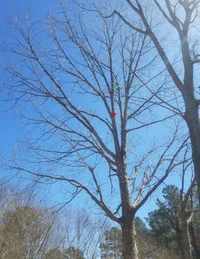
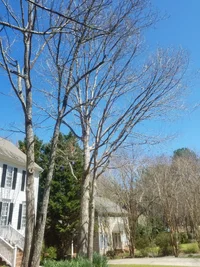
In the first picture, two of the codoms are visible coming off the acute crotch, at the second "whorl" up. The other junction is 2 feet up on the right leader, and not visible. The picture is taken next to the house, which is immediately left of the frame.
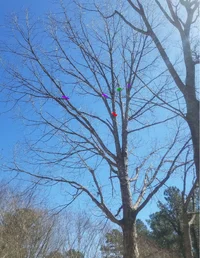
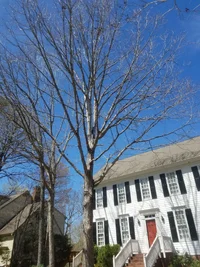
In the second picture, the tree is the backmost of the three and the second acute crotch with codoms is visible, just above the first.
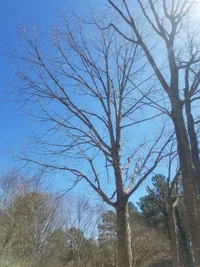
The third picture is taken from the remaining angle and may not convey more information than is already expressed.
What would y'all do? I would love a variety of opinions and a little collegial input.
The tree is about 50 ft. tall, growing close to vertical, with about 18" dbh. There is a house on one side that, all else equal, I'd like to massage the canopy away from. About 20% of the crotches are acute, scattered evenly throughout the canopy. Of greatest concern are two acute crotches where the main trunk splits into ~7-8" diameter codominant leaders, then splits similarly again two feet higher, resulting in three codominant leaders. The primary goal is to maximize structural integrity with respect to the house. Running a very close second are the two equally important goals to maximize structural integrity for the tree's own sake, and maximize aesthetic appeal.
In the first picture, two of the codoms are visible coming off the acute crotch, at the second "whorl" up. The other junction is 2 feet up on the right leader, and not visible. The picture is taken next to the house, which is immediately left of the frame.
In the second picture, the tree is the backmost of the three and the second acute crotch with codoms is visible, just above the first.
The third picture is taken from the remaining angle and may not convey more information than is already expressed.
What would y'all do? I would love a variety of opinions and a little collegial input.