Case study

colb

Been here a while
Location
Florida
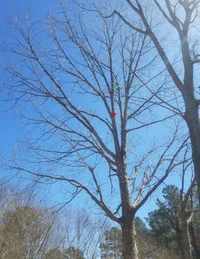
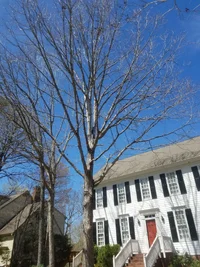
Hi folks. I'm at my friend's house in Durham, NC. This white oak is up for some work. I think I know what the options are. They are all imperfect, and fairly viable. I thought I'd throw it out to the Buzz to see what others would do.

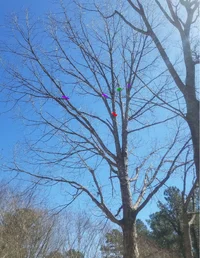
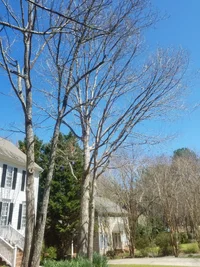
The tree is about 50 ft. tall, growing close to vertical, with about 18" dbh. There is a house on one side that, all else equal, I'd like to massage the canopy away from. About 20% of the crotches are acute, scattered evenly throughout the canopy. Of greatest concern are two acute crotches where the main trunk splits into ~7-8" diameter codominant leaders, then splits similarly again two feet higher, resulting in three codominant leaders. The primary goal is to maximize structural integrity with respect to the house. Running a very close second are the two equally important goals to maximize structural integrity for the tree's own sake, and maximize aesthetic appeal.

In the first picture, two of the codoms are visible coming off the acute crotch, at the second "whorl" up. The other junction is 2 feet up on the right leader, and not visible. The picture is taken next to the house, which is immediately left of the frame.
20180331_130721.webp

In the second picture, the tree is the backmost of the three and the second acute crotch with codoms is visible, just above the first.
20180331_130902.webp

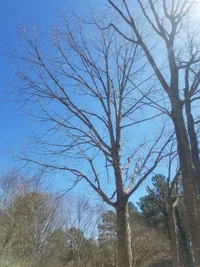
The third picture is taken from the remaining angle and may not convey more information than is already expressed.
20180331_131934.webp

What would y'all do? I would love a variety of opinions and a little collegial input.
 
Cobra cable the two co doms and subordinate the third smaller one. Bit late to get rid of a codom lead unfortunately.


Sent from my iPhone using Tapatalk
 
Reduce and train, perhaps follow up with PBZ. Upsell a bed expansion?

Check out the older wounds from previous limbing up if you haven't already, which I doubt. One looks like it has little wound reaction though it's hard to tell on the phone.
 
Reduce and train, perhaps follow up with PBZ. Upsell a bed expansion?

Check out the older wounds from previous limbing up if you haven't already, which I doubt. One looks like it has little wound reaction though it's hard to tell on the phone.

What is the exact application pattern and purpose of pbz for this?
 
It's interesting to me to hear similar feedback to what I'm feeling - whether to cut off a codom (I'm very reluctant to, but also seeing purer low maintenance distant future gains), leaving a 7" wound, or reduce and train - probably with cabling and bracing, leaving lifelong acute junctions. @JD3000 and @Jackjcc may have different opinions, yet seem to be on the very fringe of those opinions where they're almost saying the same thing - maybe actually are.

Feedback is great, and really appreciated guys.

I was thinking to ask about compartmentalization in white oaks. I do not deal with mature white oaks in my Floridian urban landscape, but do have swamp chestnut oak and bluff oak. @JD3000 is astutely pointing out that this very tree has information about its capacity for wound closure...
 
If not taking it off at the first split, I'd probably at least cut it a little h
igher where the other fork is (red line). This will significantly reduce that codominate leader and establish the other as the dominate leader going forward. But that side looks like it needs help as well. Again, I'd reduce one of those codominates - green line.

These cuts should allow the central leader to fill in over the next several years. Come back in 5 years to reduce those further back without leaving such an unbalanced canopy.

The fork on the left of the first picture looks to be more centered over the trunk which often makes the better long-term leader. It is also straighter. But it is also a the smaller diameter fork - and towards the house... There are times I have a good plan in place after walking around the tree a few times. Then I get up in it, look at the situation up close and change my mind. I don't think either makes a bad choice here...

wocodom.webp
 
Pbz is short for paclobutrazol, commonly referred to as Cambistat.

Soil injected or basal root soak, lasts a few years.

I thought if it because reduction points and the rest of the canopy are likely to sprout after this pruning. I use a lower rate than on the labeling however. Fungicidal properties of the product are also interesting.

I would much rather reduce some co-doms rather than making a larger cut on the stem to remove one in its entirety. Likely to decay, though white oak (and most if the sub-genus for that matter) is a very long lived species and a strong compartmentalizer. However, individual trees may have health issues which is why I was wondering about looking at older wounds and assessing overall vitality.

My 0.02 now that the Buzz is functional again...
 
I said earlier:
The fork on the left of the first picture looks to be more centered over the trunk which often makes the better long-term leader. It is also straighter. But it is also a the smaller diameter fork - and towards the house... There are times I have a good plan in place after walking around the tree a few times. Then I get up in it, look at the situation up close and change my mind. I don't think either makes a bad choice here...

Looking at it again today, maybe I'd lean towards keeping the left fork today. Leave the red line and make cuts at the purple lines... I still think both are good options and I'd probably make the final decision in the tree. The bigger picture is that one needs reduced so the other can establish dominance and you take a lot of force off of that fork.
wocodom2.webp
 
I just wanted to say that reducing the weaker leader is what I would do if I was sent to prune this tree, (I am not in a position to argue with any BCMA) but it is also a white oak. It probably knows what it is doing. They're incredibly good at not falling apart, and even the poor unions are quite strong.
 
  • Like
Reactions: ATH
I said earlier:
The fork on the left of the first picture looks to be more centered over the trunk which often makes the better long-term leader. It is also straighter. But it is also a the smaller diameter fork - and towards the house... There are times I have a good plan in place after walking around the tree a few times. Then I get up in it, look at the situation up close and change my mind. I don't think either makes a bad choice here...

Looking at it again today, maybe I'd lean towards keeping the left fork today. Leave the red line and make cuts at the purple lines... I still think both are good options and I'd probably make the final decision in the tree. The bigger picture is that one needs reduced so the other can establish dominance and you take a lot of force off of that fork.
View attachment 50601

I do find your selection of cuts interesting. I would have leaned towards taking the more horizontal shoots off rather than the vertical ones, just to keep them from reaching as much over the life of the tree. Is my gut wrong/ can you explain for my benefit why you would make those where you drew them?

Edit: I totally get the left one. My question is more for the other two, and especially the right one.
 
I have a hard time picking limbs out to prune from pictures on my phone. I'll take everyone's word for it on where to prune in most cases. As he said, you may change your mind after seeing it again and getting in it.
 
No works cited = grey literature. You can do better...
SDS with toxicology info first. Then some state govt analysis, then a study/review or two I think.
 

Attachments

Pbz is short for paclobutrazol, commonly referred to as Cambistat.

Soil injected or basal root soak, lasts a few years.

I thought if it because reduction points and the rest of the canopy are likely to sprout after this pruning. I use a lower rate than on the labeling however. Fungicidal properties of the product are also interesting.

I would much rather reduce some co-doms rather than making a larger cut on the stem to remove one in its entirety. Likely to decay, though white oak (and most if the sub-genus for that matter) is a very long lived species and a strong compartmentalizer. However, individual trees may have health issues which is why I was wondering about looking at older wounds and assessing overall vitality.

My 0.02 now that the Buzz is functional again...

Thanks for following up on the pbz, @JD3000 . I would just prune sprouts in a subsequent year, mainly because I don't have enough experience to apply pbz for canopy-related issues. Is it normal to throw down pbz after any reduction pruning? How do you decide?
 
No, just an option I threw out there. More appropriate for heavy reductions and utility pruning amongst other examples. Fast growing and sprout prone trees come to mind. I'm thinking of using it on some god awful Freeman maples that got a pretty good dose of structural pruning in hopes to reduce sprouting and hopefully lengthen pruning cycle.

I've also used it to green up chlorotic red maples in limey soils.

Interesting stuff, just don't combine it with any triazole fungicides or major regulation will occur. I use a little less than the labeled rate generally speaking.
 
Last edited:
I said earlier:
The fork on the left of the first picture looks to be more centered over the trunk which often makes the better long-term leader. It is also straighter. But it is also a the smaller diameter fork - and towards the house... There are times I have a good plan in place after walking around the tree a few times. Then I get up in it, look at the situation up close and change my mind. I don't think either makes a bad choice here...

Looking at it again today, maybe I'd lean towards keeping the left fork today. Leave the red line and make cuts at the purple lines... I still think both are good options and I'd probably make the final decision in the tree. The bigger picture is that one needs reduced so the other can establish dominance and you take a lot of force off of that fork.
View attachment 50601

I want to establish the fork going away from both the house and the other trees (and going towards the driveway and road) as the primary leader. It's one of the codoms on the higher of the two acute crotches. The back one going towards the house is just future trouble, in my view, although I'm interested in what @SomethingWitty is saying about the white oaks being incredibly strong.

Tbh, the white oak group were only recently planted in landscapes around here, and are not too common in natural areas. I have a list that fits on one hand of the emergent bluff oaks in town. We are at the very southern extent of the white oak range, ten miles north of town. Swamp chestnut oaks are around at low but consistent frequency, but almost always in natural areas. I hardly ever get to work with these oaks, but would like to... They are all over the place around here!
 
  • Like
Reactions: ATH
I just wanted to say that reducing the weaker leader is what I would do if I was sent to prune this tree, (I am not in a position to argue with any BCMA) but it is also a white oak. It probably knows what it is doing. They're incredibly good at not falling apart, and even the poor unions are quite strong.
Curious...which are you looking at as the weaker leader? Feel free to argue, as I've argued with myself ;)

Yes, white oak are stronger than most....but a co-dominate leader with included bark will still be the weakest point of the tree and prone to failure during a storm. Especially as the "lever" pulling at the defect gets 40' longer in the future.
 
No, just an option I threw out there. More appropriate for heavy reductions and utility pruning amongst other examples. Fast growing and sprout prone trees come to mind. I'm thinking of using it on some god awful Freeman maples that got a pretty good dose of structural pruning in hopes to reduce sprouting and hopefully lengthen pruning cycle.

I've also used it to green up chlorotic red maples in limey soils.

Interesting stuff, just don't combine it with any triazole fungicides or major regulation will occur. I use a little less than the labeled rate generally speaking.

Any idea if it can be injected to a single leader, or would it just go systemic anyways? I'm sure you're probably wishing you hadn't brought it up, but it's definitely interesting to me.
 

New threads New posts

Kask Stihl NORTHEASTERN Arborists Wesspur TreeStuff.com Teufelberger Westminster X-Rigging Teufelberger
Back
Top Bottom