X-rigging rings

Kevin and Monkey, you guys have made some excellent points and I appreciate your insight. I don't know why but I must have been in an argumentative mood. There are already plenty of good tools to use as a crane tie in, so I'm gonna let this idea go.

We're not saying it's a bad tool either, just that that's not what it was made or approved for but it's a good simple tool so there's a million ways to use it. Best of luck with them
 
I was texted and told there is talk about X-Climbing rings on here. We have had prototypes for two years I think now. I don't think the market will be willing to pay for the cost of them when regular solid aluminum rings are cheap, that's why I haven't pulled the trigger on them. I haven't read all your posts yet.... I'll stop back in when I get more time.
 
Hey, TreeBuzz is going to get even better again. I saw the new version. On the new version; Mark installed my article on friction titled:
WHERE SHOULD FRICTION BE IN OUR ROPE RIGGING SYSTEMS?
The new Buzz with this article and several other articles should happen any day, from what I hear.
Also, Mark asked if I had any video to go along with the article. So I made one. The video will be imbedded in or around the article also.
My work is done, so now you can bug Mark..... :bailando:
 
Somehow my large x ring n ring got nicked. I think it was trimming ivy and the saw jumped. I'm crushed. It was only the outer sheath. X, what do you suppose the strength loss is? When I can spring for another, I'll send the damaged ones to treestuff and see if they can splice me up a new one about a foot or two longer.
 
You guys seriously now gotta bug Mark. Send him PMs or whatever. Say: WHERE IS THE NEW BUZZ WITH X's Friction Article???
Really busy people don't get around to doing stuff unless they are really bugged repeatedly. I know.
 
I'm s
You guys seriously now gotta bug Mark. Send him PMs or whatever. Say: WHERE IS THE NEW BUZZ WITH X's Friction Article???
Really busy people don't get around to doing stuff unless they are really bugged repeatedly. I know.
I'm sure he is getting to it as soon as possible.

But how about the tht thread lol
 
I was just catching up on a few back pages and just now read Chris G's response.

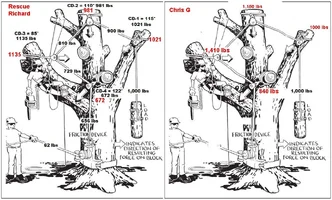
I took his numbers and compared them to rescue Richards, I put them on the diagram in red.

rescueDick and Chris G diagram.webp
 
LOL, Yup, You've got to love Bryan Kotwica's "Arbor-girl" illustrations and I mean that in the most flattering way to our female climbers.

David, thanks for putting my numbers to the drawing.
 
I'm looking at both those pics from an outside point of view and I am thinking they are both right. I am also thinking that since we don't rig in a bubble that there are a lot of variables that could come into play. I am also thinking that if I am worried about a 100lbs making or breaking my setup, I probably need to get a bigger setup or cut smaller pieces. The difference between SWL and failure are pretty far apart, way more than that 100 lbs.
 
God, im really pulling for girard. If for no other reason than the alternative comes off as such a combative, pompous butthole most times (well intentioned or not). And that doesnt accomplish anything. Id really hate to have to concede to that..

I think that it is actually 1,000lbs, but that is besides the point. And you are right, there are way to many variables to actually calc. the true loads.

But guys, I think that you’re missing the point. I already said (in my REALLY long post) that RescueMan’s numbers are mathematically closer to reality, BUT in tree rigging we deal in worst-case scenario, which means that we assume zero friction at the block. This in turns gives you the same loading on either end of your rigging line, which will give you a higher reaction force at your rigging point (i.e. – block, sling and tree).

This allows us to design a MARGIN OF SAFETY into our rigging plan, knowing that our actual loads are less…due to the friction that we know is really there. Do you know what I mean? I am not trying to confuse the matter and sure hope that I can make people see where I’m going with this.

Yes I know my “numbers” aren’t right, but they were computed that way on purpose for ease of computation to come up with the highest load that the rigging points in the sketch would see plus a little safety factor, provided the theoretical 1000lb log is being held still.
 
Riggers will will able to see and understand this much better when they read David's excellent article. As he mentions; "When you are adding friction to a rigging point, you are not multiplying the force on the rigging point, as much as you were when using a near-frictionless block. When you have friction at a rigging point, you are lessening the force on one leg of the rope that is pulling on that rigging point."
 
I'm looking at both those pics from an outside point of view and I am thinking they are both right. I am also thinking that since we don't rig in a bubble that there are a lot of variables that could come into play. I am also thinking that if I am worried about a 100lbs making or breaking my setup, I probably need to get a bigger setup or cut smaller pieces. The difference between SWL and failure are pretty far apart, way more than that 100 lbs.
Well then I guess if both are right then both could still be wrong with all the variables
 

New threads New posts

Back
Top Bottom