









Working on a topped tree questions.

ClimbingTN

Branched out member
Location
Columbia
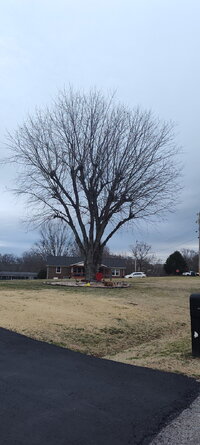
I didn’t top this Silver (I think) Maple. The owner wants the new growth cut off again. Is it too late to structure this or is it doomed to a lifetime of topping? I’ve studied a lot of Gillman and I think this falls into the too late to fix category, plant a better tree. Would you top it or stay away for reputation sake?
 

Attachments

  • 6017658597302268076.jpeg
    6017658597302268076.jpeg
    425.8 KB · Views: 56
Using older terminology, it doesn’t look to far gone. I’d go with ‘restoration pruning’ outlined by Cass Turnbull, probably on a lighter dose or repeated to achieve goal. Couple it with a legit reduction on the remainder.
I typically make my reductions much harder on some, just to mark future removal cuts.
 
I was about to say I wouldn't touch that with a 10' pole but then I remembered the savage trimming I did on an apple earlier today and well... I wasn't thinking about my reputation, oops.

Anyways, silver maple, that thing is probably all rotten and hollow. I don't know though, ask @Mick Dempsey!
Thanks Levi!
Ime silver maples rot quickly from cut points, turn to mush.
You can usually get 2 or 3 retoppings in before they fall to pieces.
Here you’d retop that without a seconds thought, but if that gives the OP a fit of the vapours whaddyagunna do?
 
Mick is absolutely right, old silvers have almost no ability to control decay. We have many around here and most have been topped at some time in the past. They all have massive amounts of decay. Yet there they are, year after year, storm after storm, with trees around them in much better condition failing.

If the situation allows, I am inclined to leave old trees because the benefits they provide are substantial. If you want to prune it, it has a lot to work with and not much in the way of targets, I'd say go for it. But don't just re-top it, reduce it to smaller laterals growing in the proper direction and leave any interior growth you can.
 
I wouldn't retop it. I'd try to determine what the customer is wanting. Pollarding is an option. Retrenchment pruning may be an option too. I agree with the light structural heavy reduction method. Establish what the customers goals are, identify what should be permanent, and retrain what's left.
Do you have a decay detector? Could always increment bore the previous topping attachments to see if it's viable at all.
Silver isn't the best compartmentalizer when mature, but they are still far better than some other species. You may think about a growth reg treatment post pruning to help it recover from the wounding a bit better.
 
Hey folks. I’ve been sick and just getting back to this. I saw some typical rot on the heading cuts. Some has migrated down the inner branches. At the point where they all meet at the trunk has rot too. I think the tree is in decline. Even if a restoration or pollard pruning was done, I still think it’s going to die. My thoughts are 1) I don’t need the work and 2) I don’t want to be the last guy that kills their tree. Thanks to all for a good discussion. Treebuzz folks rock! Craig
 
Hey folks. I’ve been sick and just getting back to this. I saw some typical rot on the heading cuts. Some has migrated down the inner branches. At the point where they all meet at the trunk has rot too. I think the tree is in decline. Even if a restoration or pollard pruning was done, I still think it’s going to die. My thoughts are 1) I don’t need the work and 2) I don’t want to be the last guy that kills their tree. Thanks to all for a good discussion. Treebuzz folks rock! Craig
We’re all going to die.
 
We’re all going to die.
lol thanks for that. Does this mean I can stop waiting at the DMV and posting on tree buzz?


I'm astonished at how long some severely pollarded Silver maples can live around here. And I suspect they live a longer life pollarded than in natural form. Maybe I'm turning to the dark side but I don't think it would be too late to repollard the tree, that looks like just a handful of years growth. This is what the tree is used to. Letting the pollard lapse is asking for branches to break in a few years. It will be hollow, as will most Silver maples of that age. It is dying. We are all dying.

Lots of space for some new trees in that lawn! The thing to sell is 'trees that don't require expensive maintenance', i.e. ones ya don't feel some compulsion to top.

But I would also not want it to be on my work order in the morning, more exciting things to do and I think the old timers in my area who've been topping trees for 40 years will probably do a better job than I will at that one.
 
Structural concerns and decay volumes do not indicate ‘decline’

Decline is a reduction of vigor and health. Apples and oranges yet sometimes there is some crossover

Edit: just took a second look at the tree. It’s very vigorous with a great growth rate. This coupled with the structural concerns should be weighted. Still from my armchair a one photo it does look like it can be managed.
 
Last edited:
I looked at the tree again. I said decline but I’m just seeing some head cut decaying from the topping. A few interior branches dead from the trunk. BTW My neighbor has a completely see through hollow maple still standing and growing that is probably 60” plus dbh. I’ve worked on maples still hanging in there with a bunch of rot. I told him I won’t top it and he should call his tree guy back that did it the first time. Then he’s like what can you do. I’m discussing pollard, retrenchment or restoration. I’ve only done pollarding on several knotted up crape myrtles. IDK which way to go with it but, I’m also trying to explain the commitment if he goes down this path.
 
I know everyone will have their own thoughts on this and I'm no different. The original topping has created decay columns below the regrowth attachments. These will need to be addressed. I believe retrenchment would be highly appropriate for this tree.

As I stated earlier, remove all heavy upper limbs leaving just smaller laterals growing at appropriate angles, upward and out, that look like they will form a proper new structure. Doing this will give direction to the regrowth while forcing the release of dormant buds and new growth lower down within the tree. With luck, cycles between pruning will be between 5 to 7 years with more options to work with on return visits.
 
Last edited:
Retooping is not = to pollarding! It’s just retopping.

Pollarding is done within short intervals training the tree as a sapling or very small immature tree. The intervals are typically 1-7 years apart and the most common are 2-3 years. Little to no decay develops in the heads, knobs or clubs. Traditionally done for harvesting.
Topping a tree, at an appreciable dimeter size, which will easily develop decay and then a decade or two later whacking off all the new stuff isn’t pollarding. SOMETIMES ITS WARRANTED and acceptable if managed. Let’s not mince words and confuse the custies.

Yes some thinning out of stems that will most likely cause weak inclusions, taking deadwood and thinning or more minor reduction is all that is probably needed for tree ‘health’. Possibly some thinning (removal) of some of the most poorly attached reiterations and reduction of the remaining if there is a target ‘threat’ on a portion could be needed but that’s not to be gleaned from a photo.

Rant over, but in my experience pollarding is poorly understood
 

New threads New posts

Kask Stihl NORTHEASTERN Arborists Wesspur TreeStuff.com Teufelberger Westminster X-Rigging Teufelberger
Back
Top Bottom












