












Navigation
Install the app
How to install the app on iOS
Follow along with the video below to see how to install our site as a web app on your home screen.
Note: This feature may not be available in some browsers.
More options
You are using an out of date browser. It may not display this or other websites correctly.
You should upgrade or use an alternative browser.
You should upgrade or use an alternative browser.
Work Photos
- Thread starter Leroy
- Start date

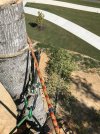

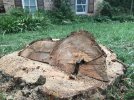
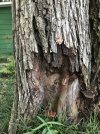
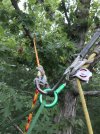
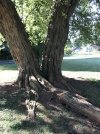
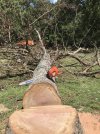

RopeShield
Carpal tunnel level member
- Location
- Ontario, Canada
Goats love trees more than me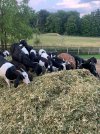
RopeShield
Carpal tunnel level member
- Location
- Ontario, Canada
Splinted ready for removal. Most dangerous I have ever worked on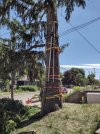
RopeShield
Carpal tunnel level member
- Location
- Ontario, Canada
Feed the goats.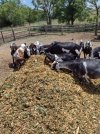
RopeShield
Carpal tunnel level member
- Location
- Ontario, Canada
Splinted tree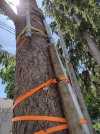
Winchman
Carpal tunnel level member
- Location
- Southwest Georgia
Got this dead limb and some broken but still live stuff down from one of my yard trees this morning. The red rope is directly below the TIP. It's a real leaner.
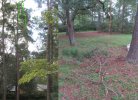
It was all tangled in other branches with no clear drop below, so I had to cut it apart in place, and move the pieces over my head to throw them down. Sure beats driving to the gym.
It was all tangled in other branches with no clear drop below, so I had to cut it apart in place, and move the pieces over my head to throw them down. Sure beats driving to the gym.
Last edited:
Winchman
Carpal tunnel level member
- Location
- Southwest Georgia
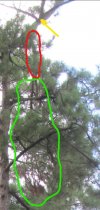
With the TIP I had Sunday I only got the lower part (green)of that hanging limb. Yesterday I set a new TIP (yellow) to get the rest (red) that's still firmly attached. Did it on the first shot with the Big Shot, but isolating it took a while with all the foliage below. Climbing through that stuff is going to be a challenge.
Winchman
Carpal tunnel level member
- Location
- Southwest Georgia
Well, I got the rest of the hanging limb and a bonus dead limb I couldn't get to earlier.
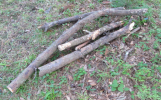
It was the most difficult climb I've made...even coming down was hard.
It was the most difficult climb I've made...even coming down was hard.
Winchman
Carpal tunnel level member
- Location
- Southwest Georgia
With a break in the heat/humidity and a gentle breeze, going after this dead limb Tuesday morning was actually fun.
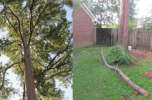
A sixty foot climb, some hand sawing followed by hand lowering...and I hardly broke a sweat. Keeping at it through the summer pays off.
A sixty foot climb, some hand sawing followed by hand lowering...and I hardly broke a sweat. Keeping at it through the summer pays off.

Steve Connally
Been here much more than a while
- Location
- Suffolk, Virginia
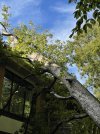
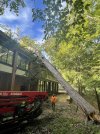
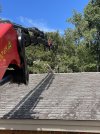
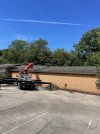
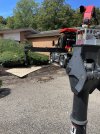
Today was an interesting one.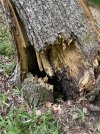
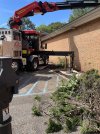
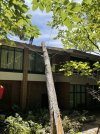

VenasNursery
Been here much more than a while
- Location
- Michigan
Looks like a fun one!
Nice pics also would of loved to be a part of that! some cool rigging
Nice pics also would of loved to be a part of that! some cool rigging
Steve Connally
Been here much more than a while
- Location
- Suffolk, Virginia
Different kind of fun. LOL. Thanks!Looks like a fun one!
Nice pics also would of loved to be a part of that! some cool rigging
Winchman
Carpal tunnel level member
- Location
- Southwest Georgia
What a nice day. I started early with a 45-minute 105 steps/minute walk followed with setting a line for an upcoming dead limb removal. After that, I arranged and gave estimates (my favorite part... "Seriously, I don't charge anything.") on three new projects.
One is for removing two hanging dead limbs, one above the other in a big pine tree. The second is for two largish attached dead limbs in a big pine.
The third project was for removing two dead trees and pulling down some low dead limbs. Since it was mostly in a shady area with no climbing involved, I decided to do it this afternoon. The dogwood was severely rotted, and broke up as it fell. The pine was larger, and it fell just where I wanted it to with a little encouragement after getting hung up in nearby trees. The second picture shows all the debris from the afternoon's labor.
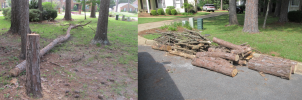
One is for removing two hanging dead limbs, one above the other in a big pine tree. The second is for two largish attached dead limbs in a big pine.
The third project was for removing two dead trees and pulling down some low dead limbs. Since it was mostly in a shady area with no climbing involved, I decided to do it this afternoon. The dogwood was severely rotted, and broke up as it fell. The pine was larger, and it fell just where I wanted it to with a little encouragement after getting hung up in nearby trees. The second picture shows all the debris from the afternoon's labor.

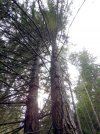
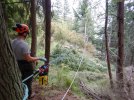
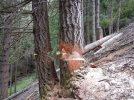
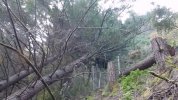
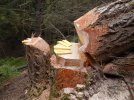
Removing some nasty firs on a nasty slope. This pair was topped ~20 years ago to make a view corridor and of course grew like 5 new 30' tops as a result. The new owner wanted to re-establish the view, so rather than just re-top it which I didn't want to do, it was decided to remove the trees completely. It had a ton of back-lean and limb-weight on the downhill side towards a neighbor and needed to go the other way, probably moving the tops around 20' to shift the balance point. I climbed to like 80' just below the old topping cut and set a static line (to eliminate rope stretch as much as possible) which was attached to a Maasdam Rope Puller to pre-tension the whole system, then attached to a Wyeth-Scott More Power Puller on a 2:1 ("12,000 pounds of pulling force") to actually shift the trees over. The smaller tree was faced and wedged first, then the bigger tree was faced, barked and wedged with 4x 10" wedges along with the big 2:1 puller about 150' uphill to tip the whole thing together. It was fun to watch from the hillside below, seeing that much tree come down above you on a steep slope feels like its happening in slow motion.

Mick Dempsey
Carpal tunnel level member
- Location
- France
Nice work and explanation, thanks.

pete3d
Participating member
- Location
- Hinchinbrooke
I like and admire your technique in this situation as usual @27RMT0N but have to admit I don’t understand the wedging or barking, in that if I had taken the trouble to climb and set a solid line or two high in a tree with a difficult balance or lean (which I have - though never as high a 80’) I would have complete confidence in the winch(es) and line(s) doing the job of tilting the tree and felling it as desired.barked and wedged with 4x 10" wedges

Seems like the wedges would prevent any recoil even if that was a small amount from rope stretch, and they would provide an insurance policy in the event of a puller slipping. Just a guess!I like and admire your technique in this situation as usual @27RMT0N but have to admit I don’t understand the wedging or barking, in that if I had taken the trouble to climb and set a solid line or two high in a tree with a difficult balance or lean (which I have - though never as high a 80’) I would have complete confidence in the winch(es) and line(s) doing the job of tilting the tree and felling it as desired.
The pull-line and wedges work together and back each-other up. Pulling makes wedging easier, wedging makes the pull easier. By the two of them working together, you reduce the load on both, giving more headroom and a larger safety factor. Without the wedges, the pull-line would have to be doing a lot more work, and holding 100% of the trees for a much longer period of time, and if some part of the system were to fail, you'd lose the whole thing backwards. Wedges act like a progress capture in addition to providing lift, but you could never wedge this over without the line.
And shaving off the bark was just to narrow up the tree and make it easier to cut and wedge. The bark was 2-3" thick all around and with that off, my 28" still didn't reach through, but it got a lot closer and easier to do and see what is going on. Also, bark doesn't provide any lift when it comes to wedging, so removing it makes wedging more effective sooner.
And shaving off the bark was just to narrow up the tree and make it easier to cut and wedge. The bark was 2-3" thick all around and with that off, my 28" still didn't reach through, but it got a lot closer and easier to do and see what is going on. Also, bark doesn't provide any lift when it comes to wedging, so removing it makes wedging more effective sooner.
Mick Dempsey
Carpal tunnel level member
- Location
- France
If there’s time (ie. you have the day on it) there is no secondary or tertiary method I’d not use if a tree like that had a back lean over a property.

Mike Islander
Branched out member
- Location
- Lowcountry of South Carolina
What happens to that wood? Incredible firewood mixed with other hardwoods. Any commercial value as lumber in your area?Some recent stuff
View attachment 83402View attachment 83403View attachment 83404View attachment 83405View attachment 83406View attachment 83407View attachment 83408
The big splitting codom was an Osage orange- pruned and cabled




















