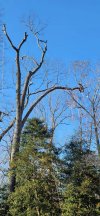
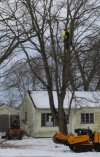
Big dead Northern red removal today. BLS I suspect ....sad the one behind it is about done as well . Seeing so many dying and dead reds last 5years or so. Guy from Rutgers said if I send samples in July-September he’ll get best test results for BLS on scorched leaves. They will test for oak wilt as well,although no confirmed cases in my state yet

Navigation
Install the app
How to install the app on iOS
Follow along with the video below to see how to install our site as a web app on your home screen.
Note: This feature may not be available in some browsers.
More options
You are using an out of date browser. It may not display this or other websites correctly.
You should upgrade or use an alternative browser.
You should upgrade or use an alternative browser.
Work Photos
- Thread starter Leroy
- Start date

Serf Life
Been here much more than a while
- Location
- Maine Island
Sweet shot with the turkey vulture

deevo
Been here a while
- Location
- Horseshoe Valley, Ontario, Canada
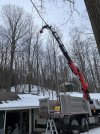
Extra crispy dead ash trees up a hill, behind a shop, they don’t call us for the easy ones

I must have been sitting in his spotSweet shot with the turkey vulture

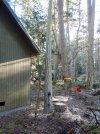
Alright, got a pretty good project here. We had a windstorm that took down quite a few limbs, standing dead and poorly rooted trees recently and this fir was one of them. A swampy area, the 90' fir simply uprooted and leaned into the cabin, with a super goofy horizontal alder in the mix as well. I'd been wanting a GRCS for a while and figured this job was the perfect reason to finally buy one.
It was incredibly lucky that large fir on the right side was there, as that gave me a high-tie for climbing and rigging lines.
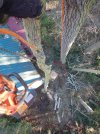
So shiny and new. The GRCS was to support, lift and then lower the fir, the port-a-wrap was for all other lowering while the GRCS would be busy supporting the leaning fir.
Climb and two lowering systems, 1/2" and 5/8", on the big fir at about 80' or so.
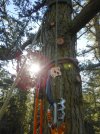
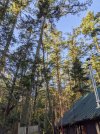
Looking down. That goofy alder reaches horizontally so far the base of the tree isn't in the frame, yet it's reaching 3/4 over the cabin and tangled in the leaning fir.
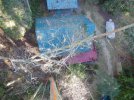
Swung from the spar tree into the alder, brushed it out with a handsaw and lowering off the port-a-wrap. It's long horizontal top acted as a 'bridge' for me to get into the leaning fir, which was quite a ways away from my tie-in point above.
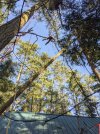
Alder brushed out, taking the limbs off the fir I could reach and then tying it off to the GRCS with the 5/8".
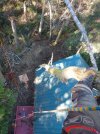
Then I worked my way through the alder, lowering off the wood still overhanging the house and getting farther and farther away.
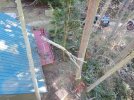
On the alder stem.
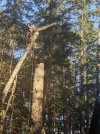
Here you can see how far from my tie in point I was, and the now unobstructed fir. Fortunately that alder stem was totally solid.
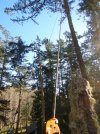
Back on the ground, it was time to use the GRCS to lift the fir off the cabin. That little dent in the flashing is the only damage that occurred. With my good rigging point, lifting the tree with the GRCS went very easy.
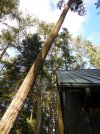
(oh, 10 image limit. Continued in the next post....)
It was incredibly lucky that large fir on the right side was there, as that gave me a high-tie for climbing and rigging lines.
So shiny and new. The GRCS was to support, lift and then lower the fir, the port-a-wrap was for all other lowering while the GRCS would be busy supporting the leaning fir.
Climb and two lowering systems, 1/2" and 5/8", on the big fir at about 80' or so.
Looking down. That goofy alder reaches horizontally so far the base of the tree isn't in the frame, yet it's reaching 3/4 over the cabin and tangled in the leaning fir.
Swung from the spar tree into the alder, brushed it out with a handsaw and lowering off the port-a-wrap. It's long horizontal top acted as a 'bridge' for me to get into the leaning fir, which was quite a ways away from my tie-in point above.
Alder brushed out, taking the limbs off the fir I could reach and then tying it off to the GRCS with the 5/8".
Then I worked my way through the alder, lowering off the wood still overhanging the house and getting farther and farther away.
On the alder stem.
Here you can see how far from my tie in point I was, and the now unobstructed fir. Fortunately that alder stem was totally solid.
Back on the ground, it was time to use the GRCS to lift the fir off the cabin. That little dent in the flashing is the only damage that occurred. With my good rigging point, lifting the tree with the GRCS went very easy.
(oh, 10 image limit. Continued in the next post....)
With the trunk lifted off the cabin, I could face it towards the block above and get some movement in that direction. Then it was cut free of the stump to make pivoting it into the block and away from the cabin even easier.
Heading back up to brush out the top of the fir. Because of the deck and wires below, I couldn't just lay the whole tree down in one piece, so it was stripped to a bare stick.
Looking down as I reduce the stem that is currently supported on the ground/GRCS.
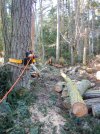
Once that was done, I cut a few pieces off the bottom while the log was held from above. Cut a few feet, lower a few feet, cut a few feet, lower a few feet. Once it was shorter, I was able to lay the remaining piece down along side the cabin and call it a day.
Heading home. Just me and one ground guy on this job, 6 hours at a very relaxed pace.
Heading back up to brush out the top of the fir. Because of the deck and wires below, I couldn't just lay the whole tree down in one piece, so it was stripped to a bare stick.
Looking down as I reduce the stem that is currently supported on the ground/GRCS.
Once that was done, I cut a few pieces off the bottom while the log was held from above. Cut a few feet, lower a few feet, cut a few feet, lower a few feet. Once it was shorter, I was able to lay the remaining piece down along side the cabin and call it a day.
Heading home. Just me and one ground guy on this job, 6 hours at a very relaxed pace.
Last edited:


Bendroctanus
Carpal tunnel level member
- Location
- Springfield
Delicious....Had a fun little project the other day, so time to bump this thread up again.
This was a long-dead, mid-sized doug fir that had broken at the base, was hanging onto the stump by just a few inches worth of fibrous wood in the still solid center, and leaning into a goofy shaped madrone. For the job I borrowed the new Stihl battery extendable pole-saw, which was great and now I want one...
Overview of the situation. While not as high as I'd have liked, I was able to set a line from the ground into that fir on the right side, which gave me a perfect rope angle.
View attachment 72510
It's a decent sized tree with a lot of weight leaning into the madrone. A rather precarious situation.
View attachment 72511
A closer look at the base and angles. This one was kind of interesting to me because usually doug firs here are very good at standing dead and usually just crumble from the top down while staying upright.
View attachment 72512
Freshly rebuilt 200T and HTA 85 polesaw hanging on the belt. Awkward especially with two climbing lines and a flipline on top of that, but was what was needed for the work.
View attachment 72513
With an SRT line in the fir behind me, I climbed up the madrone with my flipline and DRT rope-sleeve so I could stay supported at opposing angles and away from the underside of the fir in case it let loose on it's own. Limbed the fir with the battery polesaw as I went up. Oh, and yah, wet madrones are SLIPPERY.
View attachment 72514
Taking the top using the HTA 85. With no higher to climb in the madrone, the goal was to cut the top out and get it to fall past and over the limbs I was standing on and the tree was resting on. This would have been an almost impossibly large cut to make with a manual polesaw, and very hard with my much heavier gas polesaw.
Always a nice feeling to get that top weight out.
View attachment 72515
With the top gone, I could then cut the trunk with the 200T and get it to the last bit of support. A single 2.5" limb was all this entire log was resting on. (that fir limb on the back side is cut free)
View attachment 72516
Here is the final cut. I just lightly tickled the limb until I could see movement and get my saw away. Fell underneath the madrone perfectly.
Everything on the ground, no cleanup, walk away happy.
View attachment 72517
Well done, sir!
Had a project the other day and the customer got a surprisingly good video.
Here is the situation, a ~100' shore pine that happens to be hanging over this well-pump house.
The trunk went up about 40' at an angle, then took a super awkward jog towards and over the pump-house. On top of that, it was covered in the fruiting bodies of red ring rot fungus, which hollows out the core of what are already weak trees.
The big picture. I thought about climbing that doug fir to it's right first and installing a climbing line in the top, but in the end decided it wasn't necessary. In case I felt the pine wasn't 100% safe to climb while I was spuring up it on the removal, I did have my grappling hook with me. That would allow me to toss into the fir, transfer into it, climb to the top and set a climb-line there if necessary to reduce my reliance on the less than ideal pine.
On the way up. Steel-core flip-line, tree-squeeze and 200' line in my backpack set up DRT. These pines are like velcro and if you have a climb-line going to the ground, the limbs you are shedding WILL catch it and cause you problems. (DRT vs SRT on projects like this is a whole other discussion.....)
Mentioned in the 'tips and tricks' thread, but below are my hinged plywood covering the roof of the pump-house.

Video:
The top had weight in the direction it needed to go (right in this photo) due to where the sun is here. That was very helpful, because at this point with the lean I was over and beyond the pump-house, and surrounded in the limbs of other trees. What I needed to do was send the top about 20'+ to my right, to 'jump' it over the building as well as clear the limbs that could cause it to roll back towards the building. Fir limb breakage was planned for and acceptable.
I made an extra deep, shallow face, extra deep side-cuts since these pines are super stringy, then sent the top with the handsaw to be as safe as possible during the swing. Once the face closed and the intentionally weak hinge broke, I pushed it towards the driveway as hard as possible for maximum distance. Yah, the tree felt like being on the end of a wet noodle at this point. The top was only 10-15', so I was at like 90' here. Even with minimal pull on the hinge-wood, it gave me a good swing.
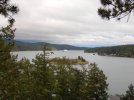
Gotta enjoy the view:
Rather than bother rigging anything, I just did a 'cut-and-toss'. For the smaller wood I made bypass cuts and tossed the wood towards the driveway. For the bigger wood, I went shorter, cut straight through and pushed those towards the driveway. No cleanup for me, an excavator will come by and put everything into a dump truck.
Here is the situation, a ~100' shore pine that happens to be hanging over this well-pump house.
The trunk went up about 40' at an angle, then took a super awkward jog towards and over the pump-house. On top of that, it was covered in the fruiting bodies of red ring rot fungus, which hollows out the core of what are already weak trees.
The big picture. I thought about climbing that doug fir to it's right first and installing a climbing line in the top, but in the end decided it wasn't necessary. In case I felt the pine wasn't 100% safe to climb while I was spuring up it on the removal, I did have my grappling hook with me. That would allow me to toss into the fir, transfer into it, climb to the top and set a climb-line there if necessary to reduce my reliance on the less than ideal pine.
On the way up. Steel-core flip-line, tree-squeeze and 200' line in my backpack set up DRT. These pines are like velcro and if you have a climb-line going to the ground, the limbs you are shedding WILL catch it and cause you problems. (DRT vs SRT on projects like this is a whole other discussion.....)
Mentioned in the 'tips and tricks' thread, but below are my hinged plywood covering the roof of the pump-house.
Video:
The top had weight in the direction it needed to go (right in this photo) due to where the sun is here. That was very helpful, because at this point with the lean I was over and beyond the pump-house, and surrounded in the limbs of other trees. What I needed to do was send the top about 20'+ to my right, to 'jump' it over the building as well as clear the limbs that could cause it to roll back towards the building. Fir limb breakage was planned for and acceptable.
I made an extra deep, shallow face, extra deep side-cuts since these pines are super stringy, then sent the top with the handsaw to be as safe as possible during the swing. Once the face closed and the intentionally weak hinge broke, I pushed it towards the driveway as hard as possible for maximum distance. Yah, the tree felt like being on the end of a wet noodle at this point. The top was only 10-15', so I was at like 90' here. Even with minimal pull on the hinge-wood, it gave me a good swing.
Gotta enjoy the view:
Rather than bother rigging anything, I just did a 'cut-and-toss'. For the smaller wood I made bypass cuts and tossed the wood towards the driveway. For the bigger wood, I went shorter, cut straight through and pushed those towards the driveway. No cleanup for me, an excavator will come by and put everything into a dump truck.
Last edited:
Here is one I've been meaning to share for a while actually, a project from back in the fall and probably one of the top-three most spectacular trees I've ever had the pleasure of climbing.
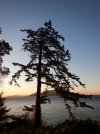
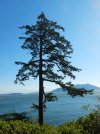
A south facing waterfront property, arriving right at sunrise. I worked in a number of the trees here, but the main event was that big fir on the right.
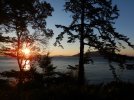
An old growth doug fir, not especially tall (maybe 90'?) as it had lost it's top in countless storms over it's long life. However it was also growing on the edge of a cliff/high bank, at least another 30' straight down to the water.
Obviously with a tree like this rule-one is 'do no harm,' so all that was going to happen was a few pieces of big deadwood, some end-weight reduction on that massive low right limb, and remove the ivy that was almost 25' up the trunk.
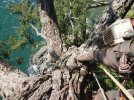
Used a bigshot and hit my limb at about 60' on the first try, which was almost a miracle given the light wind and tangle of brush I was in at the base of the tree. Set a canopy tie on the big limb, SRT up and then switched to DRT on another big limb farther up, directly over the area to climb out on and right between these two big limbs I'm standing on.
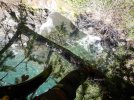
Limb walking and end-weight reduction, way out over the water. I think I only made 4 chainsaw cuts on live wood, and maybe a dozen live cuts total over 3" on this tree.
Having fun.
Another 45 minutes stripping ivy.
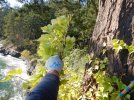
Almost on the ground.
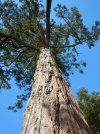
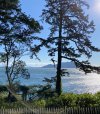
The end result.
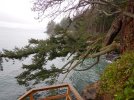
A few weeks later I went back for more work at the property, including more on this tree. That day it was just dead-wooding the other massive limb on the tree, which came from only about 6 feet off the stump, swept downwards over the water, was 24" in diameter and 30'+ long. Like a small tree itself. Spent another 45 minutes just working from those stairs with pole tools cleaning it up and it's just wonderful now, the structure and the way it frames the beach below.
Obviously I climb a lot of trees and I get to do it on a wonderful place, but this one was special. Don't tell the customer, but I would have done this for free just for a chance to climb it
A south facing waterfront property, arriving right at sunrise. I worked in a number of the trees here, but the main event was that big fir on the right.
An old growth doug fir, not especially tall (maybe 90'?) as it had lost it's top in countless storms over it's long life. However it was also growing on the edge of a cliff/high bank, at least another 30' straight down to the water.
Obviously with a tree like this rule-one is 'do no harm,' so all that was going to happen was a few pieces of big deadwood, some end-weight reduction on that massive low right limb, and remove the ivy that was almost 25' up the trunk.
Used a bigshot and hit my limb at about 60' on the first try, which was almost a miracle given the light wind and tangle of brush I was in at the base of the tree. Set a canopy tie on the big limb, SRT up and then switched to DRT on another big limb farther up, directly over the area to climb out on and right between these two big limbs I'm standing on.
Limb walking and end-weight reduction, way out over the water. I think I only made 4 chainsaw cuts on live wood, and maybe a dozen live cuts total over 3" on this tree.
Having fun.
Another 45 minutes stripping ivy.
Almost on the ground.
The end result.
A few weeks later I went back for more work at the property, including more on this tree. That day it was just dead-wooding the other massive limb on the tree, which came from only about 6 feet off the stump, swept downwards over the water, was 24" in diameter and 30'+ long. Like a small tree itself. Spent another 45 minutes just working from those stairs with pole tools cleaning it up and it's just wonderful now, the structure and the way it frames the beach below.
Obviously I climb a lot of trees and I get to do it on a wonderful place, but this one was special. Don't tell the customer, but I would have done this for free just for a chance to climb it
Last edited:
Winchman
Carpal tunnel level member
- Location
- Southwest Georgia
Wow, just wow.
I wish I could see the last four pictures, though.
I wish I could see the last four pictures, though.
I wish I could see the last four pictures, though.
I wonder why? They are uploaded to the forum just like all the others and I can see them when I check from a different browser even in incognito mode...
Edit: A few more, why not.
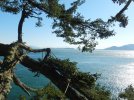
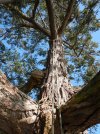
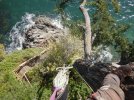
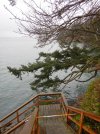
Last edited:

VenasNursery
Been here much more than a while
- Location
- Michigan
They show up on my endI wonder why? They are uploaded to the forum just like all the others and I can see them when I check from a different browser even in incognito mode...
(I had so many beautiful photos from this tree it was hard to cut it down to 10...)

Reach
Been here much more than a while
- Location
- Atglen, PA
Wow, that’s a beautiful view and a magnificent tree!Here is one I've been meaning to share for a while actually, a project from back in the fall and probably one of the top-three most spectacular trees I've ever had the pleasure of climbing.
A south facing waterfront property, arriving right at sunrise. I worked in a number of the trees here, but the main event was that big fir on the right.
View attachment 73430
An old growth doug fir, not especially tall (maybe 90'?) as it had lost it's top in countless storms over it's long life. However it was also growing on the edge of a cliff/high bank, at least another 30' straight down to the water.
Obviously with a tree like this rule-one is 'do no harm,' so all that was going to happen was a few pieces of big deadwood, some end-weight reduction on that massive low right limb, and remove the ivy that was almost 25' up the trunk.
View attachment 73431
Used a bigshot and hit my limb at about 60' on the first try, which was almost a miracle given the light wind and tangle of brush I was in at the base of the tree. Set a canopy tie on the big limb, SRT up and then switched to DRT on another big limb farther up, directly over the area to climb out on and right between these two big limbs I'm standing on.
View attachment 73432
Limb walking and end-weight reduction, way out over the water. I think I only made 4 chainsaw cuts on live wood, and maybe a dozen live cuts total over 3" on this tree.
View attachment 73433
Having fun.
View attachment 73434
Another 45 minutes stripping ivy.
View attachment 73435
Almost on the ground.
View attachment 73436
The end result.
View attachment 73437
A few weeks later I went back for more work at the property, including more on this tree. That day it was just dead-wooding the other massive limb on the tree, which came from only about 6 feet off the stump, swept downwards over the water, was 24" in diameter and 30'+ long. Like a small tree itself. Spent another 45 minutes just working from those stairs with pole tools cleaning it up and it's just wonderful now, the structure and the way it frames the beach below.
View attachment 73438
Obviously I climb a lot of trees and I get to do it on a wonderful place, but this one was special. Don't tell the customer, but I would have done this for free just for a chance to climb it

laddo
New member
- Location
- New Orleans, LA

• Aim High, Climb Trees •

Stihlmadd
Been here a while
- Location
- Adelaide South Australia
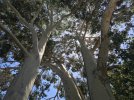
Spotted Gum Maintenance prune .
the chains are from a previous companies work about 20 years ago.
dmonn
Branched out member
- Location
- Port Washington Wisconsin
Looks like it was a pretty windy day. Did the wind direction help or hinder?Had a project the other day and the customer got a surprisingly good video.
Here is the situation, a ~100' shore pine that happens to be hanging over this well-pump house.
View attachment 73226
The trunk went up about 40' at an angle, then took a super awkward jog towards and over the pump-house. On top of that, it was covered in the fruiting bodies of red ring rot fungus, which hollows out the core of what are already weak trees.
View attachment 73227
The big picture. I thought about climbing that doug fir to it's right first and installing a climbing line in the top, but in the end decided it wasn't necessary. In case I felt the pine wasn't 100% safe to climb while I was spuring up it on the removal, I did have my grappling hook with me. That would allow me to toss into the fir, transfer into it, climb to the top and set a climb-line there if necessary to reduce my reliance on the less than ideal pine.
View attachment 73229
On the way up. Steel-core flip-line, tree-squeeze and 200' line in my backpack set up DRT. These pines are like velcro and if you have a climb-line going to the ground, the limbs you are shedding WILL catch it and cause you problems. (DRT vs SRT on projects like this is a whole other discussion.....)
Mentioned in the 'tips and tricks' thread, but below are my hinged plywood covering the roof of the pump-house.
View attachment 73230
Video:
The top had weight in the direction it needed to go (right in this photo) due to where the sun is here. That was very helpful, because at this point with the lean I was over and beyond the pump-house, and surrounded in the limbs of other trees. What I needed to do was send the top about 20'+ to my right, to 'jump' it over the building as well as clear the limbs that could cause it to roll back towards the building. Fir limb breakage was planned for and acceptable.
I made an extra deep, shallow face, extra deep side-cuts since these pines are super stringy, then sent the top with the handsaw to be as safe as possible during the swing. Once the face closed and the intentionally weak hinge broke, I pushed it towards the driveway as hard as possible for maximum distance. Yah, the tree felt like being on the end of a wet noodle at this point. The top was only 10-15', so I was at like 90' here. Even with minimal pull on the hinge-wood, it gave me a good swing.
View attachment 73231
Gotta enjoy the view:
View attachment 73232
Rather than bother rigging anything, I just did a 'cut-and-toss'. For the smaller wood I made bypass cuts and tossed the wood towards the driveway. For the bigger wood, I went shorter, cut straight through and pushed those towards the driveway. No cleanup for me, an excavator will come by and put everything into a dump truck.
View attachment 73233
Looks like it was a pretty windy day. Did the wind direction help or hinder?
There was some wind, maybe the occasional 10-20mph gust, but where I'm taking the top is at a similar canopy level to the surrounding trees so I certainly wasn't taking that full force. Keep in mind I'm around 85' up here, tied in where the trunk is only about 5". Movement at that height in this kind of tree is normal and expected, every motion becomes multiplied as you are basically hanging on the end of a fishing-pole when working single-stem leaning trees. The wind direction was somewhat helpful here, but still around 45* from optimal. There are many times when I will use the wind to my advantage but here given the potential movement at this height, I was more interested in finding a break between gusts for maximum stability when making the critical cuts. Getting the top where I wanted was really about accurate cuts, a narrow face so it broke soon and giving it a big push in the right direction.
View attachment 73467
Spotted Gum Maintenance prune .
the chains are from a previous companies work about 20 years ago.
Beautiful tree, wish I had stuff to climb like that out here. How were the chains installed, eye-bolts and tight to the opposing stem? Any thoughts on static verses dynamic support in a tree like this?

Cereal_Killer
Branched out member
- Location
- Ohio
Some pics from a job we did for the Montgomery County Land Bank a few weeks ago. They sent out a photographer and I was able to get in contact with her and get some of her photos. This was my first ever crane job and that morning before lunch was my first time ever riding the crane to set a few chokers that were just out of Adrian's reach from the bucket on the first tree.
She also got a few of me deadwooding the tree out front while Adrian did that removal.
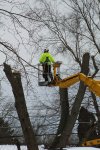
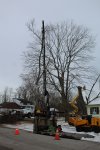
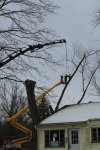
She also got a few of me deadwooding the tree out front while Adrian did that removal.


