Wood weight

The Z (annex E) has a green log weight chart and you should definitely have one of those.

My basic rigging kit includes 200' of 9/16" stable braid (for use with a block), 200' of 1/2" Super Braid (for use with natural crotches), a CMI one ton block, a couple of 5/8" Tenex loopie slings, a 1/2" Tenex spider leg balancer, a big steel porta wrap, a really long 5/8" Tenex whoopie to go with the porty. Some other stuff I keep handy but is not essential is a 5:1 fiddle block, some steel rigging biner's, a little 3:1 block, a few prusiks, a few eye slings, and some loop runners. That's all I can remember right now.
 
[ QUOTE ]
[ QUOTE ]
That's all I can remember right now.

[/ QUOTE ]


The Kitchen Sink?


SZ

[/ QUOTE ]

If it has a GRCS in it, sure!
nuke.gif
 
[ QUOTE ]
Lumberjack found and posted scale i've seen! (doyle scale) it went beyond the avg. green log chart to give weights on diameters over 36 inches.

[/ QUOTE ]


That spreadsheet is a great reference. The only drawback is that it has an 'average' weight for 'oak' and pine.

If someone wants to calculate the weight of a species of log that is in the chart, but the log is greater than 36" in diameter, they can use the following simple formula.

1) Convert diameter in inches (d) to diameter in feet (D)

2) Find the volume of a log with diameter D and one (1) foot long (volume of a cylinder = pi X radius squared X length)

(Here length is one foot because that is the length of all of the other samples in the chart.)

3) Multiply the volume times the weight in pounds per foot cubed of that species (this is the second colume in the chart, immediately following the species).

It may sound a little complicated, but once the steps are figured out the weights of different diameters can be found very quickly with a calculator.

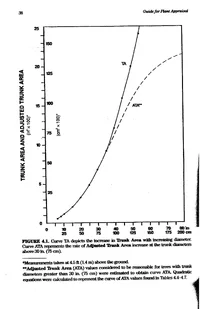
I've also found the attached chart (from the ninth edition of The Guide to Plant Appraisal) can be very instructive. The solid line plots the increase in diameter (x axis) against the increase in area (y axis). Area (and thus volume and thus weight) increases much faster than diameter.
 

Attachments

  • 103977-trunk_area_vs_trunk_diameter_graph2-17-0527(2).webp
    103977-trunk_area_vs_trunk_diameter_graph2-17-0527(2).webp
    150 KB · Views: 59
Thanks for the compliments. The only drawback to these shows is that there is not enough time to meet and talk with everyone.

I had a great time and hope to meet more Buzzers at future events.

Pancake, how do you like New England?
 
I was looking in the ANSI for Palm weight and unless I missed it, highly likely, I did not see it. Does any one know a source or know what the weight of a Washingtonia at 22 inch per foot is?

Thanks
 
One interesting esoteric observation to note: we had a little difficulty lately (not that it ended up mattering, since the crane company sent a 220 ton (!) instead of the 70 ton we ordered), figuring Horsechestnut weights. The chart in Blair's book says "Chestnut" --55 lbs per cubic foot. The chart in the ANSI standard says "Horsechestnut" -- 41 per. So, a 24" by 20' section, Blair, weighs 3460; same piece, ANSI, weighs 2580.

So, there may well be innacuracies on these charts. Leaf weight on early pics changes things, too, so you are guessing early, and only have a few pics later to figure out what wood alone really weighs. Also, hollowness and seasonal variations in water content can make a big difference.

On our job, reality was that the pieces weighed closer to 41 than to 55. But that knowledge comes after the fact (if you're using a crane): you have to pic them first, to find out. What we should all do anyway: go small, and work up toward your load limit, with high safety factors.
 

New threads New posts

Back
Top Bottom