
Willow Tree Hit By Rain / Wind...Growing Fast??

climbingmonkey24

Carpal tunnel level member
Location
United States
I pruned this tree back in May of this
year and here are the Before and After photos.
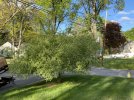
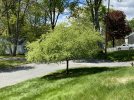
6AF3F00E-C887-4DFC-A007-D31691F31785.jpeg8510190A-4AC0-4902-9491-DF316CBCE1D8.jpeg

Client contacted me because I guess after some heavy rain the branches seem to be sagging a little but he also said it bounces back but it’s grown out quite a bit in just the short time since we last pruned it.

A recent picture:
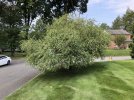
35854E35-E819-43B8-906C-BB72A5A14607.jpeg

This is a town tree in the front yard of my client. I had to get a permit to prune, so it isn’t something that had been maintained regularly like it should’ve I’m guessing.

So my question is should anything be done because of the recent weight / force of the rain on the tree?

Also, that seems like quite a bit of growth in a short amount of time. Would pruning it a second time this year be advisable? Might it look more overgrown than it really is simply because of water weight and branches being bent down etc.? I haven’t seen it in person since we pruned it, client just contacted me today with a pic.
 
oh give me a break there’s nothing fucking wrong with the tree. As it happens the client likes the tree.

What is the desire on here to chop down a perfectly healthy tree?

Completely ridiculous and unnecessary and totally unrelated to the topic of the thread.

I’m in the business of caring for and improving the health and appearance of trees, not cutting them down for no reason!
 
Last edited:
It has to do with it being a willow next to a street and under wires. If I need to explain all the reasons why it should be removed I feel like i would be wasting my breath. Nothing personal but there was an idiot involved with that decision of planting a willow in one of the worst locations possible.
 
What genius planted it there? All sarcasm implied.
City tree? City planted? If so have your customer call and bitch every day until they cut it down.
Ahhhhh!!! Truth hurts. To keep it there will require a long-term pruning plan.

Interesting when you look at wild willows, they’ve evolved to simply fall over, put roots in the ground from wherever the trunk contacts the ground. Whatever limbs are on the up side of the trunk will become the new tree or trees. Over many years they just crawl around along the river banks and wetlands where they like to be.

I worked on a really nice one, huge multi-leader, massive trunk, did a fairly aggressive crown reduction so nothing will hit the the property owner’s house (direction of lean) if/when it fails.
-AJ
 
Last edited:
Obviously it’s a bad location which goes without saying but it’s a town tree so it can’t just be cut down. It’s not an option. So pruning regularly is the only choice.


I was looking for serious opinions and discussion not to make it a big joke just because people think the tree is in a bad spot.
 
Last edited:
I am being serious. The city forrester who made that decision is an idiot or who ever planted it is an idiot. Best thing to do to that tree in that piss poor location is to pollard it and repollard as needed. Often. I have no doubt it will make you money over the years.
 
I think it looks pretty good at the moment, but it’s a ticking time bomb given its location and species. Willow grows so extremely fast that a routine maintenance plan will either necessitate aggressive height reduction or multiple prunes a year.
What others have pointed out in no uncertain terms is that the bigger issue is not the structural integrity of the branches at the moment, but rather its ill fate given its location. This is a textbook case of wrong tree in the wrong place. I would say that rather than this concern being a cursory, irrelevant thing to bring up in this thread, this should be the main conversation to have with the client. Whether the tree should remain at all.
 
I think it looks pretty good at the moment, but it’s a ticking time bomb given its location and species. Willow grows so extremely fast that a routine maintenance plan will either necessitate aggressive height reduction or multiple prunes a year.
What others have pointed out in no uncertain terms is that the bigger issue is not the structural integrity of the branches at the moment, but rather its ill fate given its location. This is a textbook case of wrong tree in the wrong place. I would say that rather than this concern being a cursory, irrelevant thing to bring up in this thread, this should be the main conversation to have with the client. Whether the tree should remain at all.
All true, note that this is a tree on the edge of client's property, city/town planted tree so cutting it down is not an option.

Great candidate for a strong crown reduction, especially width-wise. It can be done and still look great (not hacked) good luck with it!
-AJ
 
We don’t even know if he planted it. I don’t even know who planted it. Just because a tree is on the town tree belt doesn’t mean it’s planted by the tree warden (out here at least).

It’s not up to me to remove the tree or to try and convince the town that it should be removed because I think it’s in a bad spot. It’s a town tree. All the client wants is to keep the tree shaped and trimmed. They LIKE the tree.
 
Last edited:
Listen to what has been said.

Wrong tree...wrong place
Pollard..two to three times per growing season
Restricted site lines

And read what I wrote,

It’s a town tree. I have no say in where it goes or whether it should be cut down. Nobody’s opinions as to whether the tree is in a bad spot matters, the town will do what they do with it if they ever do something with it.

All the client wants is to keep it shaped and trimmed. Removal and location shouldn’t even be apart if this discussion, because there’s nothing that can be done about it. Completely different situation if we were talking about a tree that actually belonged to homeowner.

People are so worried about the location and cutting it down except it’s out of the equation because it’s a TOWN TREE and the client LIKES the tree.
 
The willow trees that I have to deal with (two are my own) require annual pruning at a bare minimum. Usually biannual. They grow several feet per year even in this state. They are prone to wind damage, and yes, even a heavy rain can damage them. None of this will kill them... that usually takes two years of drought conditions... but they are a high-maintenance ornamental. If a permit is required to prune them, then I'd be asking the city council or equivalent for a variance to allow you to prune it two or three times annually without the need for a permit.

I'm surprised that the city hasn't removed it themselves. In nearly all of this state, including the small towns, you can't plant them on the right of way area (what we call the "parking"... colloquial term left over from the days when that is what it was actually used for). They have very invasive roots that are always looking for water and wrapping around whatever subterranean features they encounter.

So, in answer to your question, most willows (especially the "weeping" varieties) you have to prune with the certainty that the growth rate is going to be roughly the same as kelp. Pruning it to look perfect today means that you'll be back in two or three months to prune it again. My weeping type willows have twig growth of as much as eight feet in a single season. Once they get to about 25 or 30 feet of height, you can prune heavier up high to reduce the number of single-season prunings. They're like shrubs in that every cut produces 3 to 7 more twigs and the monster gets out of hand quickly. Sometimes you have to be rather brutal, but their fast growth rate means that they look pretty good, again, in a very short time.

I do think that you are going to have to contact the town officials if you want to set up a regular pruning schedule that doesn't involve the homeowner paying a permit fee each time. I have such an arrangement with several properties and my only obligation is to notify the towns after I do the work. They do a drive-by inspection of the work and notify me if they have any issues. So far, the only followup calls have been to ask me to go speak to a homeowner with an unruly or damaged tree on the right of way.
 
But how many times of year would ideally you need to prune to keep on top of it?

Maybe like a Spring / Fall plan, or would it be better to do Spring / late Summer, etc.?
 
If it were mine and I for some God awful reason wanted to keep it I'd prune early spring before leaf out to nip any obviously undesirable growth before it happens, late spring after leaf out and again late summer while it's still in leaf.
Around here they're one of the last to drop their leaves so you'd have quite a while to get that one in before winter.
 

New threads New posts

Back
Top Bottom