wildland tree climbing

Hey, folks...new member here, though I have been reading and learning from this fine site since soon after it's inception. My question reflects differences in my work situation and that of most of you in pro arborist work. I do consider myself a professional climber (after all, I get paid to climb), but I work exclusively in wildland stands, rather than urban/suburburban environments. I also work almost exclusively in conifers. While I have successfully adopted SRT for old-growth some years back and DbRT for the limited work I do in hardwoods, I continue to have trouble using anything but spurs (or stacking tree ladders or Swiss tree grippers) getting into second-growth. To try to keep this note short, can y'all give me some advice on accessing 50-150 year old Doug fir that have dense crowns in close contact with each other and generally small diameter limbs that are questionable as sole anchor points for SRT or DbRT? I'd not turn down discussion of your personal opinions on the appropriateness of spurs for wildland tree work. Thanks.
 
From the tone of your post I think that you realize that spurs aren't supposed to be used for pruning. You might get toasted a little, but most of the Buzzers here will be professional and not get into a flame war.

Is your difficulty from not being able to install a line high in the crown of the tree? I find that's the case with thick crowned trees. Try setting your line a little lower over a secure branch and ascend like normal. Once you get to the access limb start to ascend by using the Double Lanyard or Double Ended Lanyard. You can use your climbing rope and friction hitch as a second lanyard to make your way up the tree to a good tie in point. This way you're always secured.

Ascending the trunk using SRT is difficult when the rope is draped along the trunk. I use a Greg Liu Easy Bar [email kliminfool for more info] and put my toes against the trunk. Kind of like front pointing with crampons.

Glad to see that you "Un-Lurked", welcome to the Bright Side!

Tom
 
Welcome, Burnham.

I work in the Puget Sound area. Yes, it is often very hard to get a line safely set in a 2nd growth conifer. It is good to aim the throw line a ways up into the canopy, and hopefully get it near the trunk, but certainly around more than one branch. Then, wrap the tail best possible around the tree, and SRT on the other end.

If all else fails, use gaffs. The damage done to a conifer is slight. Rarely do I see any decay when removing previously gaffed firs. And most of them over 60 yrs old have fairly thick bark at least up 50 feet or so.

Crotch selection can be tough, and climbing on a possible dubious set, is on of the most hazardous things we do. No tree is worth so much as to take too much risk...

That said, it has been a while since I've had to gaff up a conifer, but then most of our residential trees arent as bare trunked and small limbed as a true woods trees.

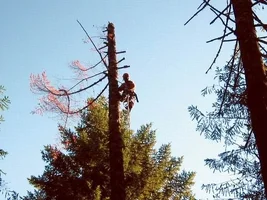
Here's a shot of me logging the last of 16 beetle killed fir. Most were 120-150 feet and very slender. This one is still 120 feet up where I'm working. It had close to 1500 board feet in it.
 

Attachments

  • 2741-skykomish dead 160 footer2W..webp
    2741-skykomish dead 160 footer2W..webp
    65.6 KB · Views: 103
Burnham, Have you tried using DbRT in these trees? I too work in Oregon and have had great success shooting a line into dougs, hemlocks etc. Then, after placing my rope, I set my split-tail on one side of the tree with the standing end of the line on the other. In essence, I turn the central trunk into my tie in point. your wieght sucks the rope right up next to the trunk so you're nicely placed. Back it up with a flipline and you're set. If you are ever in the Eugene area look me up and we can go climb. Also I don't know how many trees you have to do in a day, but please try not to use those spurs . Spur holes are bad: they provide entry points for insects, even if you're careful they often damage the critical holding wood in the top end of conifer branches, and finally I doubt you're sterilizing your spurs between trees(god knows what goodies are being transported on their surface only to be jabbed into a healthy tree). Hope I've been some help. If you have any questions let me know. Thanks, and good luck
 
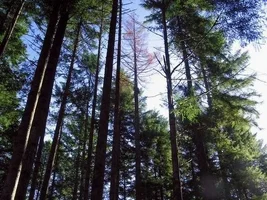
Here's a shot of some forest trees that would be mostly impossible to get a safe line set. Only way to get up without spurs would be with mechanical climbers.

It was 80-110 feet to the first branch on many of these, and the branches were under 2 inches, and with no strength built, thus no reaction wood, due to the close canopy.
 
By the way, the term, coined by tom Dunlap and others, is DdRT, or doubled roped climbing.

No way would I use it for long ascents. SRT is easier. It also may allow the line to be choked around the trunk, thus allowing a safer entry. Either way, the line must not be stuck out a ways on a small limb, or the limb could break.
 
Thanks for the input, Tom, Roger, and Jason. Roger, you accurately perceive the situation I frequently find myself facing in these stands. There just are very few limbs available that I can be confident will support SRT. I can sometimes get a line in there that includes several limbs, but usually only one carries the load, and I sure don't want to subject any of the others to the dynamic loading that would occur if the load bearing one fails. When climbing old-growth I am generally successful with SRT, placing the line with slingshot or Bigshot. Tom, I climb SRT in the Texas system with two footloops, two handled ascenders, and ascend against the trunk just as you describe, toes to the bole.

Jason, I hear what you are saying about tree health, but let me share my thoughts as well. I am completely in agreement that spurs are not appropriate in situations where each tree is a valued individual, say in urban/suburban environments. However, I am not engaged in tree care. My work is in wild stands. There are perhaps 200-250 trees per acre in these second growth Doug fir stands, and my district is over 425,000 acres. If you're keeping score, that's over 100 MILLION trees! Frequently, in following stand managment prescriptions, I am intentionally damaging trees by topping, girdling, or implanting heartrot inoculum. The concern is with not having enough snags and cavities for a variety of wildlife species in these uniform aged relatively young stands, rather than with protecting an individual tree. I need a method that is not too time consuming and is energy efficient, and spurs seem to be the only method that fit the bill.

Having said all that, I also collect cones and grafting scion, and chose from the best growing, best formed individuals for these purposes. I have no desire to damage them unduly, so I posted my question. I must say that I agree with Roger that Douglas fir handles spuring with minimal impact to health. I have climbed for nearly 20 years and have never seen a DF decline from this, even some used in training situations that have been climbed dozens of times over many years. Noble fir, Western larch, and Ponderosa pine all seem to shrug off the gaff wounds easily. Not to say all conifers are like this; I use other methods with Western white pine as they are very sensitive. Hardwoods are another story, of course, and I use Ddrt or SRT in that case, though my experience there is mostly of the recreational climbing variety.

So I guess I have not yet heard any really viable way to get around the problem...if it really is a problem. Do others think the conditions I work in should be viewed as I currently do, or not?

 
Having read all this, I think it is time to go back and read Dr. Alex Shigo's research on the effects of wounding trees with climbing spurs. He is the accepted scientific authority. The results? Spurs are not acceptable. Period.

Some trees are easier to get into than others. If the effort is made, it can usually be done. If it is not economically feasable to make this effort, that's just too damn bad. No matter how you want to ask (then state your opinion that minimizes the damage), we already know it is a rationalization. Sounds like you've got a 20 year addiction to a bad habit. It is pretty common for dyed-in-the-wool spur climbers to want to re-hash this debate. Don't expect us to help you justify opening these wounds, especially in western Oregon, where an epidemic of bark beetles is waiting to sniff them out.

And please, don't say that "The boys over at The Buzz said it was OK to use spurs". It's not.

If it sounds like I've got my nose out of joint about it, that's true. For 30 years I've been treated like that stupid Tinman--doesn't even know enough to come in out of the rain". There's only two things that stand between us obtaining professional recognition and being categorized as laborers, it's spur climbers and tree toppers. Why is this? Because spur climbers & tree toppers are ignorant, placing their own financial gain ahead of the value of the resource.

Burnham, you've come out of the woods into the realm of sophisticated landscape design professionals. The forest industry needs to interact more with allied trades. We've got plenty of heart, and we won't give up without a fight. In the last dozen years, 18,000 arborists have made the investment in obtaining their industry certification. We're about a quarter of the way there. "Physician, first do no harm." is on page one. I'd suggest you start there, then finish reading the book.
1995redwood2web.jpg
 
What an absolutely fascinating job! I'm jealous! I'd love to get paid to climb without a chainsaw. Do you carry a handsaw to clear small branches/ deadwood out of your way?

I usually only climb pines to remove them, climbing with gaffs, so I'm not familiar with using SRT on your 120'-150' conifers out there. If retrieval of your rope can be set up (tying the end of your throwline through the knot) I'd imagine you could ascend SRT by setting the rope and tying a running bowline up to choke the trunk. Even a small limb would hold the rope safely because most of the force would be on the trunk.
 
That is true, Brian. But in some of these firs with small branches and not starting til 80-100 feet up, it is mighty hard to get a line set right against the trunk. And, usually, there will be some small dead branches lower that make it hard to choke the line.

I can just imagine what Burnham is talking about, as with most of our city work, the trees aren't that tough to set lines.

Thus, I say, go easy Mike!! However, I would hope that you are able to make clean ascents into the good trees, Burnham. The ones that are being made into habitat trees need not be preserved from spur marks, I would presume to think. Here's a thought. On the good cone picking trees, how about leaving some cheap line for the next climb. I have a source for very cheap stuff that should hold its strength for a couple years in the shady underforest.
 
Oops, looks like the pic I thought I posted yesterday is not up. So here goes.

These are forest trees, 80-110 feet to the canopy of mostly small branches...pretty dang hard to get a safe line set in these..
That's me in the bronze colored fir.

(We were logging a few beetle killed ones.)
 

Attachments

  • 2819-skykomish dead 160 footer 1500 board feetW.JPG.webp
    2819-skykomish dead 160 footer 1500 board feetW.JPG.webp
    97.5 KB · Views: 85
Yep, Roger, your picture shows the situation pretty well.

I really hope to be able to join you here as fellow pro climbers, but Oxman, your attitude reinforces my initial reluctance to sign on and engage. We have very different objectives. I am working in ecosystem management, not as a landscape design professional. You are the physician, I am not. The biologists and foresters who write the management plans I imlement don't see corrolary damage as a negative thing. In your position I would do exactly as you do, and I think if you were in mine you might see logic in my practices. I am neither ignorant nor do I gain financially by using spurs. If I were a dyed-in-the-wool spur addict I would not have invested the time and expense to aquire the training and equipment to pursue SRT or DdRT. My employer does not need it; this comes from me. But we are not so far apart in the challenges and rewards of our work. You would excel at mine, and I feel pretty sure I would not embarrass myself in yours. I don't need you to agree with me or give me validation, any more than you need mine. So, peace. I would like to read Dr. Shigo's work; I've not been exposed to it. What is the best way to get access to it?

I agree with you, treeclimber165, I do have a great job. The very best part is the "species of interst" surveys. Mostly older, bigger trees where I'm looking for stuff like lichens, brachophytes, goshawk nests, red tree vole nests. I usually carry a folding Corona razortooth, about a 13 " blade. If I am facing alot of deadwood I'll carry a fixed blade Corona razortooth, about 27" blade, in a sheath. Alternatively, and pretty often, I tote a "rat whacker"; my choice is a Sandvik brushing tool without the blade. The frame and head has enough weight to bump pretty good-sized dead branches.

Roger, your idea of leaving a line behind for rigging the next time is an interesting one. I can see some times that would be useful. One complication is that in wild stands, pickable cone crops come irregularly both in time and geography, so the likelyhood of picking the same tree inside 5-6 years is low. Still, it's a good suggestion to remember.
 
I once had to train 2 guys to climb tall skinny Larches (around 70 feet). They needed to access Bird of prey nests to check on them. They were specially licensed to interfere, but needed to be in and out within 40 minutes so as the eggs didn't get too cold. The nests were located out in the wilds and they had to cross rivers etc and needed to travel light.

I introduced them to the big shot to set an access line that was anchored at the base of the tree through a gri-gri. This was long enough to lower the climber if need be. This was ascended with two handled ascenders attached to the harness via a Y absorbica sling.

The anchor points were questionable, so were backed up by clipping a dynamic line and energy absorber to the chest. This was then fed through runners placed around the trunk at safe intervals during the ascent, and was belayed on the ground by the second man. If the anchor point failed, the back up would catch and the ground man could lower all to the ground. The absorbica y on the static rope would protect from a shock load if the static line caught on another branch.

As the branches were reached, if they were strong enough to climb on, a long lanyard with distel and pulley could be used in the conventional DdRt. Changeovers would be backed up by the dynamic line and/or sling.

If the branches weren't strong enough to climb on, this meant the climber climbed free but backed up by placing slings and the dynamic line and enrgy absorber to the chest. The danger is falling across a strong branch, but presumably these aren't available to climb on, which is why the technique is used. Either of the techniques could be used depending on the changing situations during the climb.

The system worked and the guys were chuffed. Previously they had been using poles with a hook and eye to attach a rope to - place the hook over a (small) branch and SRT up. The poles weighed a ton! One of the guys nearly drowned when he fell in a river with them and a full sack on his back! If the anchor branch failed, they just hoped it would catch on another - now I like falcons as much as the next guy, but not THAT much!

Its a system I really like and it was a real challenge to come up with the solution. The groundworker was an ex rock climbing instructor, and was familiar with the equipment and set up, which made it really slick and effective. Training and practice is the key to making it work on a daily basis. The good thing about the system is its versatility - You can add or remove items as the risk assessment dictates. Its just two long ropes and a long lanyard, with plenty of slings. Not forgetting the big shot and throwlines. There are several harnesses available that have work positiong and fall arrest attachment points. Just remember to clip into the chest with energy absorber if you climb above the anchor point, and make sure no strong branches are in the fall path.

I hope you consider this method over spurs. <font color="green"> </font color>
 

New threads New posts

Back
Top Bottom