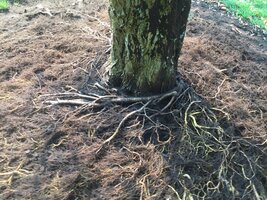
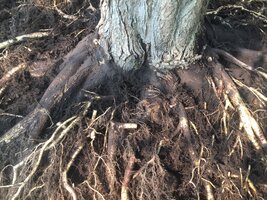
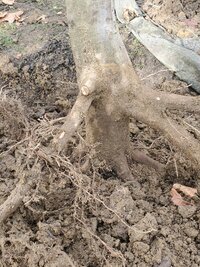
Why does deep planting encourage girdling roots?

Is it known exactly why planting a tree too deeply encourages roots to circle? I can imagine, why roots would emerge from buried trunks, but why would such roots not radiate outward as with normal root development?
 
Last edited:
Not every root radiates. It only takes one to go the wrong way. - maybe deflected by a rock or the like.

Also, if the tree was containerized at any point during propigation - even as a liner stock, it is not improbable to have encircling roots already developed. If the tree is too deep, you end up with girdling roots.
 
Not at all my area of expertise, but is it known that planting a tree too deeply encourages girdling roots? I'm just wondering if the premise is true. Is it well established through scientific methods? I know people theorize it's true, but I don't know if it's proven.

Surely someone here can shed some light on this subject.
 
We do know:
A) Trees that are not planted too deep (or not volcano mulched - which mimics deep planting) do not develop stem girdling roots.
B) Stem girdling roots actually happen.

Perhaps "encourage" may the wrong term... Deep planting provides an environment where SGR are possible.
 
I've seen a couple trees planted without removing wire baskets (smaller "mesh" size) that ended up growing roots this way. Also our curse here is City contractors who hydraulic spade a tree planting location in clay soil hardening the sides into pottery, they don't even use a shovel or spade to break up the sides of the hole that's hard as concrete, and then plop the tree in - this to me is just a big clay pot - tree grows for 10 or 15 years and then mysteriously starts to struggle. Haven't seen SGR in this scenario but it wouldn't be a stretch in my mind. Kinda my two cents.
 
Many species will stump sprout, these sprouts don't know what they want to be until the environment they grow into, stress triggers this.
Alternate and opposite buds are not exclusive to the crown. Japanese maples are a great example of girdling root hell.
It does happen..
sometimes girdling roots just happen, seen it many times on wild trees.
1670564385340.jpeg1670564505680.jpeg1670564557841.jpeg
 
Last edited:
From my experience it does seem that adventitious roots tend to have higher girdlle potential. My thoughts are that the may be a little weaker than primary growth and deflect off of soil particles easier after emerging and then follow that same growth pattern. I have never come across an adventitious root mat (majority) that protrudes straight out from the trunk.
 
Lateral roots from the root flare or below will grow outward, more or less, as that is what they are designed to do.

Adventitious roots that come from above the root flare, aka what would and should have been the trunk of the tree, aren’t supposed to be making ground contact. When they do, they often encircle the stem of the tree. As to exactly *why* they do this, I don’t have a clear answer for you. But they do not behave like normal roots because those latent epicormic buds weren’t designed to become roots. They were supposed to remain above ground and become a branch if something whack happened to the structure of the tree.

Also roots will encircle the tree from being in a pot too long. The root system looks like a hurricane. And guess what? The roots never change direction, they just get bigger and keep growing in the same direction.

I’m getting into air knife work these days and transplanting and planting trees, working with some real bright minds. Very illuminating.
 
@Stumpsprouts l'm not sure this part is technically accurate:
But they do not behave like normal roots because those latent epicormic buds weren’t designed to become roots. They were supposed to remain above ground and become a branch if something whack happened to the structure of the tree.

I'm open for correction - I am not a plant physiologist! My understanding is that secondary roots (or advantageous edit to correct adventitious roots) come from parenchyma cells. Parenchyma cells are undifferentiated. that means they weren't designed for a specific purpose...they were designed to respond to their environment. If the tree is at correct depth, they will become part of the normal trunk of the tree. If they are in a dark moist environment they look around and say: "A root! That's it, that is my calling. It's what I'm going to be when I grow up is a ROOT!"

These cells may also become rays in the wood, callous tissue, create gums and resins, or even become photosynthetic. I don't think they can become vascular tissue.

It is my understanding that the parenchyma cells on their way to becoming roots divide into what is called induced primordia. On the other hand, "normal roots" arise from preformed primordia which are intended to be roots all along.

Maybe a propigation expert - especially one who works with rooted cuttings can explain the formation of these roots better...

 
Last edited:
Lateral roots from the root flare or below will grow outward, more or less, as that is what they are designed to do.

....
Let's expand on this a little too.

Yes they grow outward....until they hit an obstruction (rock, wall, or the side of a pot). You alluded to that later in the post so obviously you know this. The reason I am coming back to this statement is even when those roots growing below the flare go the "wrong" direction, as long as they stay below the flare* they will not cause girdling. Remember, there is no such thing as a root girdling root - they will graft. The problem is stem girdling roots. Trunk and root tissue will not graft.


*Even misdirected roots will stay below the flare as long as the environment is not favorable for root growth above the flare - ie, planted or mulched too deep.


(Disclaimer: some plants will develop aerial roots. Their behavior and consequences are beyond my expertise! I wish aerial roots on poison ivy would girdle the vine and kill the whole plant, but it doesn't work out that way.)
 
@Stumpsprouts l'm not sure this part is technically accurate:
But they do not behave like normal roots because those latent epicormic buds weren’t designed to become roots. They were supposed to remain above ground and become a branch if something whack happened to the structure of the tree.

I'm open for correction - I am not a plant physiologist! My understanding is that secondary roots (or advantageous roots) come from parenchyma cells. Parenchyma cells are undifferentiated. that means they weren't designed for a specific purpose...they were designed to respond to their environment. If the tree is at correct depth, they will become part of the normal trunk of the tree. If they are in a dark moist environment they look around and say: "A root! That's it, that is my calling. It's what I'm going to be when I grow up is a ROOT!"

These cells may also become rays in the wood, callous tissue, create gums and resins, or even become photosynthetic. I don't think they can become vascular tissue.

It is my understanding that the parenchyma cells on their way to becoming roots divide into what is called induced primordia. On the other hand, "normal roots" arise from preformed primordia which are intended to be roots all along.

Maybe a propigation expert - especially one who works with rooted cuttings can explain the formation of these roots better...

Adventageous and adventitious (formed accidentally or in an unusual anatomical position)
are different.
 
  • Like
Reactions: ATH
These cells may also become rays in the wood, callous tissue, create gums and resins, or even become photosynthetic. I don't think they can become vascular tissue.
I think you are correct- so they are similar to stem cells, in that way- this is all good food for thought. I’ve been wondering about whips that are cuttings that have been soaked in rooting hormone- they can become a healthy tree and establish a root flare- but all the root tissue initially came from the parenchyma as you describe.

Trees are so cool.

Hoping someone with a biology degree will chime in and save us.
 
My guess...the tree already has a root system. It cannot support both.

On cuttings, do they develop a true root flare...they do, right? I think of the true American elm DED-resistant cultivars. It is my understanding those are all propagated with rooted cuttings because if they used non-resistant root stock, the tree would still get DED. They have trunk flares. So, at some point, the tree "decides" this is my trunk flare. I have never seen that on a secondary root system except on a couple of American hornbeam trees.

20201102_095819.jpg

You can see here, it looks like the secondary roots were "behaving". I still planted it at depth of the original root flare.
 
Last edited:
I guess I hadn't thought about that... No evidence of a graft. But that condition would make more sense if it was a rooted cutting. Do you think I made a mistake planting it at that lower root collar if so? It did OK this summer. Not great...but OK. It is pretty well anchored into the ground so It seems the roots did well enough. I didn't cut that biggest higher (secondary?) root off yet, but it is mostly dead now. I didn't want to shock the tree too much all at once at transplant.

I'm 99% sure this is straight species, so would they grow that from seed or cuttings? (I know...I should be 100%. It is in my own yard. I planted it 2 years ago and purchased it along with a truckload of other trees...on that sales order there was 1 straight species and 2 Autumn fire. Pretty sure I planted that straight species at home.)

We just planted a Native flame C. caroliniana for a client that looked similar, but not as pronounced.
 
Last edited:
Good thoughts, I have no clue! I do know if it is grafted, and the advantageous roots occur above the graft line they will frequently become dominate! Trees like to be 'normal'...
For dwarf or semi dwarf root stocks more so! I use to talk shit on the nurseries for selling or mixing up the wrong root stocks (still happens I'm sure!).. I did a RCX on a apple that was too deep and was suppose to be a semi dwarf, I found a vert similar root structure to the above photo, BUT the tree certainly was NOT A SEMI DWARF in form!
 
Do you think I made a mistake planting it at that lower root collar if so?
Oh my god. Pondering the imponderable. In moments like that I wish I had faith in a higher power to answer these questions for me lol

The space between the two root collars surely looks like it was meant to be trunk. It's quite defined. So I would have made the same call you made, in your shoes.
 
  • Like
Reactions: ATH

New threads New posts

Kask Stihl NORTHEASTERN Arborists Wesspur TreeStuff.com Teufelberger Westminster X-Rigging Teufelberger
Back
Top Bottom