White pine issues

Crimsonking

Been here a while
Hey all,

Phc has not been a part of my career, but I’m running into needs as I grow my business.

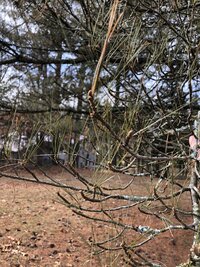
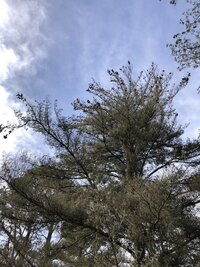
A customer’s white pines are looking strange, with all the tips sweeping upward and inward, and the clusters are thin, missing needles, and the remaining needles look short for white pine. I took a photo of a section which had half-dead needles and something black and segmented on one needle. Any ideas of the issue(s) and steps forward?
 

Attachments

  • IMG_6143.jpeg
    IMG_6143.jpeg
    577 KB · Views: 48
  • IMG_6142.jpeg
    IMG_6142.jpeg
    867.4 KB · Views: 47
  • IMG_6144.jpeg
    IMG_6144.jpeg
    980.6 KB · Views: 49
Looks rooty to me. If you were more north I’d guess salt damage. To generalized for blisterrust, see if any signs or armillaria at the base like shoestrings under lifted bark etc. Recent soil disturbance etc?
 
No recent disturbance, not for years. The soil looks a little hard, maybe. Another pine on the neighbor’s property down the hill has the same issues, and is half dead. I’ll inspect its base tomorrow when I go for some other pruning. The bases of my customer’s trees look good from the surface. I asked if any fruiting bodies showed up inside the drip line in the warm season and he said yes, but wasn’t sure what kind of structure or if they were on the exposed, large roots.

I saw one bag worm on one of the trees, but it was solo as far as I could tell.
 
Take a hand lense to the stomata found in rows on the underside of the needle in pines, look for black pustules erupting from them. Could be distotherma
 
Last edited:
Daum I can’t spell with a crap…
Check this
This is what I was referring to in my above post

Check with a local extension plant pathology lab. Fees are typically $20-$40 and they might be able to grow it out and ID.
 
Daum I can’t spell with a crap…
Check this
This is what I was referring to in my above post

Check with a local extension plant pathology lab. Fees are typically $20-$40 and they might be able to grow it out and ID.
That's the best answer. Take samples, including some soil samples.
 
Yo!! I hadn’t read this thread till now.

I’m in Maine, third of the way up the state, camp on a lake.

I was here last 10 months ago, there was nothing amiss.

Arrived late today and see 98% of the pines along the camp road are fully dead or dying. Many are mature white pines, 120’+, 100+ y old.

My mind is blown.

How widespread is this in The Pine Tree State?
 
Yo!! I hadn’t read this thread till now.

I’m in Maine, third of the way up the state, camp on a lake.

I was here last 10 months ago, there was nothing amiss.

Arrived late today and see 98% of the pines along the camp road are fully dead or dying. Many are mature white pines, 120’+, 100+ y old.

My mind is blown.

How widespread is this in The Pine Tree State?
I live farther up the coast and have been noticing this year a lot of mature white pines with what appears to be some kind of needle cast (presumably due to one or another of these fungal pathogens?), seems to be an emergent issue in my area. I haven’t had a chance to look more closely at any of the individual trees yet; just noticing them in passing.
 
I'm in central NY and haven't noticed anything odd, although I have seen more storm damage than usual.
Especially white pines.
 
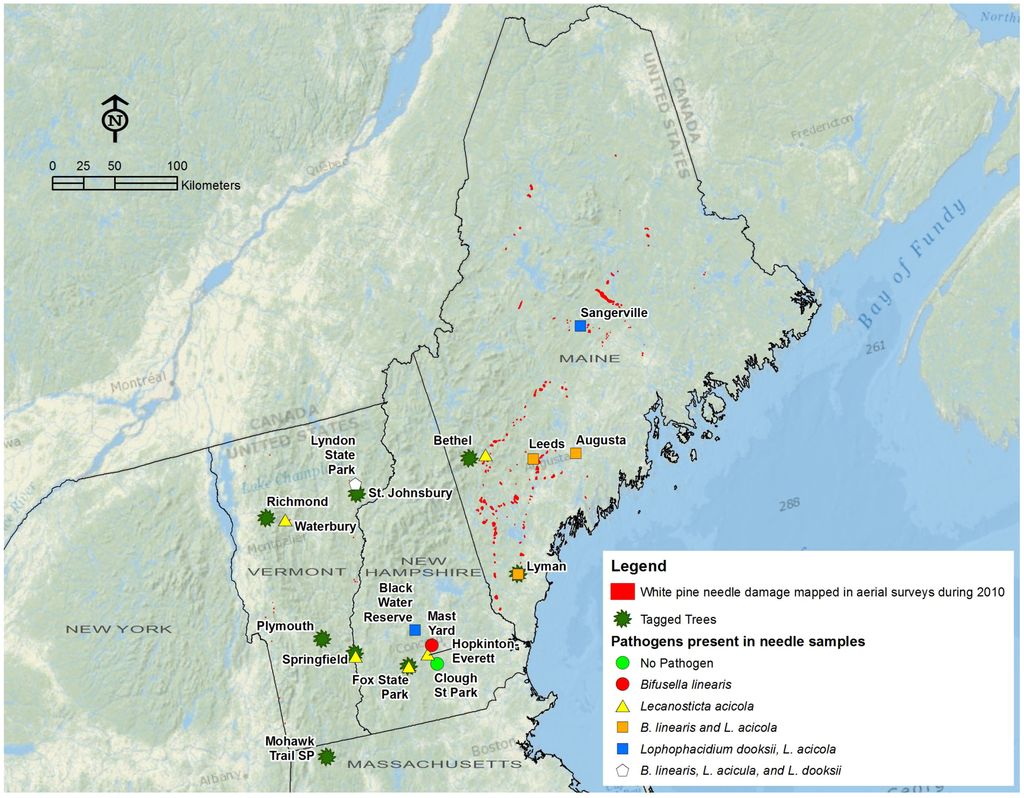
These are great resources! Thanks for posting. WPND is definitely what I'm seeing around here. Seems like it's probably a result of last summer's non-stop rain, since it states:
"Most symptom development and spore dispersal occur during June of the following year, when the whole needle eventually turns yellow to reddish brown or straw-colored."
 
The tallest known white pine in New England the "Jake Swamp Pine" is currently defoliating. It is in an optimal location for white pine in the Northern Berkshires/western Massachusetts. Surrounded by many tall white pines, soil compaction not an issue, well drained steep site but plenty of groundwater pressure from an adjacent big/steep hill. Multiple causes, white pine are being hit hard across the state. It's very patchy, you'll see several healthy trees in a grove, a bunch with thin crowns, and then a few on the way out. Often it is the lower limbs in the crown, or just one limb.

https://ag.umass.edu/landscape/fact-sheets/dieback-of-eastern-white-pine

-AJ
 
Not just White Pines . . . a year or two ago I had a Scotch Pine that was healthy in the spring and three month's later dead. Stone dead. Waited till next spring to remove after we tried watering and fertilizing in the summer but it didn't come back. During removal, the wood was actually "crispy" - that dry. Stemwood wasn't discoloured on cutting, just dry. It's like some fungus got into it and totally blocked off any water transport or something. No root damage, no bugs, no soil compaction or any of the usual. Total mystery and sooo quick. Whatever it was, it was good at what it did.
 
I'm running some tests on a stand of mature white pines that are dying back. One has a large obvious canker that I think could be white pine blister rust. There was evidence of borers and root rot in the effected trees. The Scotts pines nearby also had minor evidence of canker (blister rust) and borer activity. I noted root rot (possibly phytopthora) due to the intense rain and some minor flooding in the area. He'd lost 4-5 large specimen over the last decade, but this is the first time he noticed the spread (browning of needles) from one tree to the next.

When I come back to put the dead one on the ground I'll get a better picture of what's going on. These are in a mostly undisturbed wildland urban interface. We're opting to treat the borer activity and get testing to see if we can treat the root rot. If they make it through the winter we'll look at a class 3 inspection with sample testing.

More monitoring to evaluate the progression of disease in the stand will help as well, though we're trying not to drag our feet. I was referred to him by DNR, which is a bummer as I'd hoped they'd know more than I do about EWP.
 
Not just White Pines . . . a year or two ago I had a Scotch Pine that was healthy in the spring and three month's later dead. Stone dead. Waited till next spring to remove after we tried watering and fertilizing in the summer but it didn't come back. During removal, the wood was actually "crispy" - that dry. Stemwood wasn't discoloured on cutting, just dry. It's like some fungus got into it and totally blocked off any water transport or something. No root damage, no bugs, no soil compaction or any of the usual. Total mystery and sooo quick. Whatever it was, it was good at what it did.
Root rot?
 
Those black dots in the first pic appear to be the eggs of white pine aphid, just based on the end-to-end attachment of the sacs. As opposed to black pineleaf scale.
 
Don't think so - after disassembly of the tree/ stem I dug around and roots were dry-ish (they had given up watering) but didn't look rotted or discoloured either.
Hey ghostice,

Do you have The Book from Sinclair, Lyon and Johnson "Diseases of Trees and Shrubs"? 1st Edition 1987

Page 380.

Wilt of Conifers Caused by the Pine Wood Nematode.

Give that a read, or someone else chime in on PWN.

Possible.....
 

New threads New posts

Kask Stihl NORTHEASTERN Arborists Wesspur TreeStuff.com Teufelberger Westminster X-Rigging Teufelberger
Back
Top Bottom