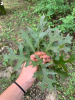
Which variety of red oak?

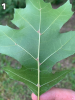
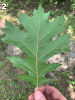
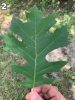
I have two large trees from the red oak group in my yard. They look pretty much the same to me, but I'm not sure which member of the red oak group they are. At various times, I've thought they were northern red, shumard, and black oak. I know these species tend to hybridize, so there's not necessarily a clear cut answer, but I'm wondering if it's obvious to anyone on the forum. Unfortunately I don't have any acorns to work from at the moment, and the buds are too high up to access. There's always so much variation in the leaves, that the guides don't really serve much purpose to me. I may read that the leaves cuneate, but then I'll find a bunch on the same tree that truncate. Or the depth of the lobes will be different, etc. And websites haven't helped much either, as a red oak leaf from one website will look like a black oak leaf on another.

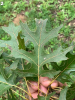
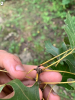
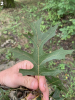
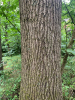
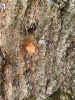
The inner bark picture I got looks a little more vibrant in color than in reality, thanks to smartphones over-saturating images. But that bark goes with the tree whose leaf has less lobes. The other leaf pictured with more lobes is from the other tree I have. Thanks.
 

Attachments

  • 1d6f9e.png
    1d6f9e.png
    454.5 KB · Views: 7
  • 3f2d64.png
    3f2d64.png
    277.6 KB · Views: 9
  • a6fd2d.png
    a6fd2d.png
    308.8 KB · Views: 10
  • a115ff.png
    a115ff.png
    294.2 KB · Views: 9
  • f1ba07.png
    f1ba07.png
    323.3 KB · Views: 8
I think black is more pubescent on the bottom of the leaves than those.

Before looking at the pictures though, I was thinking that variabilities in the leaves may be sun leaves vs. shade leaves. Those differences tender to be more pronounced on Black than Red...so I would have said Black based on description. However, I've found some Red Oak leaves bigger than a sheet of paper with more "normal" leaves on the same tree so that is not a hard/fast rule either.

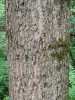
Post a couple of pics with more bark patterns. Black oak is decidedly more blocky than Red oak (but, again, not as obvious as we'd prefer!).
 
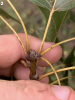
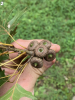
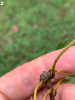
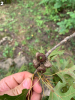
I went outside to take pictures of the bark and found a small bunch of leaves below one of the trees with some buds and small acorns. You can also see how different these leaves are from the larger ones I posted before.

Just to differentiate because I don't know if both trees are the same variety, I've labeled the two trees' pictures in this post and my original with a 1 or a 2 in the upper left corner. All the pictures with a 1 correspond to tree 1, and similarly with 2. Thanks.

 

Attachments

  • image0.png
    image0.png
    1.8 MB · Views: 13
  • image1.png
    image1.png
    1.2 MB · Views: 14
  • image2.png
    image2.png
    1.5 MB · Views: 10
  • image3.png
    image3.png
    1.2 MB · Views: 14
  • image4.png
    image4.png
    2.7 MB · Views: 15
  • image5.png
    image5.png
    1.5 MB · Views: 15
  • image6.png
    image6.png
    1.3 MB · Views: 13
  • image7.png
    image7.png
    1.7 MB · Views: 10
  • image8.png
    image8.png
    2.5 MB · Views: 12
  • image10.png
    image10.png
    1.9 MB · Views: 9
Last edited:
A pretty good field guide to oaks of eastern North America is at: https://www.fs.fed.us/foresthealth/technology/pdfs/fieldguide.pdf

A critical observation is of the presence/absence and location of fine hairs on the leaves. This will likely require a handlens. Look on the underside of several leaves. Any hairs? Fine or coarse? On leaf veins or between veins? Along the vein near the base only or at points of vein branching?
How about hairs on the imbricate scales of them acorns?

ATH is right, leaf size and outline is the least conserved (and thus the least reliable) trait for identification, even within the same tree!
 
Now I think Q. velutina but I'm not convinced. The bark looks a little more like Black oak (especially Image4). Image5, sure look like that wants to be a Black oak acorn when it grows up...but too early to say for certain.
 
I’ll have to check tomorrow to see if I can grab a few good leaves and inspect the hairs.

Concerning the bark, I have a picture of the inner bark of one tree in the original post. I read that black oak is supposed to be yellow/orange. I know it kind of looks orangish in my picture, but that’s only because the camera on my phone turns the saturation way up. In real life, it kind of just looks like the color of red oak hardwood floor.
 
I went outside to take pictures of the bark and found a small bunch of leaves below one of the trees with some buds and small acorns. You can also see how different these leaves are from the larger ones I posted before.

Just to differentiate because I don't know if both trees are the same variety, I've labeled the two trees' pictures in this post and my original with a 1 or a 2 in the upper left corner. All the pictures with a 1 correspond to tree 1, and similarly with 2. Thanks.

 

Attachments

  • Screenshot_20200803-050254.png
    Screenshot_20200803-050254.png
    977.6 KB · Views: 16
A pretty good field guide to oaks of eastern North America is at: https://www.fs.fed.us/foresthealth/technology/pdfs/fieldguide.pdf

A critical observation is of the presence/absence and location of fine hairs on the leaves. This will likely require a handlens. Look on the underside of several leaves. Any hairs? Fine or coarse? On leaf veins or between veins? Along the vein near the base only or at points of vein branching?
How about hairs on the imbricate scales of them acorns?

ATH is right, leaf size and outline is the least conserved (and thus the least reliable) trait for identification, even within the same tree!

What would I expect to see from each of the possible varieties as far as hairs go?
 
At first, I thought the original query was for which species of oak are represented by those two trees. If horticultural varieties are the target, I'm out of my depth.

Given the limitations of tree identification from leaves, I'd collect a few leaves, sit down quietly with good light and a handlens (magnifying glass), maybe a ruler, and go through the keys in that reference I linked to in an earlier post (keys start on page 120). You clearly know botanical terms, which is a great asset. If you do that rigorously, you'll learn a lot more about those trees than I do!
 
  • Like
Reactions: ATH
At first, I thought the original query was for which species of oak are represented by those two trees. If horticultural varieties are the target, I'm out of my depth.

Could you explain the difference between "species" and "horticultural varieties"? I was just wanting to know what kind of red oaks they were: northern red, shumard, or black. I'm not sure how those distinctions are categorized.
 
Sorry to be confusing! My fault, I was being technically rigorous, which is not always the best path here. "Northern red oak" and "shumard oak", etc. are indeed naturally occurring species, which is what I believe you meant. I was briefly confused by "varieties" which botanically are cultivars or particular lineages within a species or a hybrid cross as in: https://www.internationaloaksociety...IO/IOS Journal #24/20-ios#24-jablonski(2).pdf
Varieties are often commercial and proprietary like "Big Boy" tomatoes or "Concord" grapes.
 

New threads New posts

Kask Stihl NORTHEASTERN Arborists Wesspur TreeStuff.com Teufelberger Westminster X-Rigging Teufelberger
Back
Top Bottom