Which rope for home owner use?

Certainly would not climb on it,
Would think elasticity beat out of it, polyester stiff to start.
.
Arborplex similar hollow 12strand polyester manufacture gets fuzzy breaking filler fibers that new drop strength and less elastic then True Blue.
All fuzz on True Blue is integral loss.
The super coating is gone, it is some class stuff.
Should compare to new on grading such things
.
Arbo rope tuff stuff, so just no real overhead work with it. True Blue hollow12 has stayed round when ArborPlex hollow12 and rounder 16 strand lines flattened under load.
But any other usage from dragging to tiedowns that keep new premium rope premium, is appreciated. Might even cut some short dragging lines, make eye2eye sling etc. if had bunch or various real bad spots to remove.samson-rope-guide.png

 
Jehinten and TheTreeSpyder:

Interesting after you mentioned it Jehinten, I started searching and could not find any 5/8 True blue being sold online. I talked to the guy selling the rope and swears it is true blue, humm.
He is also now saying that this rope is not the rope his company is using but rather rope they bought as part of a bid on some equipment.
Anyway I got him to give me a 4' piece so I could inspect it a bit better.
Maybe some of you guys can tell what rope this might be and if it would be worth buying a section to just use around the farm for general use.

I see how as it is worn on the outside, even though the inside may look god, it looses strength because the fibers are broken.

According to the chart at Samson, I would gues the outside is between a 5 to 6 while the inside is about 3

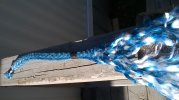
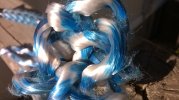
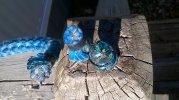
Here are a few pics with then end unbraded, what it looks inside, what it looks like after heating a old knife to melt it into and what it looks after cutting it with a knife.
Thanks
Charrie WP_20201031_006.jpgWP_20201031_004.jpgWP_20201031_010.jpgWP_20201031_012.jpg
 
Its definitely a 12 strand like true blue, that said (and I'll have to go check my own true blue to confirm this) I don't think true blue is white inside. Your rope looks to have been dyed after being woven together and I think true blue is dyed before weaving making the strands a consistent color.

Certainly not a big deal to dye it that way, but may be a sign of a different manufacturing process.


Depending on what "general use around a farm" is, I say go for it if you don't want to buy a new rope just to drag through the mud. Also you can always break a piece of it to know its strength. Even pulling it between two trucks with no scientific data you can see a lot by the amount of effort it takes to break.
 
Most of our land is overgrown and we have been working on thinning out the smaller trees but there are several medium size trees that have died and fallen over and a few still hung up in other trees. We cant get the tractor back to them and out chain is too short to reach but 100' rope would reach them all. Also as we cut the smaller trees we stack them with all the butts in the same direction. A rope would be much easier you cinch around them then a chain so we can drag them where they need to go.

I have seen some videos where an angry rope snapped and took out a rear windshield. In one of the videos by Terry Hale he mentioned putting blankets or something heavy across the rope in a couple of places in case it breaks.
We have an old Buick regal we need to drag up the hill. That would be a good test..

Thanks
Charrie
 
Blanket, tarp, branch etc., anything to confound the recoil, make the force 'tie its own self up'.
.
Standing inline w/loaded rope is standing on the loaded axis of equal /opposite to force.
Like escaping to rear of fall, cannon, gun recoil, rocket launcher etc.
 
For general-use, for dual purpose (also just for climbing, in general) I'd recommend Mercury, if you wanna spend more (and get slightly heavier, slightly stronger ropes) then Samson has 2 thicker nylon-cored climblines available, though neither is as much as bargain as Mercury...Mercury doesn't float (unsure if that'll matter in your uses, you'd want something w/ polyolefin for that) but is otherwise one of the best deals, if not needing to save $ then I'd get their 12mm nylon core double-braid (velocity I think it's called...starts with a V, is like 9k or 10k lbs ABS)

For climbing it's amazing (and it's the most colorfast rope I've ever used which is neat), I use it alongside Ice Tail ($1.30/ft) and have zero complaints, even the fact that I can't splice it doesn't bother me as it's strong enough that I don't mind knotting with it.

I agree that a rope that's seen hard loading - whether by virtue of snubbing a log while rigging or arresting a fall while you're climbing - should be retired (I guess "critically evaluated, with a very cautious/conservative framework for decisions", Samson has some worthwhile literature on this decision/evaluation I think they include that pamphlet in all bags of climbline) But, I gotta say I am definitely guilty of using climblines as either pull-rope or bullrope, w/o "retiring them from climbing" (the most frequent instance would be one wherein I'm going to be pulling a tree over, and I'll leave my climbline at the top of the spar // rappel down it // use it as a pull/tagline to be yanked while I'm felling it)


[[edit-to-add: I use Polydyne in 1/2 and 5/8 for bullrope, and chose it for its combo of nylon/poly which allows the 3.5% elongation while retaining that 11k lbs(1/2") or 19k lbs (5/8") static strength, worth pointing out that the thin lil 11mm Mercury is like 75% as strong (8.5k lbs) and same nice 3.5% elasticity, I don't get the "16 strand/3-strand" arguments because their strength-per-dollar isn't some bargain they're surprisingly expensive IMO if you look at what you get...honestly you can't go wrong w/ poly-over-nylon from any reputable company, just use price, ABS, elasticity and diameter as your parameters and stick w/ a known company and it's hard to go wrong, today's ropes are truly amazing :) ]]
 
Last edited:
I have seen some videos where an angry rope snapped and took out a rear windshield. In one of the videos by Terry Hale he mentioned putting blankets or something heavy across the rope in a couple of places in case it breaks.
It's always nice to hear someone watching T.Hale, his collection is outstanding I rewatched it this past week while doing a scary(to me) Oak removal, also rewatched much of the Work Safe BC Feller Training Standards series which Hale actually links&recommends in his video (it's either the Leaners or Back-Leaners vid)
 

New threads New posts

Back
Top Bottom