TheTreeSpyder
Branched out member
- Location
- Florida>>> USA
Part of the problem is this is 'legally' a backleaner...
Because the CoG forcepoint starts behind, not in front of the compressed part of hinge that forms the DEFINING pivot of the works.
The first thing you do with a backleaner, is make it a Zer0 /balanced/no leaner
then; make it a shallow leaner.
.
Shallow leaners to me have a mathematical fault in birthing a hinge.
To me, if carefully walking a backcut, cutting 1 fibre at a time until fails
Forms formulae: strength in the hinge = can hold that much load at given sine - 1 fibre (to incite fhold further cutting weakens this setting)
>>the sidelean angle across long axis profile of hinge/none here; determines the loading pattern across the narrow axis profile of hinge
>>forward push/pulls to target across narrow axis profile of hinge just intensify the same pattern of loading in hinge; perhaps adding another row across of tensioned fiber at a now higher leveraged position/distance from compressed part of hinge as pivot
.
The sine of the FORWARD angle from CoG to the pivot is the leverage;
The lean forces so much strength into hinge for us!
The change to the next degree, tests this imbued strength.
The amplitude of change of the sine from degree to degree is the impact of change that we fight and try to prep hinge to fight.
.
Sine is changing so fast in shallow leans; that by comparison
a 30degree /1 o'clock lean forces a hinge stronger ;more suited to loading at 31 degrees
Than, forging it's strength at 1degree lean; and the MUCH GREATER IMPACT of change incurred at 2 degrees.
The hinge is much weaker to it's purpose AND then has even farther to fall in shallow leaners...
We be playing into a stacked deck... and not to our benefit!
.
The load i say goes from a range of hold to fall; we try to capture control in thru gradients between thru range of' controlled 'fhold' (hopefully) before fairly uncontrolled free-fall
The load forces it's own hinge strength; the more load/angle the more intense arm wrestling done to birth stronger hinge.
We pull with rope, and lift with wedge, to arm wrestle/challenge/fake-out/exercise more strength in hinge by falsley loading the math until hinge births
THEN relieve extra wedge, rope loadings to leave the strengthened hinge carrying a lighter load than it was made for!
This is especially needed in shallow leaners;due to the rapid HIGH IMPACT of loading change as fhold starts.
.
i would have roped over the top for highest leveraged pull
>>rope position chosen is lesser, straight line, leveraged reduced at first movement forward
>>over the top gives best leverage, rotational input, maintains/even can INCREASE leverage as moves
as we try to leverage more, to birth a stronger hinge to usher load thru arc on hinge as far as possible
.
Whenever i see something working against me; like span between block hitch and load hitch;try to figure how can use that same force someday,mebbe even today!..
i would have prussiked to span between and had another pull line to sweat this line
>>more pull on load
>>IF ground control is slick enough and extra frictions ready to apply (rope around tree after Porty):
would have ground control try to snatch even more purchase from line, thru Porty, then add extra frictions at drop.
.
i'd look to use semi-truck tire spoon(small lip for kerf, lever made by super strong forging ) rather than wedge to urge from back, replaced by push when she moves
ANYTHING to forge stronger hinge as birthing it
When, load movement is committed/ will not stop all false hinge loadings of rope pulls and pushes are to stop!
We have challenged hinge stronger,but now don't want to extra load to essentially weaker!!
Then, strength is already set into hinge; must trust to hand off to it to control acceleration/hit.
We used extra load forces to strengthen hinge/fhold with more fibers; now remove extra fake loadings so hinge is stronger to it changes it will meet on tour around hinge.
My crazy azz at this point mite even be seen pulling back on load !!
ANYTHING to slow the acceleration(but not stop motion)
farther out bod in opposite direction, just like guy line would ballast against some loading to more so have the balance of forces conducted more INLINE properly down the stem as a support device.
.
If using guy line would to same theory pre-tighten it over compensating/ tighten it TOO much;
so is leaning back some, this way you know it is tight;
and look for hit to compensate Naturally by pulling stem more into pure inline at the peak loading impact.
.
Rope still looks puny to me.
BUT no matter the rope, i would have tried to give the device the most chance/done the same dance.
Force as much strength in hinge, whatever else to drop the peak force input from acceleration.
If had to rig, probably would have had hitch points closer, and favored not facing on worst side to do so..
.
If watch can see skinny hinge/no strength. CoG rolls up the hill over pivot, then pretty much freefalls w/o hinge restriction.
Longer piece, more risky due to CoG rotation to farther out pull when moving, more need for opposing force guy rope to ballast peak forward pull forces and more usher and inline flow of force down spar properly during peak loading pulse thru system of the hit.
.
i probably would have cut into or closer to time of fhold
>>climber set minimal hinge, of minimal strength, then load was pulled
>>didn't really try to set a hinge strength in youth; for hinge then to arm wrestle the load ; ushering longer hand-off and slower hit into system.
Because the CoG forcepoint starts behind, not in front of the compressed part of hinge that forms the DEFINING pivot of the works.
The first thing you do with a backleaner, is make it a Zer0 /balanced/no leaner
then; make it a shallow leaner.
.
Shallow leaners to me have a mathematical fault in birthing a hinge.
To me, if carefully walking a backcut, cutting 1 fibre at a time until fails
Forms formulae: strength in the hinge = can hold that much load at given sine - 1 fibre (to incite fhold further cutting weakens this setting)
>>the sidelean angle across long axis profile of hinge/none here; determines the loading pattern across the narrow axis profile of hinge
>>forward push/pulls to target across narrow axis profile of hinge just intensify the same pattern of loading in hinge; perhaps adding another row across of tensioned fiber at a now higher leveraged position/distance from compressed part of hinge as pivot
.
The sine of the FORWARD angle from CoG to the pivot is the leverage;
The lean forces so much strength into hinge for us!
The change to the next degree, tests this imbued strength.
The amplitude of change of the sine from degree to degree is the impact of change that we fight and try to prep hinge to fight.
.
Sine is changing so fast in shallow leans; that by comparison
a 30degree /1 o'clock lean forces a hinge stronger ;more suited to loading at 31 degrees
Than, forging it's strength at 1degree lean; and the MUCH GREATER IMPACT of change incurred at 2 degrees.
The hinge is much weaker to it's purpose AND then has even farther to fall in shallow leaners...
We be playing into a stacked deck... and not to our benefit!
.
The load i say goes from a range of hold to fall; we try to capture control in thru gradients between thru range of' controlled 'fhold' (hopefully) before fairly uncontrolled free-fall
The load forces it's own hinge strength; the more load/angle the more intense arm wrestling done to birth stronger hinge.
We pull with rope, and lift with wedge, to arm wrestle/challenge/fake-out/exercise more strength in hinge by falsley loading the math until hinge births
THEN relieve extra wedge, rope loadings to leave the strengthened hinge carrying a lighter load than it was made for!
This is especially needed in shallow leaners;due to the rapid HIGH IMPACT of loading change as fhold starts.
.
i would have roped over the top for highest leveraged pull
>>rope position chosen is lesser, straight line, leveraged reduced at first movement forward
>>over the top gives best leverage, rotational input, maintains/even can INCREASE leverage as moves
as we try to leverage more, to birth a stronger hinge to usher load thru arc on hinge as far as possible
.
Whenever i see something working against me; like span between block hitch and load hitch;try to figure how can use that same force someday,mebbe even today!..
i would have prussiked to span between and had another pull line to sweat this line
>>more pull on load
>>IF ground control is slick enough and extra frictions ready to apply (rope around tree after Porty):
would have ground control try to snatch even more purchase from line, thru Porty, then add extra frictions at drop.
.
i'd look to use semi-truck tire spoon(small lip for kerf, lever made by super strong forging ) rather than wedge to urge from back, replaced by push when she moves
ANYTHING to forge stronger hinge as birthing it
When, load movement is committed/ will not stop all false hinge loadings of rope pulls and pushes are to stop!
We have challenged hinge stronger,but now don't want to extra load to essentially weaker!!
Then, strength is already set into hinge; must trust to hand off to it to control acceleration/hit.
We used extra load forces to strengthen hinge/fhold with more fibers; now remove extra fake loadings so hinge is stronger to it changes it will meet on tour around hinge.
My crazy azz at this point mite even be seen pulling back on load !!
ANYTHING to slow the acceleration(but not stop motion)
farther out bod in opposite direction, just like guy line would ballast against some loading to more so have the balance of forces conducted more INLINE properly down the stem as a support device.
.
If using guy line would to same theory pre-tighten it over compensating/ tighten it TOO much;
so is leaning back some, this way you know it is tight;
and look for hit to compensate Naturally by pulling stem more into pure inline at the peak loading impact.
.
Rope still looks puny to me.
BUT no matter the rope, i would have tried to give the device the most chance/done the same dance.
Force as much strength in hinge, whatever else to drop the peak force input from acceleration.
If had to rig, probably would have had hitch points closer, and favored not facing on worst side to do so..
.
If watch can see skinny hinge/no strength. CoG rolls up the hill over pivot, then pretty much freefalls w/o hinge restriction.
Longer piece, more risky due to CoG rotation to farther out pull when moving, more need for opposing force guy rope to ballast peak forward pull forces and more usher and inline flow of force down spar properly during peak loading pulse thru system of the hit.
.
i probably would have cut into or closer to time of fhold
>>climber set minimal hinge, of minimal strength, then load was pulled
>>didn't really try to set a hinge strength in youth; for hinge then to arm wrestle the load ; ushering longer hand-off and slower hit into system.
Last edited:


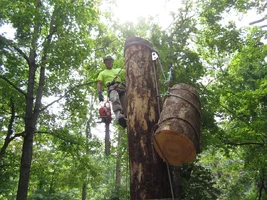
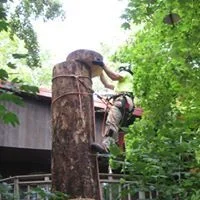




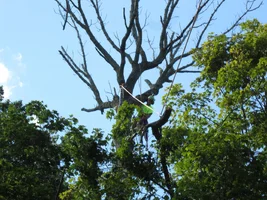


 I always enjoyed your old videos where it seemed like you were pulling over trees that I would not have dreamed of. I agree with your analysis above, and also that piece was bigger than I originally thought too. It was so big it made that rigging line look like half inch when it was actually three-quarter inch. I bet he put the sling so low because his last cut was so close to the stub, and he was worried that there wasn't enough good trunk above the stub for the sling. I like the idea of double block rigging, but I think we all know why he did not do that. What a pain.