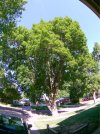
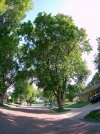
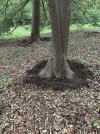
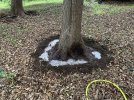
What would you do? I'm a rec climber and want to KEEP my healthy ash tree...

TREEfool

Participating member
Location
Sioux Falls, SD
Hi guys! I recently bought a house with 3 big ash trees. We had the tree in our back yard treated professionally for the ash bore (which are currently wreaking havoc here in Sioux Falls, SD). The same guy that treated our backyard tree recommended we let the street-side trees die so the city will come and cut them down for us. This broke my heart but the $750 price tag every two years to treat them (see photos below) would break my wallet! So I decided to let nature take its course and started researching replacement trees.

However!!!!!! This week I invited one of my good climbing friends over and we set up a huge rope swing for jumping off the roof of my house. It was a riot! We also had a few smaller swings for the kids and it just made me fall in love with the tree. I began researching how to treat the tree myself but the circumference measures over 10 feet (4' above the ground) and according to the chemicals that I can buy without a license this is just too big of a tree. Any recommendations? Let the city take it down? Treat it myself? Stop whining and pay $500 to keep the big tree?

You guys are the best! Thank you so much :)
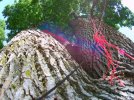


Ash Tree SF SD permanent climbing pull lines.jpgAsh Tree Sioux Falls SD.jpg
 
Firstly the street trees aren't yours to do anything with without getting a permit or approval from your municipality.
The backyard tree, you will be paying and paying and paying if you want to keep it healthy.
The ash are 95% gone here and the ones that are alive are horribly suckered out with one oddball here and there being keep alive by injection.
Good luck with your decision.
 
I agree with Jzack605 push the city to manage it. Regardless PLANT NOW
I don’t know your financial situation, but if I recall you have a medical field background? Think if it this way, it’s life support. Cut and dry, keep emotion and your personal desires out of it. It will be a VERY long time to grow a replacement. Best to pull the plug? Are you keeping this tree alive for your own desires? Things shift and change, but ultimately it’s not your call
 
Firstly the street trees aren't yours to do anything with without getting a permit or approval from your municipality.
The backyard tree, you will be paying and paying and paying if you want to keep it healthy.
The ash are 95% gone here and the ones that are alive are horribly suckered out with one oddball here and there being keep alive by injection.
Good luck with your decision.
that depends entirely on the municipality. Here, you don't need permission to treat the trees. When we started, it was a good idea to let the city know you were doing it so they didn't remove the tree proactively. Check with your locality before doing anything with the street trees. Maybe if they won't treat, they'd split the cost?

There are plenty of trees treated without suckering. The key is treating early before EAB has stressed the trees.

As for "home treatment", there are a few options:
*soil drench with imidacloprid. I'd recommend using the 2F formulation. That is a big tree for that treatment, but the ones we started early are still doing well.
*Bark spray with Safari. This is significantly more expensive, but still less than hiring it out. Again, on big trees, this is a little less effective, but if you get the timing right (May-ish), it can really help.
*Buy your own injection tools and treat with tree-age. Tree-age G4 formulation is not restricted use (in most states...). The equipment is not cheap...but you'd only buy it once.

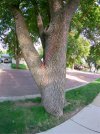
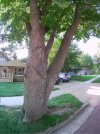
That tree doesn't look to "really" be 38" DBH (10' circumference). I think the diameter is artificially inflated because of the branches there. If you measure the lowest point on the trunk below the branches, how big is that? Post a couple of better pictures from different angles.

If it is a 38" tree, $500 would be $13 per inch of trunk diameter. That is on the high end of pricing for using only tree-age. We are quite profitable a at less than that...actually we treat some trees with both tree-age (every other year) and soil drenched imidacloprid (every year). When we double up, we are still a little under $13...but I wouldn't call that out of range if they were doing both - especially in a larger market. Perhaps call around to see if you can find a better price. But make sure you know what they are using, how much, and that they are doing it correctly.

Having said that...the form on that tree looks miserable. If it needs to be removed, that is on the city...right? I've talked more than one client about not treating trees with bad form as they are going to get torn up by a storm at some point. Again - more pictures may help.
 
that depends entirely on the municipality. Here, you don't need permission to treat the trees. When we started, it was a good idea to let the city know you were doing it so they didn't remove the tree proactively. Check with your locality before doing anything with the street trees. Maybe if they won't treat, they'd split the cost?

There are plenty of trees treated without suckering. The key is treating early before EAB has stressed the trees.

As for "home treatment", there are a few options:
*soil drench with imidacloprid. I'd recommend using the 2F formulation. That is a big tree for that treatment, but the ones we started early are still doing well.
*Bark spray with Safari. This is significantly more expensive, but still less than hiring it out. Again, on big trees, this is a little less effective, but if you get the timing right (May-ish), it can really help.
*Buy your own injection tools and treat with tree-age. Tree-age G4 formulation is not restricted use (in most states...). The equipment is not cheap...but you'd only buy it once.

That tree doesn't look to "really" be 38" DBH (10' circumference). I think the diameter is artificially inflated because of the branches there. If you measure the lowest point on the trunk below the branches, how big is that? Post a couple of better pictures from different angles.

If it is a 38" tree, $500 would be $13 per inch of trunk diameter. That is on the high end of pricing for using only tree-age. We are quite profitable a at less than that...actually we treat some trees with both tree-age (every other year) and soil drenched imidacloprid (every year). When we double up, we are still a little under $13...but I wouldn't call that out of range if they were doing both - especially in a larger market. Perhaps call around to see if you can find a better price. But make sure you know what they are using, how much, and that they are doing it correctly.

Having said that...the form on that tree looks miserable. If it needs to be removed, that is on the city...right? I've talked more than one client about not treating trees with bad form as they are going to get torn up by a storm at some point. Again - more pictures may help.
Reading your posts are always quite educational. Thank you for your willingness to share your vast tree health care knowledge!
 
Reading your posts are always quite educational. Thank you for your willingness to share your vast tree health care knowledge!
Thanks Reach! That is why we are all hear to learn and share, right? I learn plenty from here myself. Every time I see a post from you I'll think of you "convincing" me to start with Jobber. That has been a HUGE help!
 
Ive got a neglected tree iv kit I'd sell on the cheap if You're interested in going the self treating route
Hey @TREEfool that sounds like something to consider. If all the parts work... I used Tree IV for years (now Quik Jet Air), and it is pretty easy to learn. Just make sure the plugs are set deep enough.
 
I would beg to differ on the ownership of street trees. The property owner may well own that property. A quick look at at the property appraisers website in your county will show you the metes and bounds of the property. In most of the cases I've seen, the property owner owns street trees.. If they become defective the city may proactively remove them in order to mitigate the risk that they'd fall into the street. There are also numerous free and paid apps like Regrid, Onyx and others which can show a fairly accurate outline of boundaries on properties.

As to treatment of the ash trees, a basal drench of a quick acting systemic like Safari, requires nothing more elaborate than a measuring cup, a bucket...and a watering can if you really want to go full monty and can be very effective. Follow up in a year with Imidacloprid basal drenches, and literally rinse and repeat as necessary.
 
that depends entirely on the municipality. Here, you don't need permission to treat the trees...........

ATH, thanks so much for the detailed answer and for pesticide recommendations as I am completely clueless. You are correct that the large branch at 4' significantly "artificially inflates" the size of the tree. But I heard 4' is the spot to measure so I just followed the rule. The tree is likely 50 years old if that helps. Our house was built in 1969 and prior to that it was a cornfield.

But on to the more important point you brought up: Here in SD we get wicked crazy winds and that huge branch at the bottom seems like a great place for the tree to split which is what you described in your post. Every windstorm that comes through just fills my yard with large branches but I don't know enough about trees to tell how big of a problem it is for longevity.


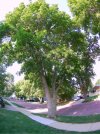
Ash Tree 50 years old 1.jpg

Ash Tree 50 years old 2.jpg

Ash Tree 50 years old 3.jpg

Ash Tree 50 years old 4 south dakota sioux falls.jpg


With all that said, I can always build a rope swing off other trees for my own pleasure so that now seems like a terrible reason to save the tree.

Reasons to keep:
1. they produce so much shade in the summer that we don't run our AC during the day
2. home value
3. they are pretty
4. climbing!

Reasons to let them die:
1. expensive upkeep
2. nasty chemicals that I don't want to touch
3. let nature take it's course?
4. it might die anyway
 
....also, here in SD if I have to mow around the trees, pay to have them pruned, and pay to treat them I would consider them NOT public property. But we do need a permit to plant new trees curbside, there are only about 20 species we can choose from, and the city decides if they are going to chop them down for safety reasons.
 
Check local laws about application of safari without a licensed applicator. You’re probably good to go but here in NY safari is banned, but when it was in use (like many pesticides) it was a restricted use pesticide and you needed an applicators license for it.

also utilize the trench technique if doing a basal drench to contain the pesticide to the target area. This is particularly important in a location like your trees. 25A58F29-DD68-4A2F-B162-1B4A9506B06C.jpeg617CF127-139C-4161-B040-B2D08553F7B0.jpeg
 
So the "standard" place to measure a tree is 4.5" off the ground measures on the uphill side of the tree. However, there are several "guidances" for measuring trees that will not offer a reasonable diameter at that height.

Measuring below the big branch will still be too big, but more realistic than right at the branch. I'd probably reduce that by somewhere between 10-20%. Of there is a straight trunk above the big branch, sometimes I'd measure there and average that with the low #. Part of this is coming up with a number then looking just looking at the tree and asking "does that look like it needs the same amount of product that a "normal" 38" tree needs?". If the company you hired to treat said to measure around that big limb to get diameter I'd question their understanding of the measurements and knowledge of the products...
 
The question of "ownership" is not unique to you! It is a mess about everywhere. Different local ordinances, State laws, court decisions, etc... play into that so there is no answer that will apply everywhere. And youay not be able to get a straight or consistent answer from city hall either.

MOST places those trees belong to the municipality. MOST places put the maintenance responsibility on the adjacent landowner. MOST places if the tree fails and causes damage liability is on the city. I say "most", but I don't claim to know if that is 60% or 95% of municipalities.

Same with sidewalks...who is responsible for those?

Other common names for a tree lawn are the devil's strip or hell strip...because they are hell for anybody to figure out what to do with them.
 
Thank you guys!!! After all of your input I decided to let them go. Having a giant ropeswing in my front yard is pretty kick-ass but I don't want to build a "house of cards". Essentially the tree would only survive with a bunch of unhealthy chemicals, money, and human labor. If I let nature take its course, the ash trees die, and then plant a few different trees I am creating a robust landscaping that doesn't need the inputs of chemicals and extensive human labor. Plus, I can plant more fruit and nut trees now!!!!

Seriously appreciate your help guys.

~TREEfool
 

New threads New posts

Back
Top Bottom