
what rope and how do you all tension the line?

never done a speedline in a removal scenario, probably because we mostly do just pruning....

anyways...lets say the scenario is speedlining peices over a house so you must tension that speed line up. How do you all actually tension and anchor the line to be sure it wont sag down too much when theres no trees for a portawrap around? would you just tie it onto your chipper? also im wondering how true blue holds up as a line for this technique. or do you all reccomend a more static line?

so yea mostly I have never done this but I may try it soon looking for more info for a first timer. thanks.
 
i occasionally speed line with true blue. i really only can if i know a little sag will be acceptable. its the only line we use other than a 3/4" bull rope for rigging just big wood.
if its a set up of any reasonable distance, like over a house, you'd want something way more static. its a limiting factor for me, and im not familiar with other static lines out there better for this technique, but i know true blue gets worse the longer the distance.
 
6" ground anchor 3' tall screwed all the way down to your fiddle block to your portawrap, keep the pieces reasonable so you don't grenade your fiddle block. provides all the pretension you need and you don't have ropes tied to your chipper to get in the way while you clean up.
 
A double braid line will work. A smaller diameter line is a bit easier to tension. If you find yourself doing this a lot then a low stretch line will be worth the investment. I have a 9/16" 200' piece of Yale Crystalyne I use for speedline and side guying trees for felling.
In my experience, True Blue will disappoint you for any tensioned application as you will spend a lot of time stretching it, just to have it stretch some more when loaded!

As for anchoring, that really depends on the situation. Ideally you want to load trees in compression by spreading the anchors in Golden Gate Bridge fashion works well, but not always possible. Develop a system and manage load weights as per your anchoring limits. Low stretch ropes are great, but reflect more energy into the tree, usually the weaestk and most hard to judge link in the system.

I have tensioned with a chipper winch, a GRCS, a fiddle block as well as a tree pulling kit and just a few "jerks" on the line:). Again, it depends on the situation, the anchors, how and when you will load the line, your ground person(s) skills, how heavy the load and how long it must travel.


Tony
 
For smaller limbs you can just have a groundie hold the rope and thus, he/she becomes the anchor.

You can also take a turn around a tree, tie an alpine butterfly 10' up the line (towards worker in tree), run the tail through the eye in the butterfly, and pull baby pull...back towards your anchor. In effect you have created a "redneck pulley" out of the rope. This works good when it's enough, and you don't want to go back to the truck for more gear.

For best results though, a very static line, a good anchor point, and some mechanical advantage with progress capture works best. The horizontal round bar at the back of our Caterpillar skidsteer works pretty good.
 
9/16" double braid is my choice.

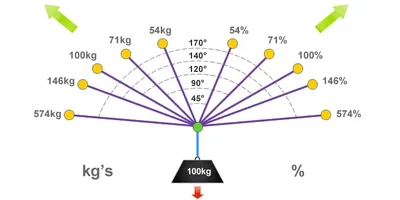
Have you spent time learning about the load multiplication that happens at the ends of the speedline? Even small loads on high tensioned speedlines can create loads that could break the tree.

Like any skill used aloft start low and slow. Learn by setting up ziplines for small limbs and logs on jobs where you can flop and drop. This is school time.
 
6" ground anchor 3' tall screwed all the way down to your fiddle block to your portawrap, keep the pieces reasonable so you don't grenade your fiddle block. provides all the pretension you need and you don't have ropes tied to your chipper to get in the way while you clean up.
Any links to these ground anchors? I like the idea. The kind you use for staking trees?
 
9/16" double braid is my choice.

Have you spent time learning about the load multiplication that happens at the ends of the speedline? Even small loads on high tensioned speedlines can create loads that could break the tree.

Like any skill used aloft start low and slow. Learn by setting up ziplines for small limbs and logs on jobs where you can flop and drop. This is school time.
Tom, do you have a link to any studies? I'd like to learn about the load multiplication I've heard about. I was told it's much harder on a rope though. Thanks.
 
im very interested in learning about this load multiplication as well.

also im not sure what you meant by the golden gate bridge reference. I mean , I know what the bridge looks like but are you saying to run the rope in that fashion up in the tree anchor end or on the ground anchor end?
 
Zip lines depend on load I think. Same with the slings. I usually run a 3:1 to a porti on my 1/2" db. You can usually crank that tight enough, if not a 5:1 fiddle block can come into play.

I like to throw in an alpine butterfly (works good as a stopper for pieces coming down) with a block then a block or xrr anchor with a pori to anchor cause it takes away any pull, shock load, extra weight all pulling on the locking cleat.
I know the cleat is supposed to be ok holding the fiddle blocks but shocking and yanking on a cleat seems wrong compared to the porti.

Does anyone know any different or better than that train of thought?
 
Go and find charts of the loads on slings. Then...understand that those same load ampifiers are what we would see on zip lines...if the slings are inverted!

Right now I don't have the time to do the homework...suffice it to say...ziplines generate HUGE loads on the ends!
 
For sure makes sense.
Another thing is if you're just learning about how zip lines work start smaller then progresively get larger.

Unless the pieces are tiny and even then, and this is a personal pet peeve, anchor to something and use at leas a 3:1. If your line is stretched out lets say 150' from T.I.P to anchor unless you are the hulk there is no way you can pull and tension a line to run a productive zipline. I find the ground tries to hold it fails when weight pulls the line slack then hates using the system cause it's not working well. Use ma.

One last point try out the zip line where it may cut down on your drag but isn't really nessesary before going over an actual target like a house. A tip is use to slings on long limbs so the slide horizontal staying carter away from the house. Please watch out for eves troughs and if you use a truck or chipper as an anchor and its T.I.P is the same tree as you put the keys of that truck in your pocket.

Stay safe and please do have fun with these I like zip line usage.

PS

For a handy anchor get a 6' T post, thicker steel not one of those thin light cheap things. Cut 2' off the top turn the 2' piece 90 degrees centre it and weld it back on solid.
This can be pounded in to the ground on a 45 degree angle as an anchor. Once low into the ground 2 options:
1- A clevis shackle around the upright post as an anchor point that can accomdate any angle needed.
2- A small piece of properly rated chain with each end linked to a rigging plate. Again good for any angle and it keeps your fiddle blocks, porti and what ever else you may require neatly organized while working.

The top cross bar is there so the hardware stays contained, for pounding, and for retrivial grip.

Hope this helps out.
 
Last edited:
I've never ran or tested these numbers it's just what I have found but they seem to make some sense. so remember guying that tree top back may be an extra step but if it lets you step through your front door that night again, I'm going with it.
 
Those forces I believe are if the piece is suspended and or controlled. If it is a cut and let fly scenario, the forces would be less I believe since the full weight of the piece is never applied to the line. I would start off with a cut and let fly approach to get your feet wet. Then add a control line.
 
wow, I am not officially overwhelmed with information on this topic and going to absolutely take your advice and take it slow. No control line and go small....patience sucks!!!!!

thanks all!
 
EDIT: I have no choice but to take it slow.....its tough working for a place with noone to help you through the learning curve. However I am smart enough at least to know when I could be trying something to advanced or over my head. Hard to resist the urge to switch companies...
 
Where are you located? There are other companies and you could move on that's an option. Or another option there are training seminars full college programs and things like that. That root could pull you up a notch.

As well if you remain with your current employer you can help progress the crew,quality of work perhaps and the over all company.

You just need to make choices of being the new guy that can learn from others (which I think is great and I do as often as possible) or even if your a bit behind the mark chisolms of the world you can still lead with great work and ongoing education. Bring that crew up to the bar you're proud of.

You sound like you have some drive in you and it's not your company so think about how hard you're wanting and willing to work to get to your goal.

Just a thought.
 

New threads New posts

Back
Top Bottom